
Why a mediocre article from last month beats a well-structured one from 2021 in AI search — and what to do about it.
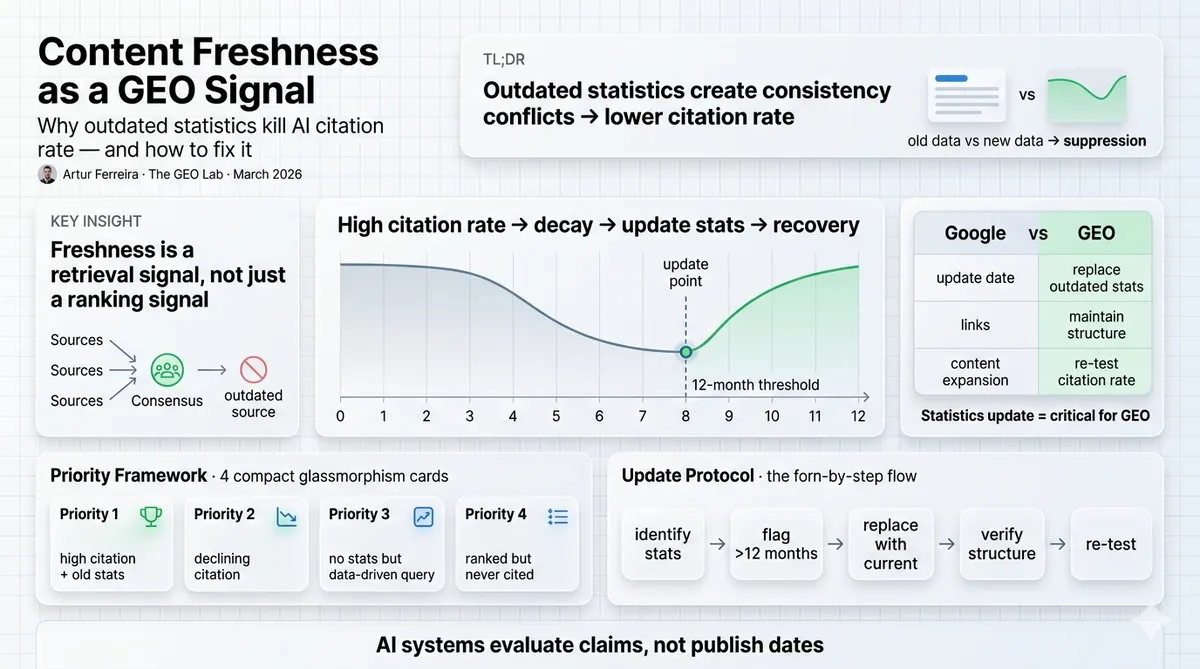
Content freshness affects retrieval probability in AI search because retrieval systems cross-reference claims against other sources. Outdated statistics create consistency conflicts that suppress citation rate — the system cannot cite a source that contradicts the consensus. Updating for GEO is more precise than updating for Google: identify superseded claims, replace with current data, confirm structure, re-test. A page updated for Google rankings may still have a decaying citation rate if the specific statistics AI systems were cross-referencing have been superseded.
The Counterintuitive Finding
I spent three weeks restructuring a page for perfect extractability. Every H2 opened with a declarative answer. Every entity was named explicitly. The 30-check protocol scored it at 60.0% citation rate. Six months later I re-ran the same protocol. The rate had dropped to 38%. The structure had not changed. The statistics had.
Content freshness is a Layer 2 signal in the GEO Stack diagnostic model — it affects extractability and retrieval probability, not just crawl frequency, which is why a perfect schema score does not protect a stale page from losing citations to a fresher one.
For time-sensitive queries, a mediocre article from last month beats a well-structured one from 2021. Not because the 2021 article is wrong. Because the retrieval system cannot tell it is not wrong.
I found this while tracking citation rates across the GEO Brand Citation Index dataset. Pages with strong Extractability scores and high retrieval probability showed citation rate decay over 6-month periods — even when the content structure had not changed. The decay correlated with statistical age: sections containing statistics dated more than 12 months prior to the test date consistently underperformed equivalent sections with current data.
The mechanism is not mysterious. AI systems synthesise answers from multiple sources. When your 2021 statistic says “AI search captures 5% of queries” and three 2025 sources say “AI search captures 30% of queries”, the retrieval system faces a consistency conflict. It resolves the conflict by deprioritising the outlier. Your page is the outlier.
Why Freshness Affects Retrieval Probability Specifically
Content freshness is not just a ranking signal — it is a retrieval signal. The retrieval corpus is constantly expanding with newer content as AI search usage grows. Older pages face increasing competition not from better content, but from more recent content making the same claims with updated evidence.
The relationship between freshness and citation outcomes is explained in the retrieval probability guide — which maps the specific conditions under which a crawled page gets included in an AI response versus passed over in favour of a more recently indexed source.
The retrieval system does not have a “freshness filter” in the traditional SEO sense. What it has is a consensus mechanism: when multiple retrieved chunks make conflicting claims, the system weights the majority position. If your page is the only source citing a 2021 figure while five other sources cite a 2025 figure, the consensus excludes you regardless of your structural quality.
Going deeper? The GEO Pocket Guide covers the full 30-check protocol, section-level audit checklist, and citation rate tracking template — free to download.
Updating for Google vs Updating for GEO
| Action | Google Update | GEO Update |
|---|---|---|
| Add new sections | Yes — signals fresh content | Only if they address an unserved fan-out query |
| Refresh internal links | Yes — improves crawl signals | Only if new link targets exist |
| Update published date | Yes — recency signal | Irrelevant — AI evaluates claims, not dates |
| Replace outdated statistics | Nice to have | Critical — removes consistency conflicts |
| Confirm declarative structure | Not required | Required — edits may break opening sentences |
| Re-run citation test | Not applicable | Mandatory — confirm change produced expected lift |
The GEO update is more precise and more consequential. A page updated for Google rankings may still have a decaying citation rate if the specific statistics AI systems were cross-referencing have been superseded.
The structural differences between a Google-optimised update and a GEO update are grounded in what GEO actually targets — Extractability and entity recency, not keyword placement or anchor text.
Content Freshness Priority Framework
I developed this prioritisation after running freshness audits across the GEO Lab’s core pages. Not all pages need freshness updates at the same urgency:
Priority 1: High citation rate + statistics older than 12 months. These pages are performing well but their citation rate is about to decay. The outdated statistics are a ticking clock. Update now before the decay starts.
Priority 2: Declining citation rate + time-sensitive claims. Decay has already started. Cross-reference your statistics against the current consensus in the retrieval corpus. Replace superseded claims immediately.
Priority 3: Time-sensitive queries with no statistics. These pages target queries where data matters but contain no verifiable current data. Adding specific, dated statistics from named sources raises retrieval probability by creating verifiable claims the system can cross-reference positively.
Priority 4: Ranked pages that have never been cited. Run a prerequisite check: are the statistics current? If yes, the problem is structure, not freshness — apply the LLM readability self-test instead.
The Update Protocol
This is the step-by-step protocol I use for every freshness update on GEO Lab content:
- Identify every statistic in the page and its source date
- Flag any statistic older than 12 months for replacement
- Find current equivalent from a named, citable source
- Replace statistic and update source attribution
- Confirm opening sentences of affected sections are still declarative after the edit
- Wait for re-indexing (7–14 days for most AI platforms)
- Re-run the 30-check protocol and compare to baseline
What NOT to do: Bulk-refresh published dates without updating content. AI systems evaluate the claims, not the date metadata. A page with a 2026 published date but 2023 statistics will still fail the consistency check against more recent sources.
Frequently Asked Questions
Does content freshness affect AI citation rate?
Yes. AI retrieval systems cross-reference claims against other sources in the retrieval corpus. An outdated statistic that contradicts more recent sources creates a consistency conflict that suppresses citation rate. The system deprioritises sources that conflict with the consensus it is synthesising.
How is updating for GEO different from updating for Google?
Updating for Google focuses on adding new sections, refreshing internal links, and updating the published date. Updating for GEO requires identifying sections where statistical claims have been superseded, replacing them with current data from named sources, confirming opening sentences remain declarative, and re-running the 30-check protocol after indexing.
How often should I review content for freshness?
Any page containing time-sensitive statistics should be reviewed every 6–12 months. Pages with high citation rates and statistics older than 12 months are highest priority — their citation rate is about to decay. The 30-check protocol re-test cadence provides specific triggers.
Can changing the published date improve citation rate?
No. Bulk-refreshing published dates without updating content is ineffective for GEO. AI systems evaluate the claims within the content, not the date metadata.
What is statistical currency in GEO?
Statistical currency is the degree to which verifiable claims in a content section are consistent with the most recent available evidence. It is a component of Extractability in the GEO Stack. Outdated statistics create consistency conflicts that actively suppress citation rate.
- Content freshness affects retrieval probability because AI systems cross-reference claims against the consensus in the retrieval corpus.
- Updating for GEO is more precise than updating for Google — replace specific superseded statistics, not just refresh the published date.
- Priority 1 for freshness updates: pages with high citation rate and statistics older than 12 months (decay imminent).
- The 7-step update protocol: identify, flag, find replacement, replace, confirm structure, wait for indexing, re-test.
- Never bulk-refresh dates without updating claims. AI evaluates content, not metadata.
Ready to apply this? Run the 30-check protocol against your highest-traffic informational pages using the AI Visibility Diagnostics Console — it generates a baseline citation rate in under 10 minutes. Then set a 6-month re-test reminder.
Questions? Contact The GEO Lab.
Have questions? Contact The GEO Lab · Return to homepage