
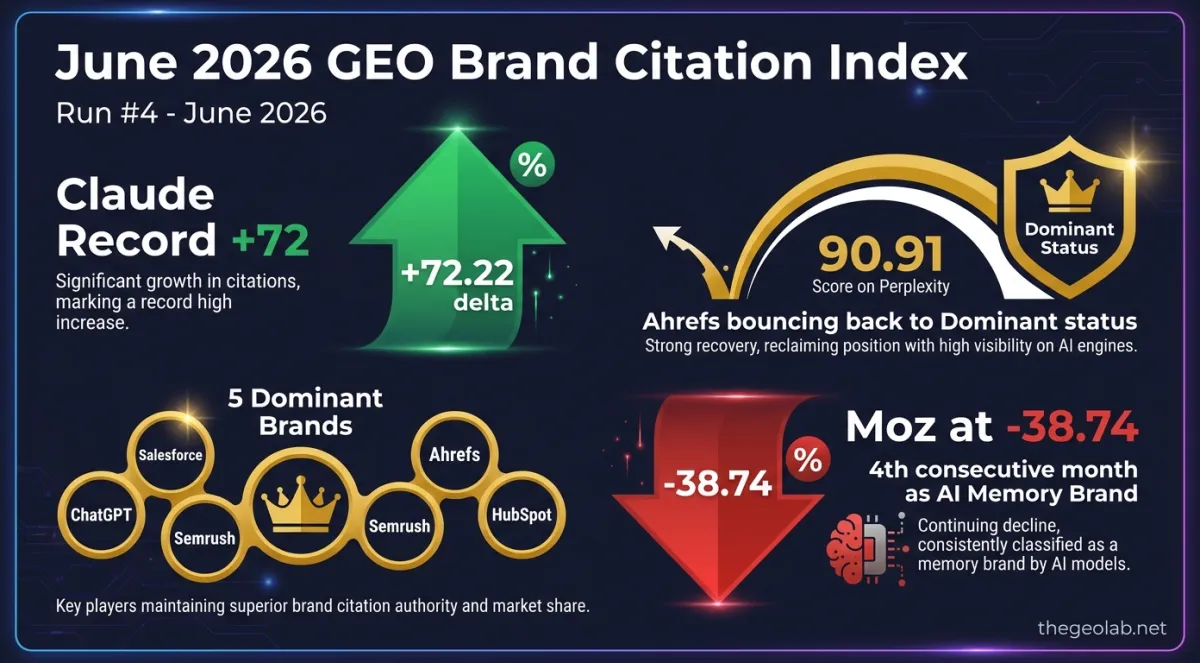
Claude’s Perplexity delta hit +72.22 — the largest in four runs. Ahrefs recovered Dominant status in a single month. The two-mechanism model now has four months of evidence.
Run #4 of the GEO Brand Citation Index tracked 36 brands across 54 queries on ChatGPT, Perplexity, and Gemini. Claude posted a record +72.22 delta — up from +60.87 in May — making it the strongest Live Search Brand signal in the index’s history. Ahrefs reversed its AI Memory classification in a single month, recovering to Dominant with Perplexity scores jumping from 60.87 to 90.91. Five brands now hold Dominant status, up from four in May.
The four-month dataset confirms the two-mechanism pattern: brands cluster around either training-data memory (ChatGPT) or live retrieval (Perplexity), and the few that hold both — Salesforce, Semrush, HubSpot — remain the exception rather than the rule.
What Changed Between May and June in the GEO Brand Citation Index
I expected the June run to be quiet. Four months in, the archetypes should be stabilising. Instead, eight brands shifted classification in a single month — the second-highest churn since the GEO Brand Citation Index launched in March.
The headline: Claude’s delta widened again. Ahrefs bounced back from AI Memory to Dominant in a single run. And Google Search Console — which had been sinking toward irrelevance on Perplexity — reversed course so dramatically that it flipped from AI Memory to Live Search Brand. In our June 2026 run, the data kept contradicting the “stable archetypes” narrative I had been building.
May vs June: The Full GEO Brand Citation Index Comparison
The GEO Brand Citation Index comparison table below shows every brand’s delta shift between May and June. Eight archetype changes in one month is unusual — the April-to-May transition had twelve, but many of those were artefacts of the Gemini key expiry correction. These eight are all genuine signal.
| Brand | Vertical | May Δ | Jun Δ | Shift | Archetype |
|---|---|---|---|---|---|
| Claude | AI & LLM | +60.87 | +72.22 | +11.35 | 🔍 Live Search |
| Ahrefs | SEO | −39.13 | −9.09 | +30.04 | 🧠 → 👑 Dominant |
| Google Search Console | SEO | −21.74 | +29.05 | +50.79 | 🧠 → 🔍 Live Search |
| Jasper | AI & LLM | −13.04 | −27.78 | −14.74 | — → 🧠 AI Memory |
| Zoho CRM | CRM | +13.43 | +20.13 | +6.70 | ★ → 🔍 Live Search |
| Pipedrive | CRM | +10.65 | +33.65 | +23.00 | — → 🔍 Live Search |
| Surfer SEO | SEO | +39.13 | +5.14 | −33.99 | 🔍 → — |
| Majestic | SEO | −8.70 | −13.04 | −4.34 | — → 🫥 Fading |
| Ubersuggest | SEO | −8.69 | −12.84 | −4.15 | — → 🫥 Fading |
| Moz | SEO | −34.79 | −38.74 | −3.95 | 🧠 AI Memory (4th month) |
| Semrush | SEO | +4.35 | +4.35 | 0.00 | 👑 Dominant |
| Salesforce | CRM | −20.83 | 0.00 | +20.83 | 👑 Dominant |
| HubSpot | CRM | +25.93 | −13.20 | −39.13 | 👑 Dominant |
| ChatGPT | AI & LLM | 0.00 | 0.00 | 0.00 | 👑 Dominant |
| Copilot | AI & LLM | +8.69 | +16.66 | +7.97 | 🔍 Live Search |
| Gemini | AI & LLM | +17.39 | +38.89 | +21.50 | 🔍 Live Search |
| Freshsales | CRM | −14.81 | −14.17 | +0.64 | 🫥 Fading |
| Copy.ai | AI & LLM | +4.35 | −11.11 | −15.46 | — |
| Screaming Frog | SEO | 0.00 | +0.79 | +0.79 | — |
The largest single shift belongs to Google Search Console: a +50.79 swing from −21.74 to +29.05. That is not a gradual trend — it is a structural change in how live retrieval systems evaluate GSC’s web presence.
Going deeper? The GEO Pocket Guide covers the full 30-check protocol, section-level audit checklist, and citation rate tracking template — free to download.
Ahrefs Regains Dominant Status After One Month as AI Memory Brand
Ahrefs is the only brand in the GEO Brand Citation Index to have held three different archetype classifications across four runs. In March, it was AI Memory (delta −48.15). April brought a partial recovery and a brief Dominant classification. May saw a relapse to AI Memory with a −39.13 delta. June: Dominant again, with Perplexity jumping from 60.87 to 90.91.
The pattern is instructive. Ahrefs’ ChatGPT score has been locked at 100.0 for four consecutive months — the training data signal is completely stable. What oscillates is the retrieval probability on Perplexity, which depends on live web signals: fresh content, recent mentions, current backlink authority. When Ahrefs publishes actively, Perplexity retrieves more. When the publishing cadence drops, Perplexity notices within a month.
The June recovery coincided with a series of high-profile Ahrefs blog posts and tool updates through late May and early June. This is not causation — the GEO Brand Citation Index measures correlation between web activity and AI citation rates — but the timing is consistent with the retrieval-probability model: live search engines reward recency. Research from Semrush’s analysis of generative engine optimisation (2025) supports the same pattern: content freshness and update frequency correlate with higher AI retrieval rates.
For brand teams watching their own citation index scores, Ahrefs demonstrates that AI Memory classification is not a permanent state. It can reverse in a single measurement cycle. The cost is sustained content investment. The signal decays within weeks of reduced publishing.
Claude Posts the Largest Delta in Four Runs of the GEO Brand Citation Index
Claude’s Perplexity-vs-ChatGPT delta has grown every month: +50.1 in March, +43.5 in April (a dip), +60.87 in May, and now +72.22 in June. The June number breaks the index record. No other brand in any vertical has posted a delta above 50 for more than one consecutive month.
The breakdown tells the story. Claude’s Perplexity score rose from 73.91 in May to 88.89 in June — a 15-point jump on live search. Meanwhile, its ChatGPT score increased marginally from 13.04 to 16.67. Gemini sits in the middle at 43.48, up from 35.71. The gap between how static training data and live retrieval systems evaluate Claude is widening, not narrowing.
What makes this signal useful for extractability research is the consistency. A one-month spike could be noise. Four months of directional growth, with only one minor dip in April, suggests a structural pattern: Anthropic’s web presence is growing faster than the training data refresh cycle can absorb.
For practitioners, Claude’s trajectory illustrates a broader GEO Brand Citation Index finding: live search brands can grow their citation rate independently of training data. The mechanism is web activity — fresh documentation, community mentions, integration guides — and the timeline for that activity to register in retrieval systems appears to be weeks, not months. This aligns with findings from the xFunnel research on GEO (Aggarwal et al., 2024), which demonstrated that content optimisation signals are absorbed by retrieval-augmented systems faster than static training cycles.
Google Search Console Flips from AI Memory to Live Search Brand
Google Search Console produced the single largest delta shift in June: a +50.79 swing from −21.74 to +29.05. In May, GSC was an AI Memory Brand — ChatGPT cited it at 39.13 while Perplexity managed only 17.39. By June, Perplexity jumped to 68.18 and Gemini reached 73.68, while ChatGPT held steady at 39.13.
The reversal is striking because GSC is a Google product. Its training-data footprint should be enormous. Yet the live retrieval systems — both Perplexity and Gemini — now cite it more frequently than the static training model. This suggests recent web activity around GSC (documentation updates, community discussions, how-to content) has outpaced the existing training signal.
Within the GEO Stack framework, this is a textbook case of retrieval-probability shifting independently of entity reinforcement. GSC’s entity authority hasn’t changed — everyone knows what it is. What changed is the volume and recency of citable content about it on the open web.
Four-Month View: What the GEO Brand Citation Index Trend Lines Show
With four months of GEO Brand Citation Index data, longitudinal patterns are becoming legible. Three observations stand out.
Moz is the index’s most stable archetype. Four consecutive months as an AI Memory Brand with deltas of −43.9, −43.7, −34.8, and −38.7. The signal does not fluctuate meaningfully. Moz’s training-data presence is deep and its live-web retrieval score is consistently below 15. Whatever Moz is doing for web presence, it is not registering in Perplexity’s retrieval pipeline. This is the clearest example of a brand living in AI memory rather than current relevance.
Ahrefs oscillates — the only brand to switch archetypes three times. AI Memory in March, Dominant in April, AI Memory in May, Dominant in June. No other brand in the GEO Brand Citation Index has reversed classification twice. The implication: Ahrefs’ citation profile is volatile, sensitive to short-term web activity. For the May report, I wrote that Ahrefs had “fallen back” to AI Memory. One month later, it recovered. Volatility, not trajectory, is the story.
The Dominant tier is stable at the top, volatile at the edges. Salesforce and ChatGPT have scored 100 across all platforms for four months. Semrush has been Dominant since April. These three are locked in. HubSpot and Ahrefs sit at the boundary — their classification depends on month-to-month live retrieval scores that move 10–30 points between runs.
Full interactive dataset and month-over-month comparison: GEO Brand Citation Index. Methodology: published methodology. Raw data: Zenodo (DOI: 10.5281/zenodo.19218295).
Frequently Asked Questions
What is the GEO Brand Citation Index June 2026 run?
Run #4 of the GEO Brand Citation Index tracked 36 brands across 54 standardised queries on ChatGPT, Perplexity, and Gemini on 15 June 2026. The index measures how frequently brands are cited by AI systems when users ask tool evaluation questions, with scores normalised to 0–100 per vertical per platform.
Why did Ahrefs return to Dominant Brand status in June 2026?
Ahrefs regained Dominant Brand classification because its Perplexity score recovered from 60.87 in May to 90.91 in June. Combined with ChatGPT at 100.0 and Gemini at 89.47, Ahrefs now scores consistently high across all three platforms — the defining characteristic of a Dominant Brand in the GEO Brand Citation Index.
What does Claude’s +72.22 delta mean in the GEO Brand Citation Index?
Claude’s +72.22 delta means Perplexity cites Claude 72.22 points more frequently than ChatGPT does when answering the same standardised queries. This is the largest positive delta recorded across four runs of the GEO Brand Citation Index, classifying Claude as a Live Search Brand — dominant on live web retrieval but under-represented in AI training data.
How many brands does the GEO Brand Citation Index track in June 2026?
The June 2026 GEO Brand Citation Index tracks 36 brands across three verticals: AI and LLM Tools (12 brands), CRM and Sales (10 brands), and SEO and Marketing (14 brands). Each brand is measured across 54 queries on three platforms.
Where can I download the full June 2026 GEO Brand Citation Index dataset?
The full dataset is published on Zenodo under DOI 10.5281/zenodo.19218295. The interactive leaderboard with filtering, sorting, and month-over-month comparison is at thegeolab.net/geo-brand-citation-index/.
The two-mechanism model holds across four months of GEO Brand Citation Index data. Brands are cited either from training-data memory (ChatGPT-dominant) or from live web retrieval (Perplexity-dominant). The five brands that manage both — Salesforce, ChatGPT, Semrush, Ahrefs, HubSpot — do so through a combination of deep historical authority and sustained current publishing. Everyone else is drifting toward one pole.
Ahrefs’ oscillation between AI Memory and Dominant — twice in four months — demonstrates that archetype classification is not permanent. Live retrieval scores are volatile and respond to recent web activity within weeks. This is the core actionable finding: if your brand’s Perplexity score dropped, the fix is not SEO — it is fresh, citable content on the open web.
Track your brand’s AI visibility. See the full interactive dataset at the GEO Brand Citation Index, or download the raw data from Zenodo.
Questions? Contact The GEO Lab.