
{
“@context”: “https://schema.org”,
“@type”: “Article”,
“headline”: “The GEO Stack: How the Five-Layer Framework Diagnoses Visibility Problems”,
“description”: “The GEO Stack is a five-layer diagnostic framework for AI search visibility: Retrieval Probability, Extractability, Entity Reinforcement, Structural Authority, and System Memory.”,
“author”: {
“@type”: “Person”,
“name”: “Artur Ferreira”,
“url”: “https://thegeolab.net/about/”,
“sameAs”: [
“https://www.linkedin.com/in/arturgeo”,
“https://x.com/TheGEO_Lab”
]
},
“publisher”: {
“@type”: “Organization”,
“name”: “The GEO Lab”,
“url”: “https://thegeolab.net”
},
“datePublished”: “2026-03-11”,
“dateModified”: “2026-03-26”
}
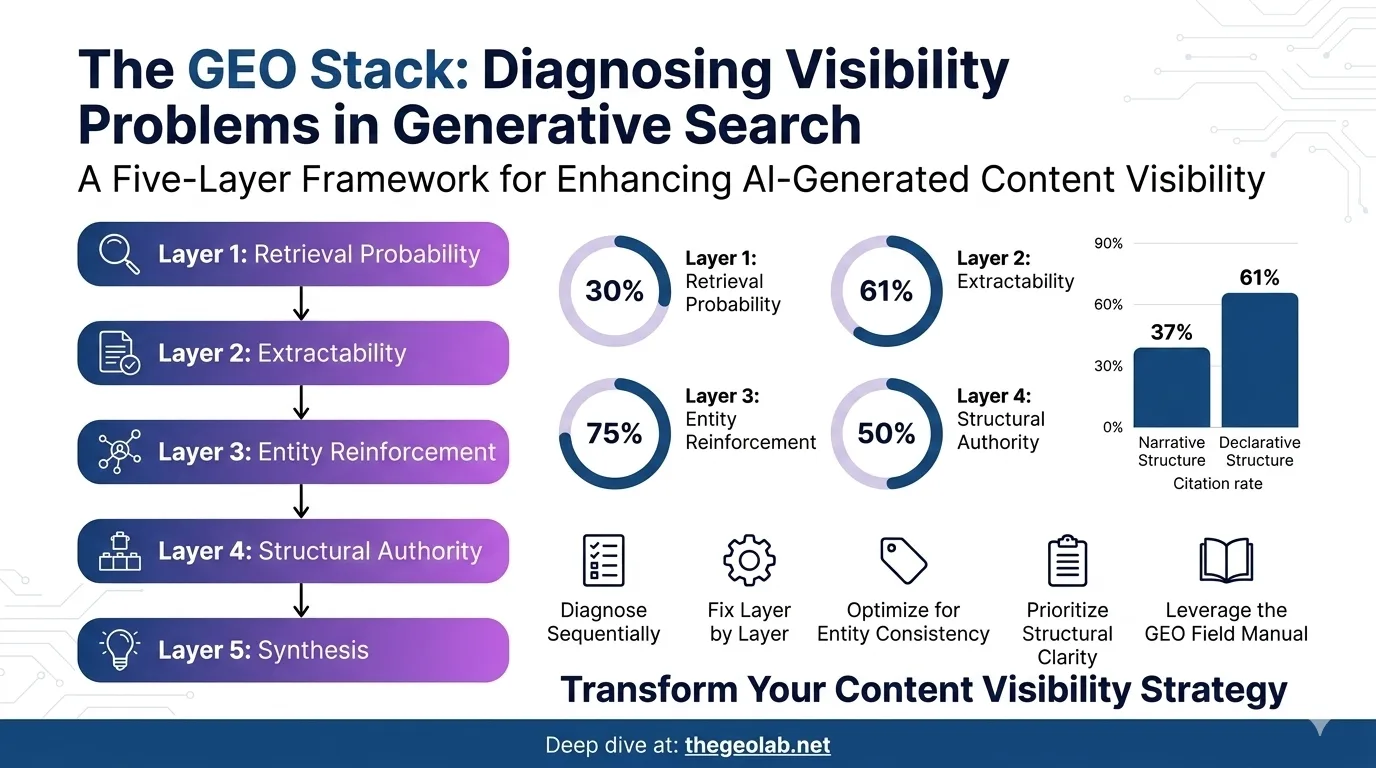
The visibility of digital content online is determined by five distinct layers of factors. Most SEO conversations flatten this into one or two layers, then wonder why their improvements don’t move the dial.
The GEO Stack is a conceptual framework—five layers of stacked factors that determine whether content surfaces in search results, gets discovered through exploration, or reaches people through social and earned channels.
Understanding the Stack is the foundation for understanding why visibility fails and what to fix.
The Prerequisite: Stage 0 — Candidate Pool Eligibility
The GEO Stack operates on content that has already been retrieved into the LLM’s candidate pool. That pool is populated from the top 20–30 organic search results for the target query and its fan-out sub-queries.
If a page does not rank in that window, Layers 1–5 interventions produce zero improvement. Not marginal improvement — zero. Retrieval cannot be optimised for content that was never considered.
This is the most common misapplication of the GEO Stack: applying passage-level optimisation to unranked pages. I have seen teams invest weeks restructuring content for extractability on pages that do not appear in the top 50 results for any target query. The structural improvements were technically correct. They produced no citation lift because the page was never in the candidate pool.
Before running a GEO audit on any page, verify it ranks in the top 30 for at least one of its target queries. If it does not, the priority is SEO — not GEO. Build ranking first, then optimise for retrieval.
The two-stage pipeline makes this explicit:
- Stage 1: Document-level relevance — classic ranking. Does the page appear in the candidate pool? This is determined by domain authority, topical relevance, backlinks, and traditional SEO signals.
- Stage 2: Passage-level retrieval — LLM readability. Once in the candidate pool, does the AI system extract and cite specific sections? This is determined by extractability, entity clarity, and structural authority.
Both stages must be addressed. Most GEO advice only addresses Stage 2. If Stage 1 is failing, Stage 2 interventions are inert.
Layer 1: Discoverability
Can the search engine find your content at all?
This layer is about crawl accessibility, indexability, and basic on-site signals that tell Google whether content is worth cataloguing. It includes:
- Robots.txt rules and crawl directives
- XML sitemaps and proper linking architecture
- Mobile responsiveness and Core Web Vitals
- Duplicate content handling and canonical tags
- Structured data markup (Schema)
Most sites solve this layer and never go further. They assume if Google can find the page, it will rank. This assumption is wrong.
Going deeper? SEO to GEO: The Complete Framework covers the full transition from traditional SEO to Generative Engine Optimisation — including the five-layer GEO Stack applied to real content.
Layer 2: Relevance
Does the search engine understand what your content is about?
Relevance is about topic matching, entity association, and semantic connection to search queries. It’s not keyword density—it’s about topical authority and conceptual depth. This includes:
- Topic clustering and semantic relationships
- Entity mentions and knowledge graph alignment
- Content structure and information architecture
- Internal linking for topical reinforcement
- Query intent alignment
A page can be discoverable and irrelevant. A page can be relevant and still not rank because it fails the next layer.
Layer 3: Authority
Does the search engine trust your content enough to display it?
Authority is about domain-level signals, creator reputation, and topical expertise. This layer is largely external:
- Backlink profile and domain authority
- Brand mention volume and context
- Author expertise signals
- Content freshness and update recency
- E-E-A-T signals (Experience, Expertise, Authoritativeness, Trustworthiness)
You can have discoverable, relevant content that doesn’t rank because you haven’t built authority in that topic area yet.
Layer 4: Retrieval Probability
Will the search engine surface your content for a given query?
This layer determines whether your content actually gets retrieved from the index when someone searches. It’s where ranking factors live. This includes:
- Click-through rate from search results
- Dwell time and engagement signals
- Query-document matching precision
- User behaviour signals and search patterns
- Freshness and recency signals for time-sensitive queries
A page can win layers 1–3 and still not rank because users don’t click it in search results, or because the retrieval algorithm doesn’t think it’s the best match for that specific query.
Layer 5: Amplification
Does your content get promoted beyond search?
Amplification is about earned visibility—how much the content spreads through social channels, citation networks, and discovery platforms. This layer includes:
- Social sharing and platform virality
- News coverage and press mentions
- Link velocity and discovery momentum
- Platform algorithms (LinkedIn, Twitter, Reddit, etc.)
- Community engagement and participation
Amplification creates upstream demand that forces search engines to retrieve your content. It also creates authority signals that feed back into layer 3.
The Two Parallel Tracks
Practitioners often treat the GEO Stack as a strict sequence — fix Layer 1, then Layer 2, then Layer 3. In practice, the five layers split into two parallel workstreams that can and should run simultaneously.
Track 1: Pipeline Optimisation (Layers 1 + 2) — immediate interventions. Structural changes to content format, heading architecture, declarative sentence structure, and section-level extractability. These are measurable within 4–8 weeks because they affect how AI systems parse content that is already in the candidate pool. I tested this directly in Experiment 001: structural changes alone produced a 24 percentage point citation rate improvement.
Track 2: Entity and Authority Building (Layers 3 + 4 + 5) — a long-term parallel programme. Building entity coherence, citation networks, topical authority, and system memory compounds over months, not weeks. These layers cannot be rushed, but they should not wait until Track 1 is finished.
The two tracks are parallel, not sequential. A team that spends three months perfecting extractability before starting authority-building has wasted two months of potential compounding. Start both tracks on day one. Track 1 delivers measurable results first; Track 2 delivers larger results later.
Why Most Visibility Strategies Fail
The most common error is assuming that optimising for one or two layers will move overall visibility. Teams spend months perfecting layer 1 (discoverability) and layer 2 (relevance), then blame the algorithm when nothing changes.
If you haven’t built authority (layer 3), discoverability and relevance don’t matter. If your retrieval probability is low (layer 4), you rank for queries no one searches. If you don’t amplify (layer 5), you lose the discovery momentum that builds authority.
The Stack shows why visibility problems require systems-level thinking, not tactical optimisation.
Diagnosing Visibility Problems with the Stack
When content underperforms, the Stack provides a diagnostic framework:
Is it discoverable? Check crawlability, indexability, and Core Web Vitals. Use GSC to verify pages are indexed. Run a technical audit. If this layer fails, nothing else matters.
Is it relevant? Analyse your internal linking structure. Map your topical clusters. Check entity mentions. Use tools like Semrush or Ahrefs to compare your topical depth against competitors. If competitors rank deeper content, your relevance is weak.
Is it authoritative? Audit your backlink profile. Check brand mention volume. Run an E-E-A-T assessment. If you’re ranking behind less-relevant content from higher-authority domains, authority is the gap.
Is retrieval probability high? Measure click-through rate in GSC. Track dwell time in GA4. Check whether your page title and meta description accurately represent the content. If CTR is low, improve SERP appearance. If dwell time is low, improve content quality or format.
Is it amplified? Check social sharing volume. Look for mentions in industry communities. Measure referral traffic from indirect channels. If the page gets no promotion, it won’t build the authority it needs to climb.
The GEO Stack in Practice
The Stack is diagnostic, not prescriptive. Every visibility problem maps to one or more layers. Fixing the wrong layer wastes time. Fixing the right layer compounds effects across all five.
Understanding which layer is the constraint is the entire game of visibility.
Ready to apply this? Run the 30-check protocol against your highest-traffic informational pages using the AI Visibility Diagnostics Console — it generates a baseline citation rate in under 10 minutes.
Questions? Contact The GEO Lab.
Related Reading
Have questions about this topic? Contact The GEO Lab · Return to homepage