
Research review · Three separate study contexts · Measurement and causal limits
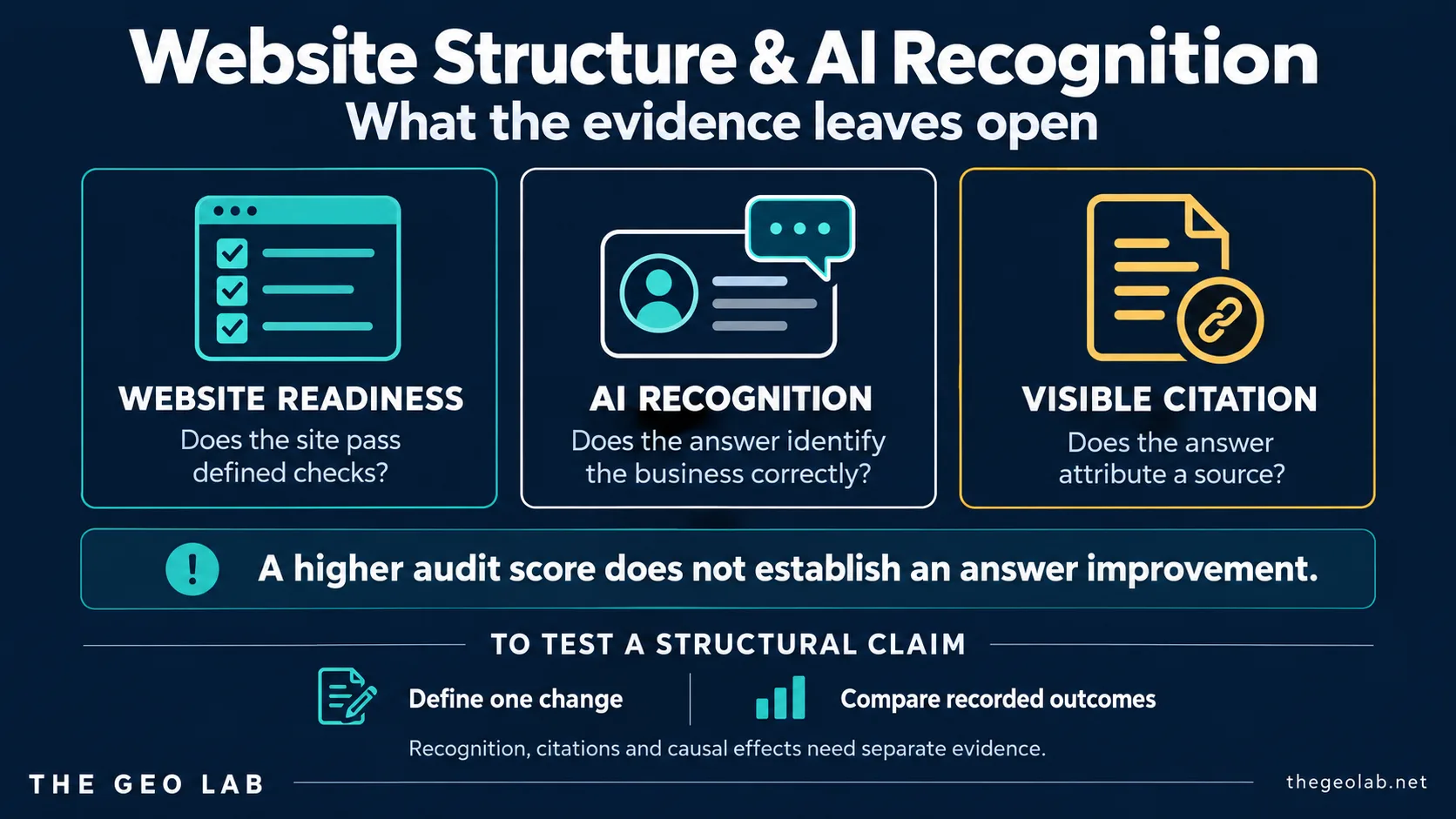
Website structure and AI recognition need separate evidence. A readiness score describes selected website features; it cannot establish what an AI system knows about a business or whether a structural edit earned a citation. As of November 2026, the three papers reviewed here examine different outcomes, from model knowledge to aggregate mentions and before-and-after cases. They offer hypotheses to test, but don’t establish a shared causal effect or a reliable waiting period for results.
A completed website audit can leave an awkward question unanswered: what changed for the person asking an AI system about your business?
Suppose you’ve clarified the company name, corrected the structured data and made the service pages easier to navigate. The audit score improves. A week later, an AI answer still describes the business incorrectly.
That would be frustrating. It would also leave several possible explanations open. The edits might have fixed a real website problem without changing the information used in that answer. The answer might have relied on another source. Or the score might reward features that have little bearing on that particular question.
I’d want to investigate those possibilities before either declaring the work unsuccessful or telling the client to wait six months.
The research on website structure and AI recognition helps frame that investigation, provided we keep each study’s measurements attached.
Website structure and AI recognition: what counts as each?
Website structure and AI recognition cover different things across the papers reviewed here.
A page-level checklist might award a point for a title tag or JSON-LD. A graph measure might describe a domain’s position among other websites. A content intervention might change the wording of an introduction and add an FAQ. Calling all of them “structure” makes the evidence look more interchangeable than it is.
The outcome needs the same care:
| Question | Observation needed |
|---|---|
| Did the website pass a structural check? | A recorded test against a defined rule. |
| Could a model identify the business? | An answer assessed against an identity reference. |
| Did a search answer cite a page? | Visible attribution in the captured answer. |
| Did the edit cause an improvement? | A comparison designed to distinguish the edit from other changes. |
These observations can inform one another. They don’t substitute for one another.
For example, a model might identify a company correctly without linking to its website. A linked answer could still misdescribe its services. A single “AI readiness” percentage would conceal those differences. The Extractability layer in the GEO Stack addresses a related but distinct question: whether content can be extracted at the passage level, not whether the business is recognised at the entity level.
The Two-Clock study separates website structure and AI recognition
Viveka Mohan Das’s Two-Clock Model working paper, version 2 studies 50 technology entities. Archived homepages supplied an eight-component structural score; dated OpenAI models, with browsing disabled, supplied answers scored against an identity reference.
The paper reports birth measurements for 48 entities with usable archives: structural presence averaged 64.2% of its maximum, while perception averaged 0.5% of its maximum. See sections 4.2–4.3 and 5.1.
That is a comparison between two normalised scoring systems. It is not a finding that 64.2% of pages were accessible while 0.5% received citations.
I’d also be careful about treating their difference as a universal performance deficit. Putting two scores on a percentage scale doesn’t, by itself, establish that one point means the same thing in each.
Going deeper? The GEO Field Manual covers the practitioner workflow for auditing, measuring and reporting AI visibility outcomes.
Browsing was disabled
The study’s recognition measurement concerns answers produced without live web search. Its dates come from a ladder of model snapshots and stated knowledge cutoffs, rather than repeated captures of one live search product through time.
That boundary limits the practical interpretation. A business asking why today’s search answer missed an updated page needs evidence about that search experience. The model-knowledge panel cannot supply its refresh schedule.
The distinction follows the same collection discipline discussed in API vs browser AI citation audits: record which system produced the observation before transferring the conclusion elsewhere.
Earlier news coverage doesn’t establish the cause of recognition
The paper also compares GDELT news-mention ramps with recognition onsets. Here, “citation” refers to news coverage, not a visible link inside an AI answer.
Section 5.4 reports that coverage came first in 28 of 33 eligible entities. The audited high-precision subset gives a smaller, statistically inconclusive result: 8 of 11, with p = 0.23. The pooled finding includes unaudited mention series.
The author acknowledges that timing alone doesn’t establish causation. A launch becoming more prominent could affect both news coverage and the material available to model developers.
Version 2 adds repeated scoring and a human check. Those checks help assess the instrument; they don’t turn the panel into an intervention on website structure.
I would therefore treat external coverage as a candidate explanation to investigate. This study doesn’t establish that buying more coverage will improve recognition, or when that improvement would arrive.
A topology association cannot tell us what an internal-link edit will do
Jorge Sánchez Mosquete’s Topological SEO and GEO preprint examines 91 high-traffic domains in Spain. Its inputs include Common Crawl’s global web-graph harmonic-centrality rank, and its outcome aggregates AI mentions.
The abstract reports topology r = −0.45 and authority r = 0.43. Section 4.2 instead gives raw topology r = −0.12, describes −0.45 after clustering, and reports authority r = 0.47. These estimates need reconciliation before supporting a superiority claim.
Its custom TGS also incorporates keyword volume and estimated organic traffic. It is not a direct internal-link audit. See sections 3.4, 4.2, 5.3 and 6.1.
My reading is narrower than the paper’s optimisation language: these domain-level associations don’t estimate the effect of editing internal links.
For a practical test, I’d want to measure the proposed change directly. If the intervention is adding links from a category page to selected service pages, record those links and their destinations. A domain’s position in a global graph answers a different question. The GEO Stack framework treats internal linking as a Structural Authority signal, but the effect of any specific linking change still requires page-level measurement.
I’d then assess the outcome on those service pages. Moving from “these domains differ” to “this edit will help this page” requires evidence connecting the two.
A successful-looking case can leave the effective change unresolved
Liao and Tsai’s GEO Fundamentals, archived version 1.4, includes content and identity cases involving several changes. These include rewrites, modular sections, schema, interlinking and deployment steps. Sections 6 and 7 describe subsequent citations.
Those observations document outcomes after the work. They don’t isolate the contribution of an individual change. The separate Sentence-BERT simulation in section 4.6 retrieves similar paragraphs; it does not query a live generative engine.
For example, if an answer appears after an introduction rewrite and an FAQ addition, both remain candidate explanations. The page may also have become available to the system during the same period. Without a suitable comparison, the capture cannot allocate credit between them.
I’d retain the case as a reason to design a narrower test. I wouldn’t use it to promise a citation increase from adding an FAQ.
These papers don’t replicate one shared effect on website structure and AI recognition
Putting the three studies together leaves us with several research questions, rather than a combined estimate of what better website structure achieves for AI recognition.
One question concerns knowledge about an entity. Another concerns differences between domains. A third concerns what happened after a bundle of changes.
Even if their findings all pointed in a similar direction, they would still need a common intervention and outcome before we could describe them as replications of the same effect.
For a website owner, the immediate consequence is in the report wording. “The audit score increased” is supportable when the recorded checks show it. “AI recognition improved” needs answer evidence. “Our structural work caused that improvement” needs a design capable of testing attribution.
How I’d test a website structure and AI recognition claim
I’d start with one proposed change and name the outcome before editing.
“Improve the site’s AI readiness” is too broad for this purpose. A more testable proposal would be: add contextual links from an existing service hub to a defined group of service pages, then assess whether those pages receive more citations for a fixed set of relevant questions.
That is a proposed experiment, not a result from the papers above.
Keep the change distinguishable
Preserve the earlier page and record the edit. If the wording, schema and internal links all change together, the test concerns that package. It cannot identify the effect of links alone.
Where feasible, use comparable pages that remain unchanged during the same period. Record how they were selected. A comparison group can help detect a platform-wide change, although differences between pages can still complicate attribution.
For the broader workflow, the GEO experiments guide covers planning a measurement around a content change.
Match the answer check to the claim
For recognition, assess whether the answer identifies the right business and describes it accurately. For citations, preserve the visible destination URL and the statement attached to it.
Keep the query set fixed for the planned comparison. Record the product surface and collection conditions, and repeat observations under a rule chosen in advance. The existing query-set reporting guide covers that sampling question separately.
Choose a review date without promising a result
A review date gives the work a boundary. It doesn’t establish the time an AI system needs to respond.
The Two-Clock paper presents its six-month checkpoint as a rule of thumb requiring category-specific evidence. I wouldn’t turn it into a client guarantee, or use it to explain away a missing outcome.
At the review, report the structural change and the answer observations separately. If the edit is verified but the intended outcome hasn’t changed, that remains the result for the tested conditions.
Frequently asked questions
Does a high AI readiness score mean a business will be recognised?
A score establishes performance against its own checks. Recognition requires answers about the business to be assessed against a suitable reference. A readiness score needs separate validation before it can stand in for that outcome.
Does better website structure cause more AI citations?
The studies reviewed here don’t establish a general causal effect. A claim about a particular structural change needs a comparison that measures the intended citation outcome and addresses competing explanations.
Can a model recognise a business without citing its website?
Recognition and citation are different observations. An answer can identify the business while providing no link. Record each outcome according to its own rule.
Should I wait six months before reviewing results?
Choose a review schedule for the test you are running. The Two-Clock framework’s six-month suggestion is not an established response time for live AI search products or a guarantee for another business category.
How should a website owner report structural work and AI recognition to a client?
Report the structural changes and their verification separately from any AI answer outcomes. “The website now passes these checks” is supportable. “AI recognition improved because of our work” requires answer evidence and a comparison designed to test that attribution.
Key GEO Lab Takeaway
A structural improvement earns a structural claim. To say recognition improved, capture and assess the answers. To attribute that improvement to your edit, build the comparison before making the change.
Until that evidence is available, a report can say: “The website passed these additional checks. We haven’t yet established an improvement in the answers we’re tracking.”
Website structure and AI recognition sit on opposite sides of an inferential gap. The studies reviewed here help define the gap. Closing it requires page-level experiments with named interventions and pre-registered outcomes.
Ready to apply this? Use the GEO experiments guide to design a test that separates structural changes from recognition outcomes.