
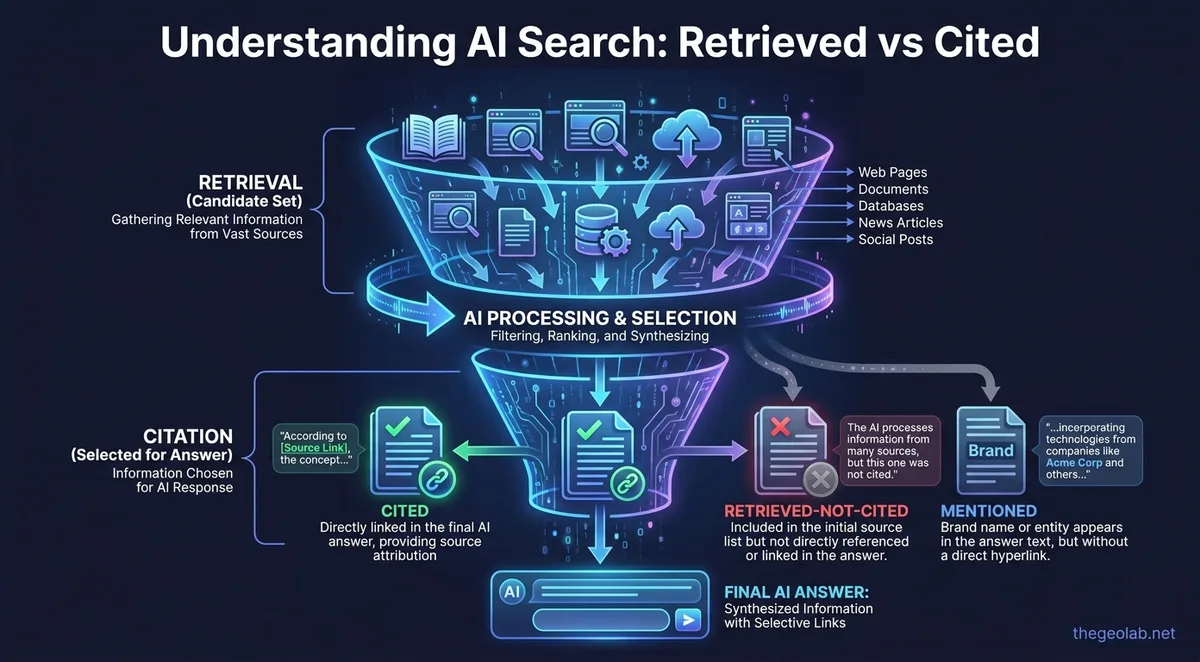
Retrieved and cited are two stages of a funnel, not synonyms. Retrieved means your page entered the candidate set. Cited means the engine selected it and linked it in the answer. A third state, mentioned, means the brand name appeared with no link and often without retrieval. Each state has a different cause and a different fix. A retrieval failure is upstream (relevance, eligibility, whether the engine searched). A citation failure is downstream (extractability, answer-first structure). Diagnosing the stage before choosing the fix is the most common step practitioners skip.
The two-stage funnel
Your site appeared in Perplexity’s source panel. It was not cited in the answer. These are two different things, and the gap between them explains most of the confusion about AI search visibility. Being retrieved and being cited are separate stages of a two-stage funnel, and a third state, being mentioned without a link, sits alongside both. Knowing which state you are in tells you what to fix. Confusing them sends you optimising the wrong stage.
AI search works in two stages. First the engine retrieves a set of candidate sources for a query. Then it selects which of those candidates to cite in the answer it generates. Retrieval is the engine deciding your page is relevant enough to pull into consideration. Citation is the engine deciding your page earned a place in the final answer. The distinction is the foundation for reading any visibility result correctly.
A page can clear the first stage and fail the second. It enters the retrieval set, shows up in a source panel or candidate list, and then loses the selection step to another candidate. From the outside that looks like a near miss, but mechanically it is a specific, diagnosable outcome: retrieved, not selected.
Going deeper? SEO to GEO: The Complete Framework covers the full transition from traditional search to AI search visibility, including the retrieval-to-citation funnel.
Three states, not two
There are actually three visibility states worth separating. A page can be cited, meaning it appears in the answer with an attributed link. It can be retrieved, meaning it entered the candidate set but was not selected for the answer. And a brand can be mentioned, meaning the name appears in the text with no link and often without the page having been retrieved at all. The mention versus citation gap covers the third state in detail, where a brand string shows up but no citation follows.
These three states have different causes and different fixes. Treating them as one metric, AI visibility, hides the information that would let you act. A mention is a knowledge signal. A retrieval is a relevance signal. A citation is a selection signal. They are not points on a single scale.
| State | What happened | Signal type | Fix target |
|---|---|---|---|
| Cited | Page selected and linked in the answer | Selection | Maintain — this is the goal state |
| Retrieved, not cited | Page entered candidate set, lost selection | Relevance (passed), selection (failed) | Extractability, answer-first structure |
| Mentioned, not cited | Brand name in text, no link, often no retrieval | Knowledge-graph | Entity reinforcement, not page optimisation |
| Not retrieved | Page never entered contention | None | Relevance, eligibility, retrieval triggers |
Why the distinction changes what you fix
If you were never retrieved, the problem is upstream: relevance, eligibility, or whether the engine searched at all. No amount of rewriting the page changes a retrieval failure, because the page never entered contention. The GEO Lab’s E042 experiment found cases where ChatGPT cited nothing because it never retrieved, answering from training data instead. This platform-specific behaviour means the same page can be cited on Perplexity and invisible on ChatGPT for the same query. On those queries the page quality was irrelevant to the outcome.
If you were retrieved but not cited, the problem is downstream: the page was a candidate and lost the selection step. Here the levers are different. Extractability, a clear answer-first structure, and the page directly addressing the query in quotable form are what move a retrieved candidate into the cited set. Optimising extractability when your real problem is retrieval is wasted effort, and the reverse is equally wasted. The diagnosis has to come before the fix.
How to tell which state you are in
Check the source panel or candidate list, not just the answer. If your page appears there but not in the answer, you were retrieved and not selected, and the work is on the selection stage. If your page does not appear in the candidates at all, you were not retrieved, and the work is on relevance and eligibility. If your brand name shows up in the prose with no link, you have a mention, which is a knowledge-graph signal rather than a citation. Read the stage first. The fix follows from the stage, and the most common mistake in AI search optimisation is skipping the diagnosis and tuning whichever lever the last guide happened to mention.
- Retrieved and cited are two separate stages. Retrieved means your page entered the candidate set. Cited means the engine selected it for the answer. A page can pass one and fail the other.
- Three states, not two. Cited, retrieved-not-cited, and mentioned-not-cited each have different causes and different fixes. Treating them as one metric hides the diagnosis.
- Retrieval failures need upstream fixes. Relevance, eligibility, and whether the engine searched at all. Page quality is irrelevant to a query that never triggered retrieval.
- Citation failures need downstream fixes. Extractability, answer-first structure, and quotable form. These only matter once the page is already in the candidate set.
Want to measure which state your pages are in? The 30-check citation protocol separates retrieval from citation across platforms, so you diagnose the stage before choosing the fix.
Questions? Contact The GEO Lab.
Frequently asked questions
What is the difference between retrieved and cited in AI search?
Retrieved means your page entered the engine’s candidate set for a query. Cited means the engine selected your page and attributed it with a link in the generated answer. A page can be retrieved without being cited when it enters the candidate set but loses the selection stage to another source.
What does it mean to be mentioned but not cited?
A mention is when your brand name appears in an AI answer as text with no attributed link, often without your page being retrieved at all. It is a knowledge-graph signal that the engine knows the name, not evidence that your page was used as a source. It is a distinct state from both retrieval and citation.
Why was my page in Perplexity’s sources but not in the answer?
That is the retrieved-not-cited state. Your page cleared the retrieval stage and entered the candidate set, then lost the selection stage where the engine chooses which candidates to cite. The fix is on extractability and answer-first structure, not on relevance, because relevance already got you retrieved.
Why does this distinction matter for GEO?
Because retrieval failures and citation failures have different fixes. A retrieval failure is upstream, about relevance and eligibility. A citation failure is downstream, about extractability and selection. Treating them as one metric leads to optimising the wrong stage, which is the most common wasted effort in AI search optimisation.
How do I check if my page was retrieved but not cited?
Check the source panel or candidate list in the AI answer, not just the generated text. On Perplexity, sources appear in a side panel. If your page appears there but is not cited in the answer body, you were retrieved and not selected. If it does not appear in sources at all, the page was never retrieved for that query.