
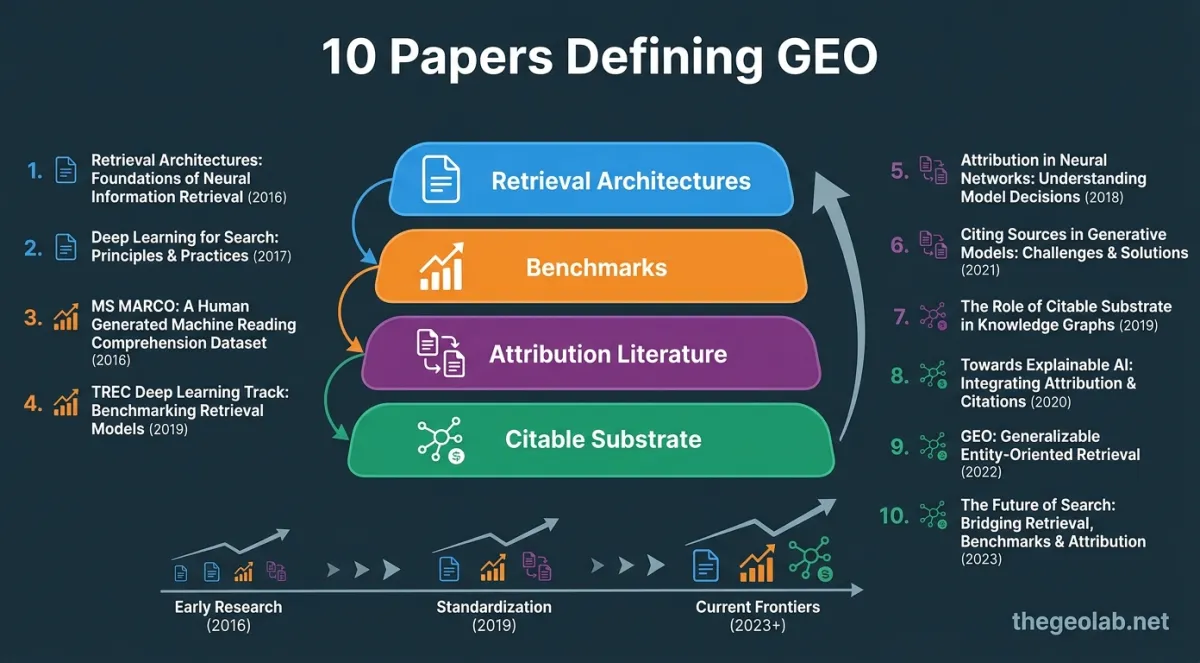
Ten GEO research papers that anchor Generative Engine Optimisation, from the retrieval architectures that make AI search work to the first study that measured the field as a distinct discipline
Generative Engine Optimisation didn’t appear from nowhere. It sits on a decade of retrieval research, REALM, RAG, DPR, that built the architecture AI systems use to fetch documents at query time. It sits on the benchmarks, MS MARCO, Natural Questions, BEIR, that made those architectures measurable. It sits on the attribution literature, ALCE, RARR, Liu’s verifiability study, that quantifies what it means for an AI system to actually cite a source. And then there’s the one peer-reviewed paper that treats GEO itself as a named discipline: Aggarwal et al. (2024).
Ten papers. Four categories. Together they form the citable substrate for every GEO claim worth making.
Why GEO Needs a Citable Substrate
Research papers that define the GEO field are rarely cited by practitioners, and that is the failure mode this post addresses. GEO is deep in it. Practitioners make claims. Practitioners cite other practitioners. Those other practitioners cite the first practitioners. Nobody ever cites a peer-reviewed source, because nobody’s quite sure where one exists. The claims calcify into consensus without ever being tested.
I’ve done this. You’ve probably done this. The phrase “AI crawlers don’t execute JavaScript” has been repeated in GEO posts so many times that it reads as received wisdom, but the evidence base is still mostly server-log observations and one much-cited blog post. This is not how a field becomes scientific. This is how a field becomes a vibe.
The ten papers below are what I treat as the citable substrate. They’re peer-reviewed, indexable, and they establish the claims that everything else in GEO builds on. When a question arises, “why does structure matter for AI citation?”, the answer lives in one of these papers, not in a LinkedIn post.
Reading all ten end-to-end is not necessary. Knowing what each paper established is. The practitioner value is in being able to say “Liu et al. (2023) found 51.5%” rather than “someone somewhere said about half”, that’s the difference between a field with foundations and a field without.
Going deeper? The GEO Pocket Guide translates the research findings from these papers into the five-layer GEO Stack practitioners use day-to-day.
Four Categories of GEO Research Papers
The ten papers split cleanly into four categories. Knowing which category a paper belongs to tells you what kind of question it answers.
The shape of this timeline matters. The retrieval and benchmark papers stacked up for years before anyone treated GEO as a discipline. Aggarwal’s 2024 paper isn’t the start of the field, it’s the moment the field caught up with a decade of substrate research and named what practitioners had been doing informally.
The Ten GEO Research Papers
GEO research papers ordered by practitioner relevance, the GEO research papers that most directly change how you think about GEO work come first.
GEO: Generative Engine Optimization
GEOAggarwal, P., Murahari, V., Rajpurohit, T., Kalyan, A., Narasimhan, K., & Deshpande, A. (2024). KDD ’24. arXiv:2311.09735.
The first peer-reviewed paper to name Generative Engine Optimisation as a discipline and measure it directly. Introduced GEO-BENCH, 10,000 queries across 9 domains, and tested nine content-optimisation methods for their effect on AI citation rate.
Statistics Addition and Quotation Addition produced the largest visibility improvements, up to 22–40% in some conditions. Other interventions varied widely by domain. Simple content signals matter measurably for AI retrieval behaviour.
This is the paper to cite when claiming GEO exists as a measurable discipline. Every subsequent serious GEO study positions itself relative to GEO-BENCH.
Evaluating Verifiability in Generative Search Engines
AttributionLiu, N. F., Zhang, T., & Liang, P. (2023). Findings of EMNLP 2023. arXiv:2304.09848. Stanford.
The first systematic audit of citation quality in generative search engines. Measured whether citations provided by Bing Chat, NeevaAI, perplexity.ai, and YouChat actually supported the claims they were attached to.
A 51.5% citation support rate across the four engines. Roughly half of the citations did not substantively support the claims they accompanied. This number remains the reference baseline for citation-quality research.
Establishes the baseline against which all subsequent attribution improvements are measured. Also documents the gap between “having a citation” and “being cited correctly” that GEO work has to account for.
Retrieval-Augmented Generation for Knowledge-Intensive NLP Tasks
RetrievalLewis, P., Perez, E., Piktus, A., Petroni, F., Karpukhin, V., Goyal, N., et al. (2020). NeurIPS 2020. arXiv:2005.11401. Meta / FAIR.
The RAG architecture, combining a parametric language model with a non-parametric retrieval component, as a general-purpose fine-tuning recipe. Demonstrated that RAG models generate more specific, diverse, and factual language than purely parametric baselines.
RAG is the underlying architecture for the majority of modern AI search engines. When you’re optimising for AI citation, you’re optimising for a RAG system. Lewis et al. is the canonical reference for what that means.
Enabling Large Language Models to Generate Text with Citations (ALCE)
AttributionGao, T., Yen, H., Yu, J., & Chen, D. (2023). EMNLP 2023. arXiv:2305.14627. Princeton.
The ALCE benchmark, Automatic LLMs’ Citation Evaluation, for measuring citation behaviour along three dimensions: fluency, correctness, and citation quality. Provided a reproducible way to evaluate citation performance across models.
Moves citation evaluation from subjective assessment to automated, benchmark-comparable measurement. The three-dimensional framework, can it cite, does the citation support the claim, is the generated text fluent, is now standard vocabulary in the attribution literature.
Dense Passage Retrieval for Open-Domain Question Answering (DPR)
RetrievalKarpukhin, V., Oğuz, B., Min, S., Lewis, P., Wu, L., Edunov, S., Chen, D., & Yih, W. (2020). EMNLP 2020. arXiv:2004.04906. Facebook AI.
That dense vector representations, learned from a small number of question-passage pairs, can outperform traditional sparse methods like BM25 for passage retrieval, by 9–19% absolute in top-20 accuracy across open-domain QA datasets.
DPR is the retrieval mechanism that made modern RAG practical. Understanding that AI retrieval is embedding-based, not keyword-based, is the single conceptual shift separating GEO practice from classical SEO practice, and DPR is the paper where that shift is technically grounded.
REALM: Retrieval-Augmented Language Model Pre-Training
RetrievalGuu, K., Lee, K., Tung, Z., Pasupat, P., & Chang, M. (2020). ICML 2020. arXiv:2002.08909. Google.
That language models can be trained to learn when to retrieve from an external corpus, not just use retrieval at inference time. Introduced learned retrieval as a pre-training objective, not an add-on.
REALM is the conceptual predecessor to RAG. It’s the paper that made external retrieval a first-class citizen in language-model training, rather than a post-hoc lookup.
BEIR: A Heterogeneous Benchmark for Zero-shot Evaluation of Information Retrieval Models
BenchmarkThakur, N., Reimers, N., Rücklé, A., Srivastava, A., & Gurevych, I. (2021). NeurIPS Datasets & Benchmarks 2021. arXiv:2104.08663. UKP-TUDA.
An 18-dataset benchmark for evaluating retrieval models across diverse domains and task types, under zero-shot conditions, i.e. without dataset-specific fine-tuning.
BEIR showed that retrieval performance doesn’t transfer uniformly across domains. A model that’s excellent on general-web retrieval may underperform on specialist-domain retrieval. For GEO, this predicts platform-specific variation in how well different AI systems handle different content types.
RARR: Researching and Revising What Language Models Say, Using Language Models
AttributionGao, L., Dai, Z., Pasupat, P., Chen, A., Chaganty, A. T., Fan, Y., Zhao, V., Lao, N., Lee, H., Juan, D., & Guu, K. (2023). ACL 2023. arXiv:2210.08726. CMU / Google / UC Irvine.
A framework, Retrofit Attribution using Research and Revision, for post-hoc attribution and editing of language-model output. RARR automatically finds evidence for claims and revises unsupported content while preserving the original output as much as possible.
Clarifies that attribution in AI search is not a single-step retrieval problem. It’s a research-and-revise pipeline. Understanding this pipeline is how to reason about why some pages get cited accurately and others get cited incorrectly.
Natural Questions: A Benchmark for Question Answering Research
BenchmarkKwiatkowski, T., Palomaki, J., Redfield, O., Collins, M., Parikh, A., Alberti, C., et al. (2019). TACL 2019. Google.
A benchmark of real user queries, 307,373 training examples plus 7,830 development and 7,842 test examples, drawn from anonymised Google Search queries and paired with Wikipedia answers. Questions use real user phrasing, not crowdsourced rewording.
Natural Questions shifted benchmarking from synthetic to realistic. The research community could suddenly measure whether retrieval worked for the kind of questions users actually ask, not for the kind of questions annotators invent. GEO measurement inherits this emphasis on realistic query sets.
MS MARCO: A Human Generated MAchine Reading COmprehension Dataset
BenchmarkBajaj, P., Campos, D., Craswell, N., Deng, L., Gao, J., Liu, X., et al. (2016). arXiv:1611.09268. Microsoft.
A dataset of 1,010,916 anonymised Bing queries, each with a human-generated answer, plus 8.8 million passages from 3.5 million web documents. The first large-scale real-world question-answering dataset sampled from actual search-engine use.
MS MARCO is what much of the dense-retrieval research trained against. The passage-ranking conventions that underpin retrieval probability, what counts as a relevant chunk, how to evaluate retrieval at scale, come from MS MARCO. Understanding how AI systems were shaped by MS MARCO’s structure is useful context for why current retrieval behaviour looks the way it does.
The Ten GEO Research Papers at a Glance
Reference table. When citing any of these in your own work, use the citation column directly.
| # | Short name | Authors / Venue | Year | Category |
|---|---|---|---|---|
| 01 | GEO-BENCH | Aggarwal et al., KDD | 2024 | GEO |
| 02 | Verifiability | Liu et al., EMNLP Findings | 2023 | Attribution |
| 03 | RAG | Lewis et al., NeurIPS | 2020 | Retrieval |
| 04 | ALCE | Gao et al., EMNLP | 2023 | Attribution |
| 05 | DPR | Karpukhin et al., EMNLP | 2020 | Retrieval |
| 06 | REALM | Guu et al., ICML | 2020 | Retrieval |
| 07 | BEIR | Thakur et al., NeurIPS D&B | 2021 | Benchmark |
| 08 | RARR | Gao et al., ACL | 2023 | Attribution |
| 09 | Natural Questions | Kwiatkowski et al., TACL | 2019 | Benchmark |
| 10 | MS MARCO | Bajaj et al., arXiv | 2016 | Benchmark |
Where GEO Research Papers Have Gaps
Three things the GEO research papers canon doesn’t adequately cover, worth knowing so you don’t cite absent work as if it were present.
First: longitudinal citation-rate studies across AI operators. The Liu et al. (2023) verifiability study measures citation support at one point in time across four engines. It doesn’t track how citation rate changes over months, how model updates shift citation behaviour, or how the four engines diverge over time. This is the gap the GEO Lab’s own experimental programme targets directly.
Second: content-structure studies at scale. Aggarwal et al. (2024) tested nine interventions on GEO-BENCH. The tested interventions don’t include some of the most-discussed GEO practices, heading-as-question patterns, structured data alignment, entity density. These remain practitioner claims, not peer-reviewed findings. The evidence base is growing but remains sparse.
Third: per-platform retrieval behaviour. BEIR shows that retrieval performance varies by domain. Nothing in the peer-reviewed canon yet systematically compares how different AI operators, OpenAI, Perplexity, Anthropic, Google, differ in retrieval behaviour for the same content. The differences are obvious in practice; they’re undocumented in the literature.
A practitioner’s honest summary of the canon’s coverage:
| GEO question | Peer-reviewed answer exists? | Where to look |
|---|---|---|
| Does adding statistics improve AI citation rate? | Yes | Aggarwal et al. (2024) |
| Are AI citations actually accurate? | Yes, at one point in time | Liu et al. (2023) |
| Does schema-content alignment affect retrieval? | No direct study | Practitioner evidence only |
| Do different AI operators retrieve differently? | No direct study | Practitioner evidence only |
| Does citation rate change over time? | No longitudinal study | Practitioner measurement only |
On treating a growing field with care. The appropriate response to a sparse canon is not to fill it in with assertions. It’s to say “this is well-grounded” where the papers support the claim, and “this is practitioner consensus” where they don’t. The ten GEO research papers above are what’s well-grounded. Everything else in GEO, including most of what the GEO Lab publishes, sits in the second category until the measurement catches up. Naming which category a claim is in is the careful practice.
Frequently Asked Questions
What is the foundational paper on Generative Engine Optimisation?
The foundational GEO-specific paper is Aggarwal et al. (2024), “GEO: Generative Engine Optimization”, published at KDD 2024. It introduced the GEO-BENCH benchmark (10,000 queries across 9 domains) and measured the effect of nine content-optimisation methods on AI citation rate. The study found that Statistics Addition and Quotation Addition were the strongest interventions, producing up to 22–40% improvements in visibility. It is the first peer-reviewed paper to measure GEO as a distinct discipline.
What’s the difference between retrieval-augmented generation and GEO?
Retrieval-Augmented Generation (RAG) is the underlying architecture, introduced by Lewis et al. (2020), that lets AI systems retrieve documents from an index and use them to generate answers. GEO is the practitioner-facing optimisation discipline that works on the content side of that architecture: making documents more retrievable, more extractable, and more likely to be cited. RAG is the engine; GEO is the fuel formulation.
Which paper established the measurement baseline for AI citation support rate?
Liu, Zhang, and Liang (2023), “Evaluating Verifiability in Generative Search Engines”, published at EMNLP Findings 2023, established the first quantitative baseline for citation quality in generative search engines. The study measured a 51.5% citation support rate across Bing Chat, NeevaAI, perplexity.ai, and YouChat, meaning roughly half of the citations these engines provided did not actually support the claims they were attached to. This number remains the reference baseline against which subsequent attribution research is measured.
Do I need to read all ten papers to work in GEO?
No. The practitioner-essential papers are Aggarwal et al. (2024) for the GEO-specific measurements, Liu et al. (2023) for the verifiability baseline, and Lewis et al. (2020) for the RAG architecture. The remaining seven GEO research papers, REALM, DPR, ALCE, RARR, MS MARCO, Natural Questions, BEIR, are the technical substrate that explains why AI systems behave the way they do at retrieval time. Most GEO practitioners benefit from knowing what each paper established rather than reading all of them end to end.
Are there newer GEO-specific papers than Aggarwal et al. (2024)?
The field is early enough that Aggarwal et al. remains the most widely cited peer-reviewed GEO-specific study. A growing body of preprints and industry research has appeared since, but peer-reviewed venues have only slowly caught up to the rapid shift from classical SEO to AI-retrieval optimisation. The GEO Lab maintains its own experimental programme specifically to contribute reproducible measurements while the academic literature catches up.
Key GEO Lab Takeaway
Ten papers form the citable foundation for GEO. Aggarwal et al. (2024) named the discipline and measured it. Lewis et al. (2020) introduced the RAG architecture that makes AI search possible. Gao et al. (2023) built the citation evaluation benchmark. Karpukhin et al. (2020) proved dense retrieval outperforms keyword matching. The remaining six papers established the benchmarks, attribution methods, and verifiability metrics the field relies on. Citing these papers by name is the difference between a field with foundations and a field running on LinkedIn posts.