
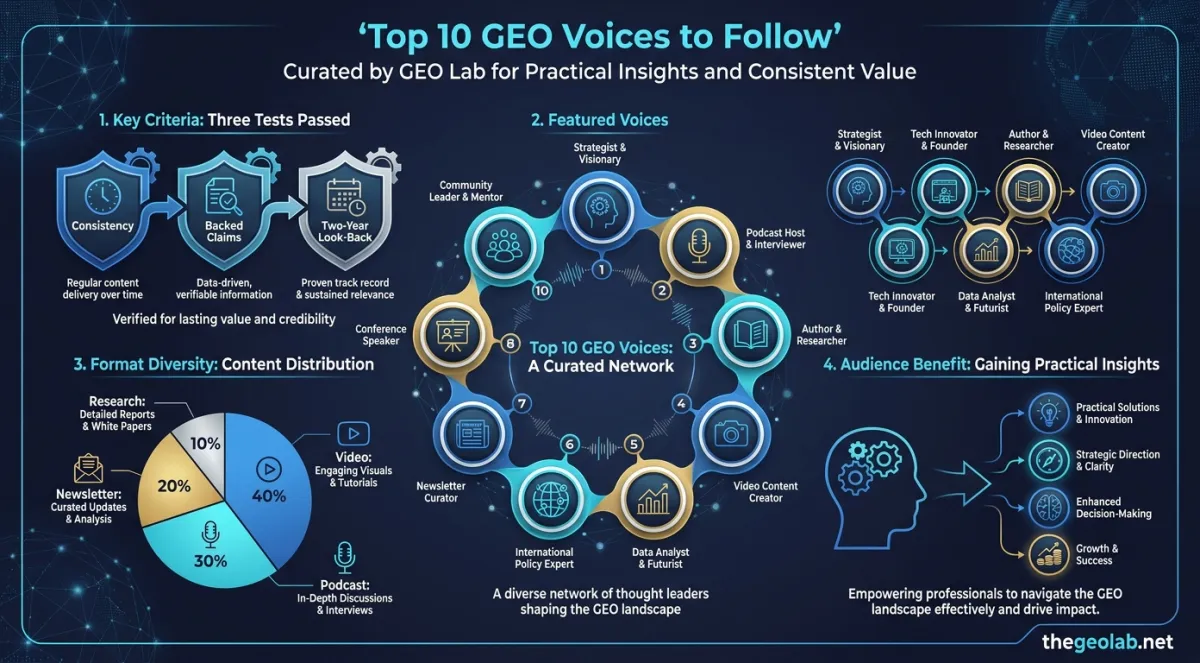
GEO voices covering AI search and Generative Engine Optimisation with depth worth your attention, across video, podcast, newsletter, and research formats
Generative engine optimisation is the practice of structuring content to earn citation in AI search systems. The GEO Brand Citation Index tracks 36 brands across three AI platforms monthly; Aggarwal et al. (2024) measured 22–40% visibility improvement from structured GEO methods on the GEO-BENCH benchmark. Ten practitioners cover this intersection with original measurement or primary-source discipline. Each passed a two-year look-back where their recommendations held up or were openly corrected, and each backs claims with data rather than assertion. Anchored by Aleyda Solis and Lily Ray, with Kevin Indig and Mike King close behind; extended with Cindy Krum, Rand Fishkin, Barry Schwartz, Marie Haynes, Glenn Gabe, and the Search Engine Journal Show.
Why a Different Kind of List
GEO voices worth following in 2026 are not the same as “AI experts to follow.” Search that phrase and you get 200 results in a few seconds. Almost none cover AI search specifically. You’ll get AI news generalists, LLM paper-readers, prompt engineers, and people who made a Twitter thread go viral six months ago. None of that is wrong. Most of it is also not what a GEO Stack practitioner actually needs.
The useful question is narrower: who is reliably covering how content behaves inside AI search engines? The practice of GEO sits at that intersection. Who is actually running studies, not reacting to product announcements? Whose claims from six months ago still hold up, and whose needed correction? That filter removes the majority of the “AI influencer” category instantly. What’s left is a smaller list, older on average, and much more practical.
The ten GEO voices below passed three tests. First, they cover AI search or the adjacent territory consistently, not as an occasional topic between hype posts. Second, they back claims with original measurement, primary source reading, or consistent real-world case observation, rather than vibes. Third, the recommendations hold up on a two-year look-back: what they said in 2024 still made sense in 2026, corrected where they were wrong.
What the list does not attempt is completeness. Plenty of excellent practitioners are not here. Plenty of emerging voices will deserve inclusion in a 2027 edition. The list is ten GEO voices I’d actually send someone to if they asked where to start.
Going deeper? The GEO Pocket Guide covers the five-layer GEO Stack, the 30-check citation protocol, and the measurement framework these ten voices reference most often.
A Territory Map Before the Individual Cards
The ten voices cluster into five coverage areas. Knowing who covers what lets you pick based on your actual gap, not on who has the biggest following.
The boundaries between areas are porous. Aleyda Solis covers algorithm signals too; Kevin Indig does audience research; Mike King shows up on news podcasts. What the map captures is each GEO voice’s primary strength, the area they’d lead with in a conference talk.
The Ten GEO Voices
Ordered by how often these names came up as primary sources while researching this post, cross-referenced against established SEO and AI search industry rankings.
Aleyda Solis
Multi-formatCrawling Mondays video series and podcast. SEOFOMO newsletter with 35,000+ subscribers. LearningSEO.io and LearningAIsearch.com curated learning resources.
The most technically rigorous independent voice covering AI search optimisation. Her “10 Steps AI Search Content Optimization Checklist” is one of the most-cited practitioner resources in the field. Aleyda bridges classical SEO engineering and AI search with a discipline that most of the “AI search” commentariat lacks.
Practitioners who want depth over hot takes. Anyone running international or ecommerce sites. Weekly industry summary through SEOFOMO.
Lily Ray
Multi-formatVP of SEO Strategy & Research at Amsive. LinkedIn analysis during Google updates. Conference keynotes posted to YouTube. Original research on AI Overviews and E-E-A-T.
When a Google update lands, the SEO community turns to Lily Ray first. Calm, evidence-based analysis that cuts through panic. Her work on E-E-A-T, site quality, and how AI search systems treat authoritative content provides the framework most practitioners actually use day-to-day.
Anyone responsible for site quality. Teams dealing with Google algorithm volatility. Practitioners trying to reason about AI citation from a quality-signals angle.
Kevin Indig
Growth Memo newsletter, 25,000+ subscribers. Original AI Mode and AI Overviews user studies. Regular guest appearances on Ahrefs, Marketing Speak, and other podcasts. Former head of SEO at Shopify, G2, and Atlassian.
Growth Memo publishes some of the most rigorous original research on AI search user behaviour in the industry. Kevin’s 250-session study on AI Mode, measuring scroll depth, click behaviour, emotional reactions, is the kind of primary-measurement work most GEO commentary lacks.
Senior marketers and growth leaders. Anyone trying to reason about AI search from data rather than anecdote. Strategic framework building.
Mike King
Research + SpeakingFounder of iPullRank. Technical SEO blog. Conference keynotes. Known for deep analysis of Google’s leaked ranking factors documentation and technical AI search experimentation.
Technical and experimental perspective on AI search. Mike pushes boundaries, his work on the Google API documentation leak was field-moving in a way few industry posts manage, and his AI search experimentation focuses on how language models intersect with search systems at the engineering level.
Technical SEOs. Engineering-minded practitioners. Anyone who wants to understand the systems-level behaviour behind what they’re optimising for.
Cindy Krum
Multi-formatCEO of MobileMoxie. Long-form blog, conference speaking, book author on mobile-first indexing. Sustained coverage of entities, fraggles, and how Google’s mobile-first architecture connects to AI search.
Cindy was writing about entity-based search and “fraggle” retrieval behaviour years before AI search made it urgent. Her long-running mobile-first indexing framework maps closely to how AI search engines now approach content chunking and entity recognition.
Practitioners working on mobile or entity-heavy content. Anyone wanting the historical context of how entity-based retrieval became AI search retrieval.
Rand Fishkin
Multi-formatCo-founder of SparkToro. Blog, podcast appearances, conference keynotes. Known originally for founding Moz; now focused on audience research and contrarian takes on the declining value of organic search traffic.
Rand’s willingness to say uncomfortable things about where organic search is heading makes him a useful counterweight to industry boosterism. The SparkToro audience research angle, what your audience actually reads, watches, listens to, is increasingly the right lens for AI citation diversity.
Senior marketers making channel-allocation decisions. Anyone questioning whether to keep investing in SEO versus diversifying to other channels.
Barry Schwartz
Daily video + NewsSearch Engine Roundtable, daily news coverage with video summaries. Search Engine Land contributor. The go-to source for day-of coverage when Google and AI search operators make announcements.
Nobody covers industry news with Barry’s cadence and reliability. Every major AI search operator change, algorithm update, or SEO community reaction gets documented same-day. Reading Barry daily is how you skip the LinkedIn commentary and get to the primary source.
Anyone needing to stay current. Agencies briefing clients on industry changes. Readers who prefer short, frequent updates over longer weekly summaries.
Marie Haynes
Marie Haynes Consulting blog and newsletter. Long-running coverage of Google algorithm updates with particular emphasis on quality signals, E-E-A-T, and how AI search engines evaluate content authoritativeness.
Marie’s analysis is forensic. Where most commentary treats Google updates as mysterious, she works through them methodically, quality rater guidelines, SERP volatility data, case-by-case site diagnostics. Her coverage of AI search quality signals is particularly rigorous.
Site owners dealing with quality-signal issues. Anyone trying to understand why a site’s AI visibility changed. Teams wanting evidence-grounded algorithm coverage.
Glenn Gabe
Research + AnalysisG-Squared Interactive founder. Long-form blog, conference speaking, X/Twitter analysis. Known for forensic SEO analysis around algorithm updates and large-scale content recovery work.
Glenn works cases the way a detective works cases. His posts documenting what actually happened on specific sites during algorithm updates are some of the best empirical content in the field. The same methodology extends naturally to AI visibility diagnosis.
Practitioners diagnosing site-specific issues. Anyone who needs concrete case examples rather than theoretical frameworks.
Search Engine Journal Show
PodcastLong-running industry podcast. Expert interview rotation covering SEO, AI search, and digital marketing. Guests include most of the voices already on this list, plus practitioners outside it.
The easiest way to broaden exposure to voices you haven’t encountered yet. The rotating guest format surfaces practitioners who don’t have their own large-audience platforms, which is where emerging GEO voices tend to appear first.
Listeners who want breadth over depth. Commuters and walkers who prefer audio. Anyone building a reading list, guests often reference their own projects and publications.
The Ten GEO Voices at a Glance
GEO voices reference table. Use the primary format column to match to how you actually consume content, newsletters are different work from podcasts are different work from daily video.
| # | Voice | Primary format | Best for |
|---|---|---|---|
| 01 | Aleyda Solis | Multi | Depth, international/ecommerce, weekly summary |
| 02 | Lily Ray | Multi | Quality signals, algorithm updates, E-E-A-T |
| 03 | Kevin Indig | Senior strategy, original AI search research | |
| 04 | Mike King | Research | Technical & engineering angle |
| 05 | Cindy Krum | Multi | Entities, mobile-first, historical context |
| 06 | Rand Fishkin | Multi | Audience research, channel-allocation decisions |
| 07 | Barry Schwartz | Daily video | Daily news cadence, primary-source coverage |
| 08 | Marie Haynes | Quality-signal diagnosis, forensic algorithm analysis | |
| 09 | Glenn Gabe | Research | Case-specific site diagnostics |
| 10 | Search Engine Journal Show | Podcast | Breadth, emerging voices, commute listening |
How to Actually Follow Ten GEO Voices Without Drowning
Following ten GEO voices is not the same as reading every post from every one. Three patterns keep the signal high and the time cost manageable.
First: one weekly anchor, one daily anchor. Pick one weekly newsletter as your main summary, SEOFOMO or Growth Memo are the strongest candidates. Add Barry Schwartz’s Search Engine Roundtable as your daily ambient check. Those two handle about 80% of industry awareness. Everyone else becomes a destination for specific questions rather than a constant subscription.
Second: match format to how you actually consume content. If you commute, the Search Engine Journal Show is your highest-return slot. If you read over coffee, pick one newsletter. If you watch on weekends, Aleyda’s Crawling Mondays and conference talks posted to YouTube work well. Trying to consume every voice in every format is the fast path to consuming none of them carefully.
Third: use the territory map to decide when to visit specific voices. Lily Ray when a Google update hits. Marie Haynes or Glenn Gabe when you’re diagnosing a specific site issue. Mike King when you want the technical deep-dive. Rand Fishkin when you’re questioning channel mix. Cindy Krum when the problem involves entities or mobile. The anchors run the base rotation; the specialists get visited on demand.
A compact rotation to start from:
| Cadence | Voice | Why |
|---|---|---|
| Daily (5 mins) | Barry Schwartz — Search Engine Roundtable | Industry news cadence, primary-source coverage |
| Weekly (30 mins) | Aleyda Solis — SEOFOMO newsletter | Curated roundup; broadest weekly coverage |
| Weekly (30 mins) | Kevin Indig — Growth Memo newsletter | Original research on AI search behaviour |
| Commute (30–60 mins) | Search Engine Journal Show | Rotating expert interviews, breadth |
| On demand | Lily Ray, Marie Haynes, Glenn Gabe, Mike King, Cindy Krum, Rand Fishkin | Visited when a specific question sends you looking |
On the risk of following too many. A common failure mode is subscribing to every newsletter on this list, queueing every podcast, saving every blog post, and then reading none of them carefully. Two or three GEO voices, attended to consistently, produce more useful thinking than ten voices consumed at the surface. The list is ten GEO voices because ten is the size of the map. It is not a subscription shopping list. Pick the two or three that match your situation. The measurement variables guide helps calibrate what each voice is actually testing.
Frequently Asked Questions
Who are the best voices to follow on AI search and GEO?
Aleyda Solis, Lily Ray, Kevin Indig, Mike King, and Cindy Krum form the practitioner anchor among GEO voices, each with established track records in SEO and consistent, data-backed coverage of the transition to AI search. Rand Fishkin and Barry Schwartz provide the industry context and daily news cadence. Marie Haynes and Glenn Gabe cover algorithm behaviour with forensic rigour. The Search Engine Journal Show aggregates expert interviews across the full field. Ten voices, multiple formats, no hype-cycle chasing.
What’s the best GEO podcast?
Crawling Mondays by Aleyda Solis is the most widely-recommended SEO-adjacent podcast that covers AI search seriously. Kevin Indig’s Growth Memo extends into podcast form through guest appearances on Ahrefs, Marketing Speak, and other shows. The Search Engine Journal Show offers the broadest practitioner rotation. No single podcast has emerged as GEO-first yet, the field is still being covered primarily by SEO podcasts expanding their scope.
Which GEO newsletter is worth subscribing to?
SEOFOMO by Aleyda Solis, weekly, 35,000+ subscribers, curates the best SEO and AI search content of the week. Growth Memo by Kevin Indig, weekly, 25,000+ subscribers, original research-backed analysis on AI search behaviour. Marie Haynes Consulting and Search Engine Roundtable also offer strong coverage, though with different cadences and focuses.
Why do you not include more YouTubers on the list?
Most popular AI YouTubers cover general AI and LLM topics rather than the specific intersection of content, search, and AI citation behaviour that GEO is about. The creators who do cover that intersection, Aleyda Solis through Crawling Mondays, Lily Ray through conference talks posted to YouTube, Barry Schwartz through daily video updates, are already on the list. Specific YouTube channels that deserve a slot over them would need to show equivalent depth on AI search specifically, and so far the field is still dominated by practitioners who distribute through multiple formats rather than YouTube-first creators.
Should I follow all ten voices?
Probably not. Two or three is usually the right number for active attention, enough to triangulate claims across voices without drowning in content. Aleyda Solis plus Kevin Indig covers most of the territory for a typical practitioner. Add Lily Ray if you care about algorithm updates and quality signals specifically. Add Mike King if you want the technical engineering angle. The other six are reserved for when a specific question sends you looking.
Key GEO Lab Takeaway
Ten voices anchor GEO coverage across five territory areas: AI search fundamentals, algorithm quality signals, industry news cadence, audience strategy, and entity context. Pick two or three that match your situation. A weekly newsletter plus a daily news check covers 80% of industry awareness. Visit the specialists on demand when a specific question arises. Depth on two voices beats surface exposure to ten.