
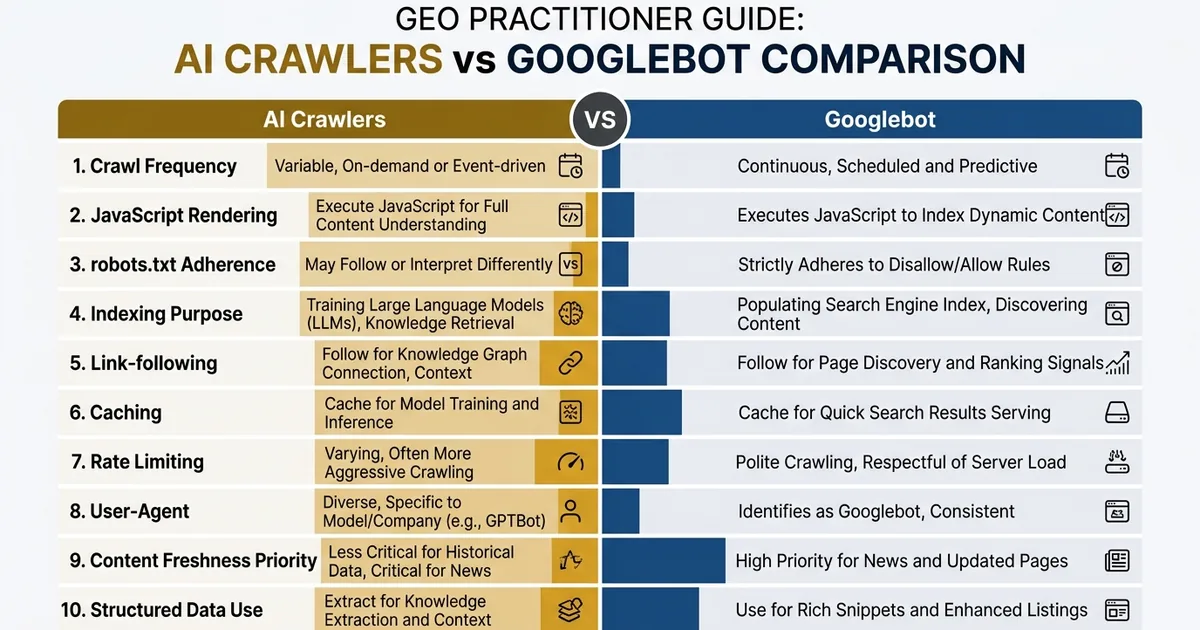
Ten structural differences between AI crawlers and the crawler everyone already knows — and the mental-model shift that has to happen before any of them make sense
TL;DR
Two decades of SEO produced a shared mental model of how a crawler works: Googlebot comes by, renders JavaScript, follows redirects, respects robots.txt, updates its index, and reports back via Search Console. AI crawlers break that model in ten specific ways: no JS execution, separate indexes, different schema interpretation, fragmented user-agent tokens, lower revisit frequency, no rendering pipeline, no centralised reporting tool, on-demand fetching as a distinct class, different redirect tolerance, and no feedback loop on content changes.
Treating AI crawlers like Googlebot-with-different-branding is how sites that rank perfectly well end up invisible in AI answers.
Treating AI crawlers as a variant of Googlebot is the single most common GEO setup error: crawl frequency, JavaScript handling, link-following logic, and robots.txt interpretation all differ — and several of the differences mean that Googlebot-optimised pages actively work against AI crawler access. The ten differences here are the mental-model update that precedes all other AI visibility work.
Why the Googlebot Mental Model Fails
I spent most of my first year thinking about AI crawlers as a variant of Googlebot. They had user-agents. They hit pages. They respected robots.txt, mostly. Close enough, I figured. Apply the same SEO mental model with a few tweaks.
The correct mental model starts with GEO Stack Layer 1 — Crawlability — which treats AI crawler access as a distinct system from search engine crawling, with different failure modes and different diagnostics.
That model is wrong in so many specific ways that using it actively produces wrong decisions. The wrongness isn’t uniform, either. Some AI crawlers are more Googlebot-like than others; some break the model in one dimension while looking like Googlebot in every other. Treating them as a single population — or as “Googlebot but for AI” — is how you end up doing work that doesn’t matter and missing the work that does.
The ten differences below are the ones that change decisions. Some of them are mechanical (JS execution, redirect handling). Some are infrastructural (separate indexes, no reporting tool). Some are conceptual (on-demand fetching as a distinct class of crawler, not a mode of Googlebot). Each one demands an update to how you think about optimisation.
This post assumes familiarity with the ten AI crawlers covered in AI Crawlers in Logs. If you want the user-agent strings and verification methods, that’s where they live. This post is about what the crawlers do once they’re identified — and specifically, how that differs from the Googlebot behaviour you already have a mental model for.
The Ten AI Crawler Differences
Googlebot pipeline
Reading these differences in practice requires access log analysis — the AI crawlers identification guide covers the user-agent strings and Nginx queries needed to distinguish each crawler’s visits from Googlebot traffic.
Phase 1: Fetch raw HTML.
Phase 2: Run headless Chrome, execute JavaScript, render full page.
Phase 3: Merge both phases into one index.
Feedback: Search Console reports back.
Typical AI crawler pipeline
Phase 1: Fetch raw HTML. Done.
No rendering pass. No JavaScript execution.
No merging. Response body is the index input.
No feedback loop. Inference only.
Ordered by how much each difference changes optimisation decisions. The first four are the ones that force a genuine mental-model shift. The last six are corrections to smaller assumptions that still matter in combination.
01
JavaScript execution
High
Comparison
Googlebot
Runs a headless rendering step that executes JavaScript before indexing. Client-side-rendered content appears in the index.
AI crawlers
Most retrieve raw HTML only. Training and retrieval crawlers do not execute JS. A minority of on-demand fetchers may render, but inconsistently.
Implication
Content hydrated by client-side scripts is invisible to the majority of AI crawler traffic. Server-side rendering is not a performance optimisation for GEO — it is a prerequisite for visibility.
02
Separate retrieval indexes
High
Comparison
Googlebot
Builds one primary index used across Google Search, News, Discover, and AI Overviews. A single crawl populates all downstream surfaces.
AI crawlers
Each operator maintains its own retrieval index. OpenAI, Perplexity, and Anthropic run independent indexes with no cross-pollination.
Implication
Being indexed by Google does not imply being indexed by any AI system. “My page ranks on Google” tells you nothing about AI visibility. Indexation has to be verified per operator.
03
Schema interpretation priorities
High
Comparison
Googlebot
Uses structured data primarily to enable rich results — FAQ snippets, How-To cards, product info. Schema enhances display, not ranking position directly.
AI crawlers
Use schema as an extraction aid. Structured data that matches the content strengthens the retrieval-to-content mapping. Misaligned schema weakens it.
Implication
Schema hygiene matters differently for GEO than for SEO. The SEO goal is “valid schema that qualifies for rich results.” The GEO goal is “schema that accurately describes the page content” — even valid schema that doesn’t match the content is a liability.
04
Fragmented user-agent tokens
High
Comparison
Googlebot
Small, stable set of user-agent tokens — Googlebot, Googlebot-Image, Googlebot-News, AdsBot. One Disallow directive per token covers the domain.
AI crawlers
Each operator splits training, retrieval, and on-demand fetchers across distinct user-agent strings. OpenAI alone has three primary tokens.
Implication
robots.txt control is more granular and more error-prone. A “block all AI” policy requires naming every documented token individually. Missing one token by oversight means that class of crawler still has access — which is sometimes intentional, sometimes not.
05
Crawl cadence and revisit frequency
Medium
Comparison
Googlebot
Adaptive crawl frequency tuned per page. Frequently-updated pages can be revisited within hours. Low-update pages visited every few weeks.
AI crawlers
Longer, less adaptive schedules. Days to weeks for most pages. Adaptive behaviour exists but is weaker and less responsive to update signals.
Implication
Content changes propagate to the AI index more slowly than to Google’s. An intervention made today may not appear in AI citations for a week or more — which also means experiments have to run long enough to capture the propagation window.
06
Rendering pipeline
Medium
Comparison
Googlebot
Two-phase crawl: initial fetch of raw HTML, then a second pass that runs headless Chrome to render the full page. Both phases contribute to the index.
AI crawlers
Single-phase fetch. No rendering pass. What’s in the response body at fetch time is what enters the index.
Implication
Late-loading content — lazy-loaded images, dynamically injected text, deferred schema — that Googlebot would catch on the second pass is lost entirely for AI crawlers. The first response has to be complete.
07
Reporting and diagnostics
Medium
Comparison
Googlebot
Google Search Console provides indexation status, crawl errors, rendered HTML inspection, and schema validation. A mature feedback loop.
AI crawlers
No equivalent tooling. No AI operator provides a Search Console analogue. Diagnosis is reconstructed from server logs and direct query probes.
Implication
Every GEO diagnostic has to be built or reconstructed. Indexation is inferred from probe queries, not confirmed by a dashboard. The reason tools like audit.py exist is that the reporting layer doesn’t exist at the operator level.
08
On-demand fetching as a distinct class
Medium
Comparison
Googlebot
One crawler class. All crawl activity is scheduled against the index. No real-time user-triggered fetching that bypasses the index.
AI crawlers
On-demand fetchers — ChatGPT-User, Perplexity-User, Claude-User — retrieve URLs in real time when a user asks about them, bypassing the retrieval index entirely.
Implication
Some AI traffic to your site is synchronous with human users asking questions, not scheduled crawling. Blocking on-demand fetchers has immediate visibility consequences — a real user is waiting for an answer right now, and blocking the fetch means they get no answer or a worse one.
09
Redirect handling
Low
Comparison
Googlebot
Follows up to five redirects per URL, consolidates signals to the canonical destination, tolerates redirect chains with graceful degradation.
AI crawlers
More conservative. Chains of three-plus redirects may be abandoned. Temporary versus permanent redirect handling is less nuanced.
Implication
Redirect hygiene matters more, not less, for AI crawlers. A chain Googlebot cheerfully follows can lose the AI crawler entirely. Clean up redirect chains as part of GEO infrastructure work.
10
No feedback loop on content changes
Low
Comparison
Googlebot
Search Console shows when the last crawl happened, whether it was successful, and surfaces rendered HTML for inspection. You can request re-indexation.
AI crawlers
No request-reindex mechanism. No cache inspection. No way to confirm whether a given content update has reached the retrieval index except by probing the AI directly.
Implication
Content update propagation is observed, not controlled. After a content change, the only signal that it has reached the AI index is seeing the updated content reflected in probe query responses — which may take days.
The Ten at a Glance
One reference table. Each row is a place the Googlebot mental model gives wrong answers for AI crawler behaviour.
Crawler behaviour differences affect citation rate indirectly — tracking what else changes between citation measurement runs is needed to isolate the effect of a crawler behaviour fix from platform noise.
| # | Difference | Googlebot | AI crawlers | Impact |
|---|---|---|---|---|
| 01 | JavaScript execution | Full headless render | Raw HTML only | High |
| 02 | Retrieval index | Single shared index | Separate per operator | High |
| 03 | Schema interpretation | For rich results display | For extraction aid | High |
| 04 | User-agent tokens | Small and stable | Fragmented per function | High |
| 05 | Revisit frequency | Adaptive, fast | Scheduled, slower | Medium |
| 06 | Rendering pipeline | Two-phase | Single-phase | Medium |
| 07 | Reporting tools | Search Console | No equivalent | Medium |
| 08 | On-demand class | Does not exist | Separate crawler class | Medium |
| 09 | Redirect tolerance | Up to 5 hops | Typically 2–3 | Low |
| 10 | Content update feedback | Dashboard confirmation | Probe-query inference only | Low |
The Mental-Model Shift
Three updates to the SEO mental model cover most of the adjustment needed.
A GEO audit surfaces most of the structural issues that cause divergent AI crawler behaviour — the ten GEO audit checks include four crawlability checks designed specifically around AI crawler behaviour, not Googlebot.
First: treat AI visibility as a separate product, not a side-effect of SEO. Separate indexes, separate crawlers, separate reporting, separate optimisation signals. A site that ranks well on Google can be entirely invisible in AI answers, and the reasons won’t show up in any standard SEO audit. AI visibility needs its own workstream, its own metrics, and its own tooling.
Second: optimise for the first response, not the rendered page. What’s in the response body at fetch time is what enters the AI retrieval index. No second rendering pass will fill in gaps. No deferred script will inject content the crawler picks up later. Every GEO-critical element — headings, answer text, schema, citations — has to be server-rendered and present at the first byte.
This is the specific mental-model shift that trips up the most sophisticated SEO practitioners. The Googlebot rendering pipeline is forgiving. The AI crawler pipeline is not. A content pattern that worked fine for Google Search for years can be entirely invisible to AI, and the diagnosis looks like nothing is wrong until you view the page source.
Third: infer everything from behaviour, not from dashboards. There is no Search Console for AI. Indexation is inferred from probe queries. Crawl health is inferred from server logs. Citation uplift after a content change is inferred from repeated measurement. Every diagnostic is a reconstruction, which means every optimisation has to be designed with observability built in from the start. A change you can’t measure is a change you can’t attribute.
The shift translates into specific practice changes across the standard SEO playbook:
| SEO habit | Still works for AI? | What GEO requires instead |
|---|---|---|
| Rely on Googlebot’s render pass to pick up client-side content | No | Server-rendered HTML with all GEO-critical content present at first byte |
| Use Search Console to confirm indexation | No equivalent | Probe queries against each AI operator to confirm indexation per operator |
| One robots.txt Disallow for Googlebot controls all Google surfaces | Partially | Enumerate each AI operator’s user-agent tokens explicitly |
| Request re-indexation after a content update | No | Wait for next scheduled crawl; verify via probe queries |
| Treat schema as “nice to have” for rich results | Partially | Schema must match content structure; misaligned schema is worse than none |
| Redirect chains tolerated up to 5 hops | Partially | Clean up chains beyond 2–3 hops to avoid AI crawler drop-off |
On the temptation to wait. Some of these differences — particularly the reporting gap — look like they will be fixed in the next year or two as the major operators mature. They might be. They also might not, because the business model for Google providing free indexation tooling is very different from the business model for OpenAI, Anthropic, or Perplexity doing the same. Planning your GEO work around tooling that doesn’t yet exist is a way of doing no GEO work for several more years. The ten differences above are what you have to work with today.
Frequently Asked Questions
Do AI crawlers index the same content as Googlebot?
No. AI crawlers maintain their own retrieval indexes that are separate from Google’s. A page crawled, rendered, and ranked by Googlebot may not appear in any AI system’s index, and vice versa. The two systems use different crawlers, different rendering pipelines, different scheduling priorities, and different content-selection heuristics. Presence in Google Search is not a proxy for presence in AI answers, and the two have to be measured and optimised separately.
Do AI crawlers render JavaScript like Googlebot does?
Most do not. Googlebot runs a full headless rendering step that executes JavaScript before indexing, which lets it see client-side-rendered content. The majority of AI crawlers — GPTBot, PerplexityBot, ClaudeBot — retrieve raw HTML and parse it without JavaScript execution. Any GEO-critical content rendered by client-side scripts is invisible to them. This is one of the single most consequential differences between the two crawler populations.
How often do AI crawlers revisit a page compared to Googlebot?
AI crawlers revisit less often than Googlebot. Googlebot tunes revisit frequency per page based on update signals, with high-update pages sometimes re-crawled within hours. AI crawlers generally operate on longer, less adaptive schedules — days to weeks for most pages, with on-demand fetchers handling real-time retrieval through a separate path. The practical consequence is that content changes take longer to propagate to the AI index than to Google’s index.
Do AI crawlers respect robots.txt the same way Googlebot does?
AI crawlers from the major operators honour robots.txt as documented policy. The difference is in the user-agent tokens. Googlebot has a small, stable set of tokens; AI operators have larger and more fragmented token sets, often splitting training crawlers, retrieval crawlers, and on-demand fetchers across separate user-agent strings. A single Disallow directive targeting Googlebot does not map cleanly to AI crawler control — each AI operator’s tokens have to be addressed individually.
Why does a page that ranks on Google get no AI citations?
Ranking on Google reflects a combination of retrieval, relevance, and quality signals tuned over two decades. AI citation reflects an entirely separate pipeline with different signals — extractability, schema-content alignment, declarative structure, entity density. A page optimised for Google’s ranking model can have all the properties that make it rank well and still fail AI extraction, because the two systems reward different structural patterns. The two indexes need separate optimisation, not a shared one.