
Perplexity, ChatGPT, and Google AI Overviews retrieve content differently. Here is what the data shows — and what we will not claim without controlled experimental evidence to back it.
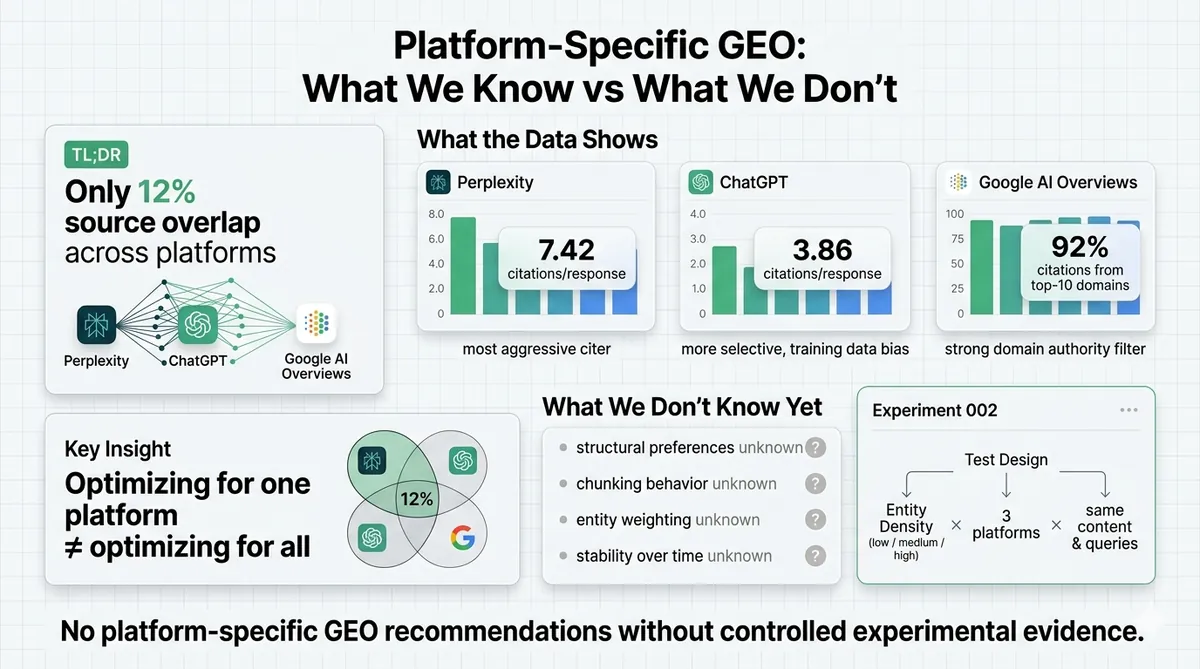
Different AI platforms cite the same content at different rates. The 30-check protocol consistently shows this divergence — only 12% of cited sources overlap across platforms (xFunnel, 2025). Three reliable patterns are documented below. We do not yet have controlled experimental data to recommend platform-specific optimisations. We will not publish recommendations without that data. Experiment 002 will test entity density variations across Perplexity, ChatGPT Search, and Gemini with controlled variables.
What the Data Shows
The first time I ran the same 30 queries across Perplexity, ChatGPT, and Google AI Overviews simultaneously, I expected similar results with minor variation. The citation rates were not similar. The same pages that Perplexity cited consistently, ChatGPT barely touched. And the pages Google AI Overviews cited were almost entirely from the top-10 organic results — a pattern neither of the others showed as strongly.
Three reliable patterns have emerged from running the 30-check protocol across multiple query sets since January 2026:
Source: xFunnel’s 2025 AI citation analysis and GetPassionfruit’s 2025 SERP analysis.
Perplexity cites more aggressively. It retrieves more sources per response and is more willing to cite niche or smaller-domain sources. If you are starting to build citation rate from a lower domain authority baseline, Perplexity is the platform where early GEO work shows results first.
Google AI Overviews have a stronger domain authority filter. 92.36% of citations come from domains already ranking in the top 10 for the query. This is not a GEO-specific finding — it reflects Google’s existing ranking infrastructure influencing its AI layer. The practical implication: for Google AI Overviews specifically, traditional SEO foundations are a harder prerequisite than on other platforms.
ChatGPT cites fewer sources overall. With 3.86 citations per response on average, ChatGPT is more selective. Its citation pattern also shows a stronger bias toward content in its training data versus live web content — I measured this divergence directly using the delta measurement methodology in the Citation Index.
The practical implication of 12% overlap: if you are only testing citation rate on one platform, you are measuring at best 12% of your total AI citation opportunity. The 30-check protocol tests across all three for exactly this reason.
What We Don’t Know Yet
The observed differences raise questions I cannot answer with current data — and I would rather say that clearly than fill the gap with extrapolation.
- Do the platforms have different structural preferences? Does Perplexity favour tables while ChatGPT favours prose? Does Google AI Overviews reward H2 alignment more than Perplexity? Unknown.
- Does chunking behaviour differ? Do they segment content at H2 boundaries or at paragraph boundaries? The chunk size affects which GEO Stack interventions have the most impact — but we have no controlled data on this per platform.
- Does entity naming have different weights per platform? Does one platform reward explicit entity naming more aggressively than another? Unknown.
- Are the differences stable over time? Model updates change retrieval behaviour. The patterns documented here reflect testing in March 2026. Whether they hold in September 2026 requires ongoing measurement.
Research position: anyone claiming platform-specific GEO optimisation advice without controlled experimental data is extrapolating. We have observed the differences. We have not isolated the variables. Those are not the same thing, and treating observations as recommendations produces bad advice.
What Experiment 002 Will Test
Experiment 002 is designed to isolate platform-specific retrieval behaviour under controlled conditions — the same methodology used in Experiment 001, extended across platforms.
Experiment 002 — Design
- Variable: Entity density — low, medium, and high explicit entity naming on identical content
- Platforms: Perplexity, ChatGPT Search, Gemini
- Controls: Same content, same queries, same test window, same domain
- Measurement: Citation rate per platform, citation position, source attribution format
- Query set: 10 queries × 3 versions × 3 platforms = 90 data points minimum
- Status: Design complete. Awaiting implementation.
If Experiment 002 finds meaningful platform-specific differences, those findings will be published in the GEO Log with the full methodology documented. If it finds no meaningful differences — that the GEO Stack applies uniformly across platforms — that finding is equally valuable and will be published with the same rigour.
If you want to be notified when Experiment 002 results are published, contact The GEO Lab.
Frequently Asked Questions
Do different AI platforms cite content differently?
Yes. The 30-check protocol consistently shows different citation rates for the same content across Perplexity, ChatGPT, and Google AI Overviews. Research from xFunnel (2025) found only 12% of sources cited across these platforms match each other. The platforms are not retrieval-equivalent.
Should I optimise differently for each AI platform?
Not yet. There is insufficient controlled experimental data to recommend platform-specific optimisations. The GEO Stack framework applies across all platforms. Anyone claiming platform-specific GEO advice without controlled experimental data is extrapolating beyond what the evidence supports.
What will Experiment 002 test?
Experiment 002 will test entity density variations on identical content across Perplexity, ChatGPT Search, and Gemini with controlled variables. The goal is to determine whether specific structural patterns perform differently across platforms. Full methodology and results will be published in the GEO Log.
Which AI platform is easiest to get cited on?
Perplexity cites the most sources per response (7.42 average) and is more willing to cite lower-authority domains. For sites building citation rate from a lower domain authority baseline, Perplexity is where early GEO work tends to show results first. Google AI Overviews are the hardest — 92.36% of their citations come from top-10 ranking domains.
Does the GEO Stack apply differently across platforms?
The structural principles of the GEO Stack — declarative structure, entity naming consistency, section-level topical isolation — apply across all three platforms based on current evidence. The degree to which each layer matters may differ by platform. Experiment 002 is designed to test this directly.
AI platforms cite the same content at different rates — and only 12% of cited sources overlap across Perplexity, ChatGPT, and Google AI Overviews. The platforms are not retrieval-equivalent.
Three patterns are documented: Perplexity cites most aggressively, Google AI Overviews have the strongest domain authority filter, ChatGPT is most selective. These patterns are observed facts, not optimisation recommendations.
We will not publish platform-specific optimisation advice without controlled experimental data. Experiment 002 will provide that data. Until then, the GEO Stack applies uniformly across platforms.
Track your citation rate across all three platforms. The GEO Brand Citation Index and the AI Visibility Diagnostics Console run the 30-check protocol across Perplexity, ChatGPT, and Google AI Overviews simultaneously — so you can see the platform divergence in your own data.
Questions about this research? Contact The GEO Lab.