
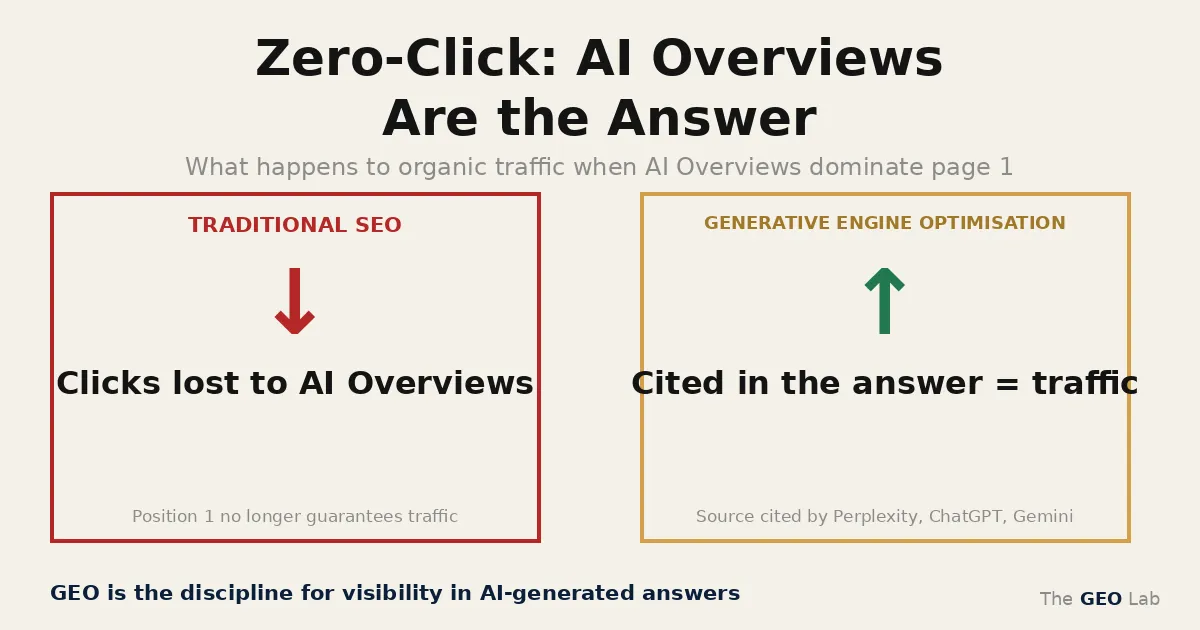
AI Overviews reduce organic CTR by 58% for top-ranking pages that are not cited. Pages cited in AI answers gain 35% more clicks. GEO optimises for citation, not position.
TL;DR
AI search engines use Retrieval Augmented Generation to synthesise answers from retrieved content sections. Pages cited in those answers receive 35% more organic clicks (Zyppy, 2024). Pages that rank but are not cited lose 58% of CTR from top positions. SEO optimises for ranking position. GEO optimises for retrieval and citation, the mechanisms that determine whether your content participates in AI-generated answers. The GEO Lab is the testing ground where those mechanisms are measured.
Why This Site Exists
I run several content sites, sports, fashion, tech. Different niches, different audiences, different content strategies. What they had in common by late 2025: they were ranking reasonably well in traditional search, and AI was never citing any of them.
Not occasionally. Not rarely. Never.
I’d run queries that my content was well-positioned to answer. The AI Overview would appear, synthesise an answer, cite three or four sources. None of them mine. The pages ranking below mine on the same query, sometimes cited. My pages, invisible to the retrieval process that now sits above the organic results.
The pattern was gradual enough that I didn’t notice it as a single event. It accumulated. And once I noticed it, I couldn’t stop noticing it.
When I want to understand something properly, I journal and test. I don’t do this on existing sites, legacy architecture and pre-existing signals make it hard to know what’s causing what. So I built a dedicated testing ground. A site where every structural decision is intentional, every experiment is documented, and every failure goes into a registry. The GEO Lab is that site.
What Actually Changed
Search hasn’t just added a new feature. The fundamental mechanism has changed.
For twenty years, SEO optimised for position, where a page appeared in a ranked list of links. A user saw the list, chose a result, clicked through. The page was the destination.
AI search systems don’t produce ranked lists of links as the primary output. They retrieve content sections from across the web, extract the relevant parts, compress them into a synthesised answer, and present that answer directly. The page is now a source, not a destination. Whether it gets cited depends on whether it was retrieved in the first place, and retrieval operates on different signals than ranking.
Traditional SEO optimises for position. GEO optimises for participation in the answer.
These are not the same optimisation target. A page can rank first and still not be retrieved. A page can rank tenth and be cited in every AI Overview for its topic.
Going deeper? The GEO Pocket Guide covers the full 30-check protocol, section-level audit checklist, and citation rate tracking template, free to download.
The Numbers
The direction is clear. AI search is not a niche behaviour, it’s the fastest-growing traffic source in the data. And the distribution within it is binary: you’re cited or you’re not. There’s no position 4 equivalent that still drives some traffic. Not being retrieved means not existing in that answer.
SEO vs GEO: A Different Unit of Optimisation
The comparison isn’t about which discipline is more important. It’s about recognising that they’re optimising for different things, using different signals, measured by different outcomes.
| SEO | GEO | |
|---|---|---|
| Optimisation unit | Entire pages | Individual sections |
| Primary goal | Rankings and CTR | Inclusion in AI answers |
| Key signals | Backlinks, domain authority | Extractability, entity clarity |
| Success metric | Position and traffic | Retrieval and citation rate |
| Orientation | Document-centric | Retrieval-centric |
The distinction that matters most: SEO ranks pages. AI systems retrieve sections. A page that ranks well but has no clearly extractable sections, no declarative openings, no consistent heading hierarchy, no component-level semantic structure, doesn’t give the retrieval system anything to work with. It ranks. It doesn’t participate.
The Four Core GEO Variables
What determines whether a section gets retrieved? The GEO Stack framework identifies four variables, each operating independently of traditional ranking signals:
The four variables, crawlability, extractability, entity reinforcement, and structural authority, are the first four layers of the GEO Stack, each measurable independently and each failing for different reasons that a single composite score cannot distinguish.
-
Retrieval Probability Will the content section be selected during the retrieval phase? Determined by semantic match to the query, heading clarity, and opening sentence structure. The section-level equivalent of a page’s ranking relevance.
-
Extractability Can the content be cleanly parsed and reused? Structured HTML, declarative sentences, and consistent component patterns make extraction reliable. Content that requires interpretation to understand is content that doesn’t get extracted.
-
Entity Clarity Are concepts unambiguously identified? Entity schema, consistent naming conventions, and explicit definitions reduce ambiguity in how AI systems understand and attribute the content.
-
Compression Resistance Does meaning survive synthesis? AI systems compress source content before presenting it. Content that loses its core claim when shortened, dense jargon, buried conclusions, complex nested arguments, compresses poorly and gets misrepresented or dropped.
These four variables are what The GEO Lab is testing. Every post in the series is either documenting a failure that reduced one of these variables, or an experiment that measures their effect on citation rate.
What The GEO Lab Is

A testing ground and a journal. Not a finished guide to GEO, those don’t exist yet, because GEO is still being figured out. What exists is documented experiments, failure registries, audit systems, and the specific technical decisions made on a real site with measurable outcomes.
The site is the experiment. Every structural decision, the v3 HTML architecture, the embedded CSS components, the schema implementation, the AI Visibility Diagnostics Console, exists because something needed to be tested, not because a best practice said so.
49% of respondents in a 2025 OrbitMedia/QuestionPro study believe AI chatbots will eventually replace traditional search. Whether that number is right or wrong, the traffic data from AI platforms is already moving in one direction. The time to understand retrieval optimisation is before your existing traffic strategy stops working, not after.
One thing this journal will be honest about from the start: GEO operates on top of SEO, not instead of it. AI search systems use RAG (Retrieval Augmented Generation), they retrieve content from search indexes before generating answers. A page that isn’t indexed and organically visible cannot be retrieved, regardless of how well its sections are structured. The experiments documented here measure section-level optimisation effects, but they assume a crawled, indexed page as their starting condition. That condition is SEO’s job.
Frequently Asked Questions
What is the zero-click AI Overview problem for content creators?
AI Overviews synthesise answers from source content and display them directly in search results, reducing the need for users to click through to the original page. For top-ranking pages, this reduces organic CTR by 58% on average. However, pages cited within AI Overviews receive 35% more organic clicks than non-cited pages. The problem is not AI search, the problem is not being cited in it.
What is the difference between SEO and GEO?
SEO optimises entire pages for rankings and click-through rate, using backlinks and domain authority as primary signals. GEO optimises individual content sections for inclusion in AI answers, using extractability and entity clarity as primary signals. The critical relationship: GEO does not replace SEO, it extends it. AI search systems retrieve content from search indexes (Google’s index in particular appears to serve as the retrieval layer for most major AI products). A page that isn’t indexed and ranking cannot be retrieved by AI systems, regardless of its section structure. SEO creates the floor. GEO determines what happens above it.
Why build a dedicated GEO testing site instead of changing existing content?
Existing sites carry legacy decisions, architecture, content structure, internal linking, that make controlled testing difficult. A dedicated testing ground starts clean: every structural decision is intentional, every experiment is documented, and results aren’t confounded by pre-existing signals. The GEO Lab exists as a journal of what was tested, what worked, and what failed.
What are the four core GEO variables?
Retrieval Probability, whether content will be selected during the retrieval phase. Extractability, whether it can be cleanly parsed and reused. Entity Clarity, whether concepts are unambiguously identified. Compression Resistance, whether meaning survives the synthesis process. These four variables determine whether content participates in AI answers, independent of its traditional search ranking.
Key GEO Lab Takeaway
SEO and GEO solve different problems at different layers. SEO earns retrieval by building the crawl, authority, and indexation signals that get your page into the candidate set. GEO earns citation by structuring content so the retrieval system can extract, attribute, and compress it into an AI-generated answer. One without the other fails: a perfectly extractable page that is never retrieved cannot be cited; a highly authoritative page with no extractable structure is retrieved but never selected for the answer. The four GEO variables (retrieval probability, extractability, entity clarity, compression resistance) are the diagnostic framework for identifying which layer is failing.