
GEO Stack Layers
Overview · Retrieval Probability · Extractability · Entity Reinforcement · Structural Authority · System Memory
Why a well-optimised page in a poorly structured site underperforms a mediocre page in a coherent cluster
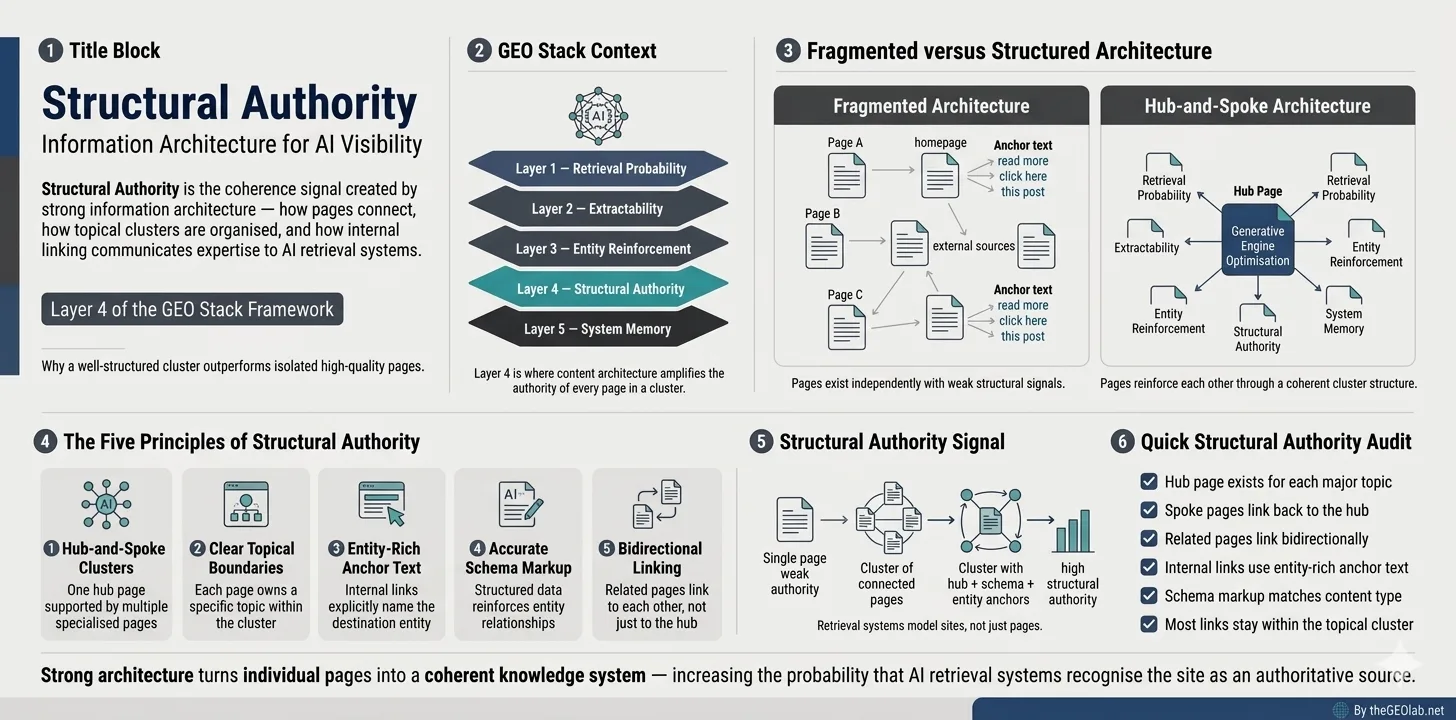
Structural Authority is the coherence signal that emerges from well-designed information architecture — how pages relate to each other, how topical clusters are organised, and whether the internal linking graph communicates a clear, deep knowledge structure to crawling systems. It is Layer 4 of the five-layer GEO Stack framework, sitting above Entity Reinforcement and below System Memory.
Structural Authority is not the same as domain authority, which measures external link equity. It is an internal signal — a function of how a site organises and connects its own content. A site with strong Structural Authority sends a coherent topical signal to retrieval systems that amplifies the citation probability of every section it contains. A site that publishes strong individual pages without that structural coherence gets less from each page than the pages deserve.
The five principles of Structural Authority: hub-and-spoke cluster architecture, clear topical boundaries, entity-rich anchor text, accurate schema implementation, and bidirectional linking.
High vs Low Structural Authority: Side by Side
The difference between fragmented and structured architecture is most visible when you map the internal linking graph. This comparison shows two sites covering the same topic area — one with fragmented architecture, one with a coherent hub-and-spoke structure.
Five posts on GEO topics. Each links outward to external sources. Two link to the homepage. One links to a post on a different topic. Internal link anchor text: “read more”, “this article”, “here”. No hub page. No topic cluster. Each page exists independently.
One hub page on GEO. Five supporting pages, each covering a GEO Stack layer. Each supporting page links back to the hub using entity-rich anchor text (“GEO Stack five-layer framework”). The hub links to all five supporting pages. Adjacent supporting pages link to each other where topics intersect. Anchor text names the entity on every internal link.
The well-structured site does not have better content. It has the same content, organised so that retrieval systems can model the topical depth and associate the entire cluster — hub and spokes — with the core entity. Every page in the cluster benefits from the structural signal of every other page in it.
The Five Principles of Structural Authority
These five principles address the specific architectural decisions that build or fragment the structural signal. They operate at the site level — a single page cannot implement Structural Authority in isolation.
Hub-and-Spoke Cluster Architecture
Every important topic should have one hub page — a comprehensive, authoritative treatment of the core concept — surrounded by supporting spoke pages that cover specific aspects in depth. The hub links to all spokes. Every spoke links back to the hub. This creates a clear topical hierarchy that retrieval systems can model: the hub is the authoritative node, the spokes are supporting evidence of depth.
The hub page should not try to cover everything. Its job is to establish the core entity, define the key concepts, and link outward to the spoke pages that provide depth. The spoke pages’ job is to go deep on a single sub-topic and link back to the hub for context. Together, they communicate depth through structure rather than length.
Clear Topical Boundaries
Each page in a cluster should own a specific, well-defined topic and stay within it. Pages that stray across multiple unrelated topic areas weaken the structural signal in two ways: they dilute the entity association of the page itself, and they create incoherent linking patterns when they link out to unrelated pages using generic anchor text.
Topical boundary clarity also means keeping cluster pages within the cluster. A spoke page on Retrieval Probability should link to other GEO Stack pages, not to a post about email marketing or quarterly planning. Every out-of-cluster link is a structural signal that dilutes the cluster’s coherence.
Entity-Rich Anchor Text on All Internal Links
Every internal link carries an anchor text signal that tells the retrieval system what the destination page is about. Generic anchor text — “read more”, “click here”, “this post” — wastes that signal entirely. Entity-rich anchor text — “Generative Engine Optimisation five-layer framework”, “Extractability at Layer 2 of the GEO Stack”, “citation rate improvement from declarative structure” — reinforces both the Structural Authority signal (Layer 4) and the Entity Reinforcement signal (Layer 3) simultaneously.
The rule is simple: every internal link should use the entity name of the destination page as the anchor text, with enough additional context to disambiguate the link from other links to the same entity. This rule applied consistently across hundreds of posts produces a site-level entity signal that individual page optimisation cannot replicate.
Accurate Schema Implementation
Structured data — Schema.org markup applied to page content — provides an explicit entity signal that operates at the metadata level, supplementing the implicit signals built through content structure and internal linking. Schema markup that accurately reflects the content type, named entities, and relationships on a page gives retrieval systems a cleaner model to work from.
The critical word is “accurately”. Schema markup that misrepresents the content — applying Article schema to a product page, or FAQPage schema to content that is not genuinely a Q&A — produces a conflict between the explicit metadata signal and the implicit content signal. That conflict fragments rather than reinforces Structural Authority. Schema should describe the actual content, not the content you wish you had written.
Bidirectional Linking Between Related Pages
A link from A to B is a one-way structural signal. A link from A to B and a link from B to A is a bidirectional signal — a stronger structural association that tells retrieval systems these two pages are genuinely related, not just that one page considers the other relevant.
Bidirectional linking is particularly important for adjacent spoke pages within the same cluster. The Extractability page and the Entity Reinforcement page — both spokes of the GEO Stack hub — should link to each other where their topics intersect, because they do genuinely intersect. Explicit entity naming is an Extractability principle and an Entity Reinforcement principle. A link in each direction makes that relationship structurally visible.
Experience Signal Checker
Paste any content section and see how well it demonstrates real-world experience — quantified claims, documented mistakes, case studies, and credentials.
You’ll see experience signal scores, highlighted claims, and missing signal indicators.
Summary
Structural Authority is the layer that determines whether strong section-level work at Layers 1, 2, and 3 accumulates into site-level citation authority — or whether each well-optimised page operates in isolation without amplifying the others. It is built through five practices that must operate at the site level:
- Hub-and-spoke cluster architecture — one hub page per core topic, surrounded by supporting pages that each link back to the hub
- Clear topical boundaries — cluster pages link predominantly to other cluster pages, not to unrelated content
- Entity-rich anchor text — every internal link uses the canonical entity name of the destination as anchor text
- Accurate schema implementation — structured data matches content type and entity naming; no conflicts between markup and prose
- Bidirectional linking between related pages — related spoke pages link to each other, not just to the hub
The key distinction from traditional SEO’s domain authority is that Structural Authority is internal and architectural. It does not require external links or brand mentions. It requires that a site’s own content organisation communicates topical depth coherently — that retrieval systems can model the structure and infer expertise from it.
Structural Authority sits at Layer 4 of the GEO Stack, developed by Artur Ferreira at The GEO Lab. It operates above Entity Reinforcement and below System Memory — and like all GEO Stack layers, it depends on the layers below it being functional. Strong architecture built on poorly retrieved, poorly extracted, or inconsistently named content does not produce the compounding authority it would produce on well-functioning lower layers. The full implementation framework is in the GEO Field Manual.
Frequently Asked Questions
What is Structural Authority in GEO?
Structural Authority is the coherence signal that emerges from well-designed information architecture — how pages relate to each other, how topical clusters are organised, and whether the internal linking graph communicates a clear, deep knowledge structure to retrieval systems. It is Layer 4 of the GEO Stack. Structural Authority amplifies the citation probability of every page in a well-structured cluster, including pages that might not individually clear the retrieval threshold. A page in a strong cluster outperforms an equivalent standalone page — because retrieval systems model sites, not just pages.
How is Structural Authority different from domain authority?
Domain authority measures external link equity — how many other sites link to a domain, and with what authority. Structural Authority measures internal coherence — how well a site’s own content architecture communicates topical depth and expertise. A site with low domain authority but strong Structural Authority — coherent hub-and-spoke clusters, entity-rich internal linking, accurate schema — will outperform a high-authority site with fragmented architecture in generative citation tests. The two signals are complementary and both matter, but they address different dimensions of visibility.
What is hub-and-spoke content architecture?
Hub-and-spoke content architecture organises content around central hub pages — comprehensive treatments of core topics — surrounded by spoke pages that cover specific aspects in depth. The hub links to all spokes. Every spoke links back to the hub. Related spokes link to each other bidirectionally where their topics intersect. This structure creates a clear topical hierarchy that retrieval systems can model as evidence of expertise depth. Every page in a well-constructed hub-and-spoke cluster accumulates structural authority from the cluster, not just from its own content quality.
Why does internal link anchor text matter for Structural Authority?
Internal link anchor text carries two signals simultaneously: a structural signal (how this page relates to the destination page) and an entity signal (what the destination page is about). Generic anchor text — “read more”, “click here”, “here” — wastes both signals entirely. Entity-rich anchor text — using the canonical entity name of the destination page — reinforces both Structural Authority (Layer 4) and Entity Reinforcement (Layer 3) with the same link. Applied consistently across hundreds of internal links, entity-rich anchor text is one of the highest-leverage site-level improvements available in GEO.
Does schema markup actually affect AI citation?
Accurate schema markup improves AI citation by providing explicit entity signals at the metadata level that supplement the implicit signals built through content structure and internal linking. A Google/Nestlé study found rich results achieve a 58% click-through rate versus 41% for non-rich results. Rakuten/Google data found pages with comprehensive structured data receive 2.7 times more organic traffic. The qualifier “accurate” matters — schema that misrepresents the content type or uses entity names inconsistent with the prose creates a conflict between metadata and content signals that fragments rather than reinforces Structural Authority.
How does Structural Authority relate to the other GEO Stack layers?
Structural Authority (Layer 4) depends on Layers 1 through 3 being functional — strong architecture built on poorly retrieved, poorly extracted, or inconsistently named content does not produce compounding authority. It feeds directly into Layer 5 (System Memory) by providing the stable topical structure within which accumulated authority builds over time. A key interaction: Entity Reinforcement (Layer 3) and Structural Authority (Layer 4) are partially built through the same acts — entity-rich internal link anchor text strengthens both layers simultaneously, which is why fixing them together produces larger citation improvements than fixing either in isolation.