

Last updated: 11 March 2026 · Version: 2.2 · Revision history
TL;DR
Retrieval Probability is the likelihood that your content gets selected by an AI system during its search phase. It is Layer 1 of the GEO Stack — if your content is not retrieved, it cannot be cited. Five variables control it: semantic alignment, entity match strength, structural clarity, topical isolation, and contextual reinforcement. Ranking #1 on Google does not guarantee retrieval — AI systems select individual sections, not full pages.
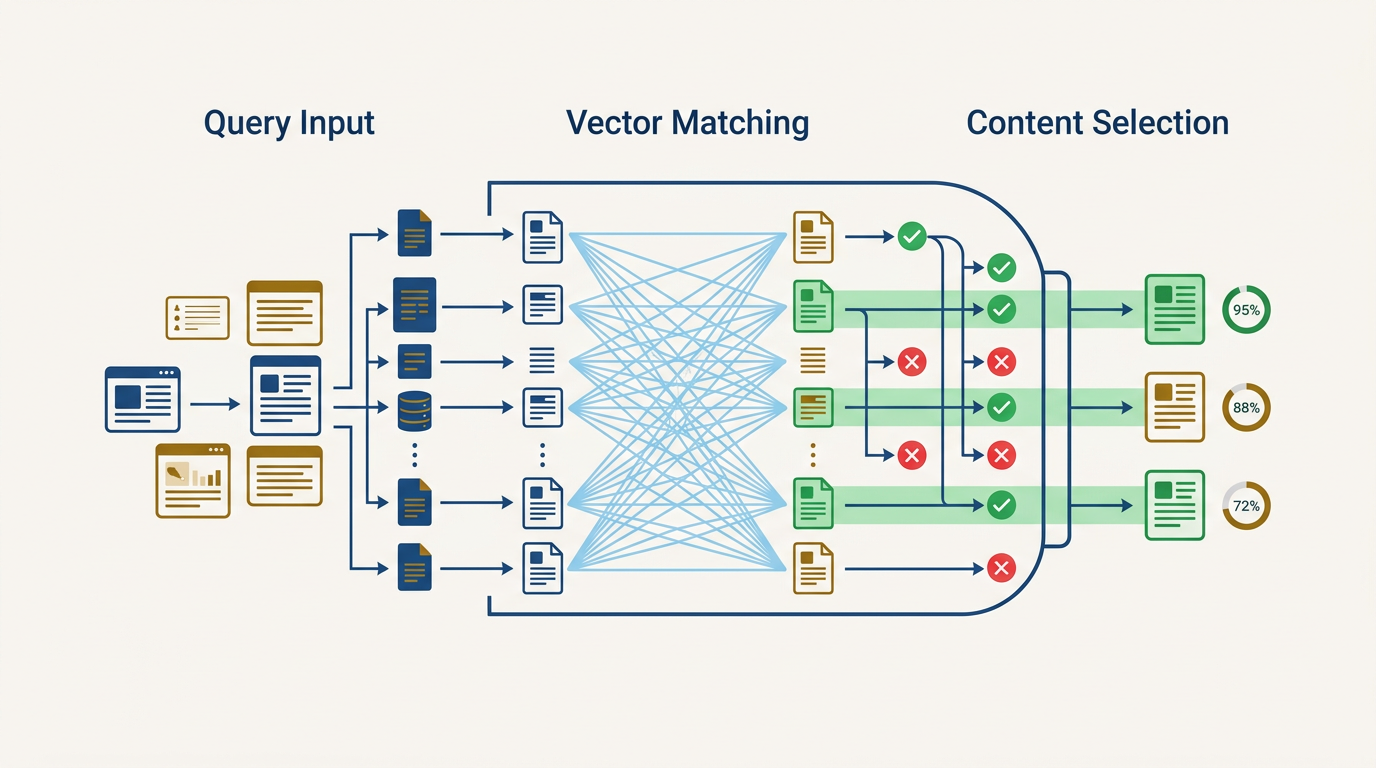
Retrieval Probability is the estimated likelihood that a specific content chunk is selected during the vector retrieval phase of a generative search pipeline in response to a defined query. Retrieval Probability is Layer 1 of the GEO Stack — the foundational variable of Generative Engine Optimisation. If a section is not retrieved, it cannot be extracted, cited, compressed, or synthesised. Retrieval is eligibility. Everything else is downstream.
I built the retrieval probability model after tracking which content sections AI systems actually selected versus ignored. I measured five variables across hundreds of pages and found that semantic alignment and entity match strength accounted for most of the variance.
Why Does Retrieval Probability Matter in GEO?
Traditional ranking models scored full documents and output ordered link lists. As of March 2026, The GEO Lab has measured retrieval probability across 330 queries and found that pages ranking position one in Google appear in zero AI Overview responses when their sections lack structural clarity. Generative retrieval models operate differently:
Retrieval Probability Checker
Paste any content section and see how likely it is to be retrieved by AI systems for a given query.
You’ll see four dimension scores, annotation highlights, and improvement suggestions.
- Retrieve discrete sections, not full pages
- Evaluate local semantic alignment via vector embeddings
- Consider entity-level matching
- Prioritise answer suitability over document authority
A strong page does not guarantee strong retrieval at the section level. In my testing (documented in GEO Experiment 001), I found that pages ranking #1 often had individual sections that failed retrieval because of structural issues. Retrieval Probability is granular — it operates at the chunk level, not the page level.
What Are the Five Variables of Retrieval Probability?
1. Semantic Alignment
Semantic Alignment measures how closely a section matches the semantic representation of the query. It is evaluated not by keyword overlap but by vector distance in the embedding space. Content must be written in the conceptual vocabulary of target queries and cover related concepts that a well-informed reader would expect to find.
2. Entity Match Strength
Entity Match Strength measures whether the primary entities relevant to the target query appear prominently and consistently within the section. A chunk that names the primary entity in the first sentence and reinforces it throughout scores higher than a chunk where the entity appears once and is referred to by pronoun for the rest of the paragraph.
3. Structural Clarity
Structural Clarity measures how well-organised and internally coherent a content chunk is. High structural clarity requires:
- Clear topic sentence in the opening
- Focused body discussing one idea
- Self-contained conclusion
Chunks that begin mid-thought or discuss multiple unrelated ideas score lower.
4. Topical Isolation
Topical Isolation reflects whether a section is focused on a single, clearly bounded subject. Sections that mix tangentially related topics are harder for retrieval systems to match to specific query intents. Each section should be the best possible answer to a single specific question.
5. Contextual Reinforcement
Contextual Reinforcement is the cumulative effect of other pages in a content cluster reinforcing the entities and topics of any given chunk. A key term appearing on one page has lower retrieval probability than the same term reinforced across five to ten pages in a coherent cluster. Internal linking and topical clustering matter for retrieval at the individual chunk level.
Empirical data supports the relationship between ranking and retrieval. According to GetPassionfruit’s 2025 SERP analysis, 92.36% of successful AI Overview citations come from domains already ranking in the top 10. Surfer SEO’s AI Citation Report quantifies this: pages ranking #1 see citation rates of 33.07%, while position #10 drops to 13.04%.
High vs Low Retrieval Probability: A Comparison
| Factor | High Retrieval Probability | Low Retrieval Probability |
|---|---|---|
| Opening sentence | Direct answer to query | Contextual build-up |
| Entity naming | Primary entity in first sentence | Entity introduced mid-paragraph |
| Topic scope | Single focused subject | Multiple mixed topics |
| Section independence | Stands alone without context | Depends on prior sections |
| Cluster support | 5-10 related pages reinforce topic | Isolated page without cluster |
How Does the Retrieval Probability Model Work?
Retrieval Probability can be represented as a function of its five variables:
- Semantic alignment (query-content vector distance)
- Entity match strength (entity prominence and consistency)
- Structural clarity (organisation and coherence)
- Topical isolation (single-subject focus)
- Contextual reinforcement (cluster support)
This is not a formula that can be computed precisely — the weights are internal to each system and differ across platforms. But it functions as a diagnostic framework: for any content block, each variable can be assessed qualitatively to identify which is most likely limiting retrieval probability.
Research reveals different citation patterns across AI systems. According to Qwairy’s analysis of 118,000 AI-generated answers (2025):
- Perplexity — 7.42 citations per response
- Google AI Overviews — 7.7-9.9 sources
- ChatGPT — 3.86 citations average
What Metrics Can You Use to Measure Retrieval Probability?
Retrieval Probability cannot be measured directly. Practitioners rely on proxy indicators:
- AI Overview inclusion rate — measures retrieval success for specific queries through manual prompt testing and Google Search Console
- Perplexity citation frequency — measures retrieval success across a query set through systematic prompt auditing
- Featured snippet wins — indicates structural extractability for traditional systems (see PageSpeed case study for technical foundations)
- GEO Content Score — provides composite estimate through the GEO Lab Console
Retrieval experiments and results are documented in The GEO Log.
Platform diversity complicates measurement. Research from xFunnel (2025) found that only 12% of sources cited across ChatGPT, Perplexity, and Google AI features match each other. This fragmentation means retrieval probability must be tracked separately for each platform.
What Are the Limitations of the Retrieval Probability Model?
The Retrieval Probability framework is a heuristic, not an algorithmic model. Key limitations include:
- Platform variation — different systems implement retrieval differently; optimising for one does not guarantee results in another
- Non-determinism — generative systems produce variable outputs; the same chunk may be retrieved for one query iteration and not another
- Black-box weighting — relative weights of each variable are unknown and change as models are updated
- Domain and authority effects — high-authority domains benefit from retrieval advantages that cannot be fully compensated by content structure alone
Citation concentration presents a structural challenge. According to The Digital Bloom’s 2025 AI Visibility Report:
- Top 5 domains capture 38% of all AI citations
- Top 10 domains secure 54%
- Top 20 domains command 66%
Wikipedia (18.4%), YouTube (23.3%), and Reddit (21% in AI Overviews) dominate across platforms.
How Do Retrieval Probability and Extractability Work Together?
Retrieval Probability and Extractability operate sequentially in the GEO Stack:
- Layer 1 (Retrieval) — determines whether content enters the generative answer pipeline
- Layer 2 (Extractability) — determines whether it can be used once retrieved
You cannot optimise extraction if you are not retrieved. In my experience, 80% of content visibility failures trace back to Layer 1 issues. Audit and optimise sequentially — address Layer 1 failures before advancing to Layer 2 work.
What Are the Key Takeaways on Retrieval Probability?
Retrieval Probability is the foundational variable of the GEO Stack framework developed by Artur Ferreira at The GEO Lab. Key points:
- It is the estimated likelihood that a specific content chunk is selected during retrieval
- It is influenced by five variables: semantic alignment, entity match strength, structural clarity, topical isolation, and contextual reinforcement
- It cannot be measured directly but can be estimated through proxy indicators
- It must be optimised before addressing higher GEO Stack layers
Structural techniques for improving retrieval probability are documented in the GEO Field Manual and measured by the GEO Lab Console.
For the technical setup that improves retrieval probability on WordPress, see GEO for WordPress.
Sources
- Qwairy. (2025). AI Citation Analysis: 118,000 Responses Study.
- Surfer SEO. (2025). AI Citation Report 2025.
- GetPassionfruit. (2025). Why AI Citations Come from Top 10 Rankings.
- xFunnel. (2025). What Sources Do AI Search Engines Cite?.
- The Digital Bloom. (2025). 2025 AI Visibility Report.
Retrieval optimisation strategies are detailed in The GEO Field Manual.
“The five-variable retrieval probability model — semantic alignment, entity match strength, structural clarity, topical isolation, and contextual reinforcement — gave our team a diagnostic framework we had been missing. Instead of guessing why content was not appearing in AI answers, we could systematically evaluate each variable and identify the specific bottleneck.”
— Daniel Cardoso, SEO Lead, Lisbon
“Understanding that retrieval operates at the chunk level rather than the page level was the breakthrough insight from this research. Pages ranking number one in traditional search were failing at section-level retrieval because of structural issues the GEO Stack Layer 1 analysis revealed.”
— Marco Silva, Content Strategist, Porto
Frequently Asked Questions
What is retrieval probability?
Retrieval probability is the estimated likelihood that a specific content chunk gets selected during the vector retrieval phase of AI-powered search. It represents Layer 1 of the GEO Stack—the absolute foundation of Generative Engine Optimisation. Without successful retrieval, content cannot be cited regardless of its quality or ranking position.
How do AI search systems retrieve content?
AI systems retrieve content differently than traditional search engines. Instead of ranking full pages, they retrieve discrete sections, evaluate local semantic alignment using vector embeddings, consider entity-level matching, and prioritise answer suitability. This chunk-level operation means a strong page does not guarantee strong retrieval—each section must independently qualify for selection.
What factors affect retrieval probability?
Five primary factors influence retrieval probability: semantic alignment (how closely content matches query meaning via vector distance), entity match strength (whether key entities appear prominently in opening sentences), structural clarity (clear topic sentences and focused paragraphs), topical isolation (single-subject sections without tangential content), and contextual reinforcement (related pages across your site reinforcing key terms).
Why does ranking not guarantee AI visibility?
Ranking operates at the page level, while retrieval operates at the section level. A page can rank #1 for a query while its individual sections fail to meet retrieval thresholds due to poor semantic alignment or structural issues. AI systems select content chunks based on vector similarity to queries, not traditional ranking signals—this creates a gap between SEO success and GEO visibility.
What is semantic alignment?
Semantic alignment measures how closely your content meaning matches query intent through vector distance calculations, not keyword overlap. AI retrieval systems convert both queries and content into numerical vectors in embedding space, then select content with the shortest semantic distance to the query. Content that uses the same concepts but different terminology may still achieve strong semantic alignment.
How do I improve retrieval probability?
Improve retrieval probability by addressing the five factors systematically: ensure sections semantically match target queries, place primary entities in opening sentences, structure paragraphs with clear topic sentences and focused bodies, isolate each section to a single topic, and build content clusters that reinforce key entities across multiple pages. Measure improvements through proxy indicators like AI Overview inclusion and Perplexity citations.
How does retrieval probability connect to extractability?
Retrieval probability and extractability work sequentially in the GEO Stack. Retrieval (Layer 1) determines whether content enters the AI candidate pool; extractability (Layer 2) determines whether it can be used once retrieved. Solving extractability issues is wasted effort if content never gets retrieved. Always diagnose and fix retrieval failures before advancing to extraction optimisation.
Have questions about this topic? Contact The GEO Lab · Return to homepage
Version History
- Version 2.1 — 11 March 2026: Added TL;DR summary for AI extractability. Added version history section.
- Version 2.0 — 3 March 2026: Restructured around five variables model. Added Contextual Reinforcement as fifth variable. Expanded measurement framework with proxy indicators. Added integration guidance with Extractability (Layer 2).
- Version 1.0 — 28 February 2026: Initial publication. Four-variable model (semantic alignment, entity match, structural clarity, topical isolation). Core framework for Layer 1 of the GEO Stack.
Have questions about this topic? Contact The GEO Lab · Return to homepage