
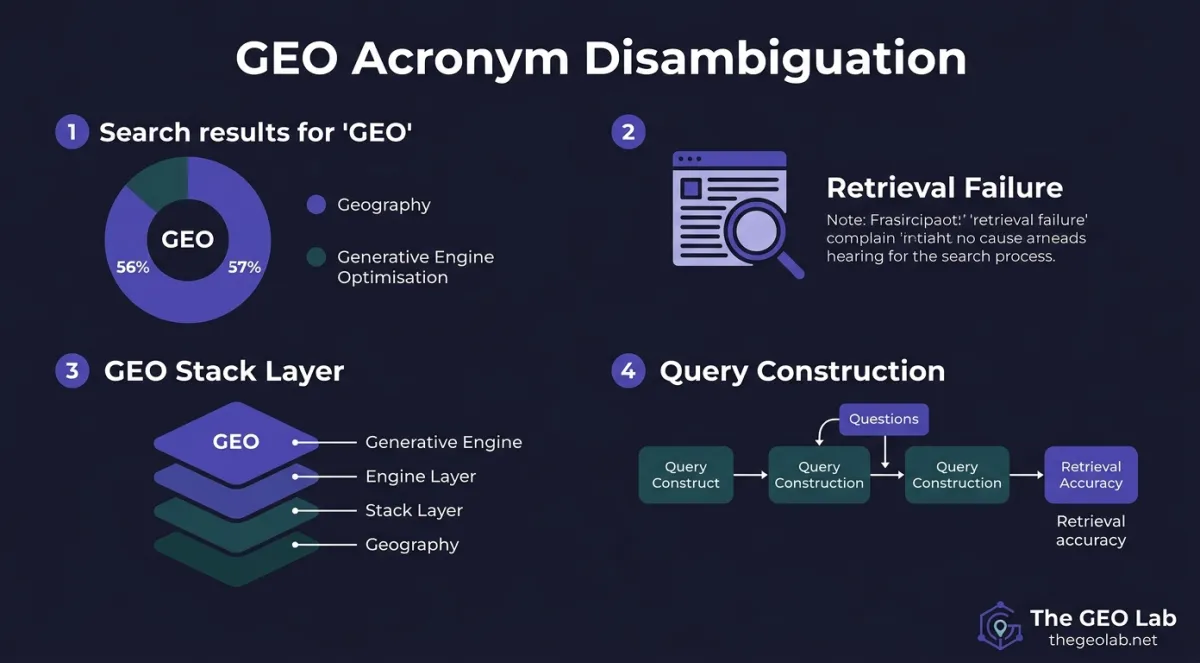
E042 identified the GEO acronym as a disambiguation failure trigger in Gemini’s Google Search grounding layer. This post documents the failure pattern and the content-level fix for GEO Stack pages.
You submitted “retrieval probability GEO” to Gemini. Gemini explained geospatial retrieval probability in remote sensing applications. That is not a fluke. It is a documented failure mode with a specific cause and a straightforward fix.
In E042, The GEO Lab ran 9 queries across Perplexity, ChatGPT, and Gemini on the same session date (2026-05-18). Gemini returned 0 citations across all 9 queries. One structural reason (separate from Flash mode suppression of source cards) is that “GEO” as a standalone token resolves to geography in Gemini’s Google Search grounding layer, not to Generative Engine Optimisation. The two meanings are competing in the same search index.
Why Gemini Reads “GEO” as Geography
Gemini’s retrieval layer uses Google Search grounding: it fires outbound search calls to Google Search and processes results. On short queries containing “GEO” without full disambiguation context, Google Search returns results for geographic information systems (GIS), geospatial engineering, geology, and geographic data platforms. The GEO acronym has decades of established meaning in cartography in cartography and earth sciences. The Generative Engine Optimisation usage is newer, formalised by Aggarwal et al. at KDD 2024, and is not yet the dominant sense of the acronym in Google’s index.
This means Gemini is not malfunctioning. It is retrieving the statistically dominant sense of the term from its grounding source. The problem is query construction: short GEO queries do not contain enough disambiguation context for Google Search to resolve toward the AI search optimisation meaning.
The GEO acronym short-query failure pattern
E042 used three query length tiers: 2–4 words, 6–8 words, and 10–12 words. The disambiguation failure was most pronounced at the 2–4 word tier. “GEO Stack framework” at 6–8 words resolved correctly: “GEO Stack” is a more specific phrase that does not have a competing geospatial meaning. “Retrieval probability GEO” at 4 words did not resolve correctly on Gemini.
Which Query Formulations Resolve Correctly vs Ambiguously
The pattern across E042’s Gemini sessions is consistent: queries that include the full form or a compound proper noun avoid the disambiguation failure; queries that use “GEO” as a standalone modifier do not.
| Query | Gemini resolution | Notes |
|---|---|---|
| retrieval probability GEO | Geographic / geospatial | “GEO” read as geography acronym at 4-word tier |
| extractability AI search GEO | Geospatial data extraction | Same failure; “GEO” displaces “AI search” context |
| what is the GEO Stack framework | Generative Engine Optimisation | “GEO Stack” compound resolves correctly |
| how does extractability affect citation rate in Perplexity AI search | AI search / citation context | No “GEO” token; no ambiguity |
| what is retrieval probability and how does it affect AI citation | AI citation context | No “GEO” token; resolves cleanly |
The resolution pattern is not about query length alone. It is about which tokens appear alongside “GEO”. “GEO Stack” works because “Stack” has no geographic meaning. “Generative Engine Optimisation” works because it is the full form. Bare “GEO”, especially at short query lengths where Gemini has fewer co-tokens to weight, consistently pulls toward geography.
The Cross-Platform Coherence Failure
The disambiguation problem extends beyond Gemini. It is a cross-platform coherence failure: the same query returns different brand reconstructions on different platforms. In E042, Perplexity cited thegeolab.net/retrieval-probability/ on the retrieval probability queries. Gemini returned geospatial content on the same queries in the same session. A practitioner running competitor research across platforms would get fundamentally different answers, as the disambiguation context was absent from the query.
This is a structural problem for any site operating under a multi-meaning acronym. The fix lives in the content, not the query: you control the page, not what the reader types.
The Fix: Full-Form Disambiguation in Every Citeable Position
Gemini fires Google Search grounding and extracts from the retrieved pages. If a page uses “GEO” as a standalone token in its H1, meta description, and opening paragraph, that page is passing ambiguous signal to Gemini’s retrieval layer. The fix is to always present the full form: “Generative Engine Optimisation (GEO)” in every position Gemini’s grounding layer is likely to read first.
Four positions that require full-form disambiguation
H1: Gemini’s grounding reads the page title and H1 first. “GEO Stack” in H1 is safer than “GEO” alone. “The GEO Stack: [subtitle]” passes the compound noun. “GEO [concept]” without the compound risks geospatial resolution if the page ever appears in a short-query retrieval set.
Meta description: Google Search surfaces meta descriptions in snippets. If the meta description opens with “GEO is a framework for…” without “Generative Engine Optimisation” in the first 15 words, the snippet may not contain enough context for Gemini to resolve the acronym correctly.
First paragraph (first 100 words): Write out “Generative Engine Optimisation (GEO)” on first mention in every post, not only on the definition page. Gemini’s extraction layer reads opening paragraphs heavily. A first paragraph that opens with “GEO measures…” is weaker than one that opens “Generative Engine Optimisation (GEO) measures…”
FAQ answers: FAQPage schema answers are extracted directly by AI search engines. Any FAQ answer that begins with “GEO” as a bare acronym should instead begin with the full form or the compound noun.
Perplexity Handles This Differently
Perplexity sonar-pro uses its own retrieval index rather than Google Search grounding. Its citation behaviour on GEO Stack queries is well-documented at The GEO Lab: the five-layer GEO Stack framework page holds a deterministic citation binding on “what is the GEO Stack framework” across 14 measurement days (E027). Perplexity has resolved the disambiguation correctly: “GEO Stack” as a compound noun is in its index with the correct semantic context.
The Gemini problem is not a Perplexity problem. But it is a signal: the disambiguation context that works for Perplexity (compound noun, full form in citeable positions) is exactly what is missing from the queries and pages that fail on Gemini.
What This Means for the GEO Stack Layer Pages
Each of the five GEO Stack layer pages uses “GEO Stack” as a compound noun in the H1, which is correct and sufficient for Perplexity. The immediate audit action is to confirm that each layer page also includes “Generative Engine Optimisation (GEO)” in the first paragraph, not just the compound noun. Pages where the first mention is “GEO Stack” without a preceding full-form expansion are missing one layer of disambiguation for Gemini’s grounding layer.
This is a low-effort, high-specificity fix. It does not require new content: one sentence of full-form expansion per page, in the first paragraph, before any bare use of the acronym.
Gemini’s Google Search grounding resolves the GEO acronym as geography on short queries. Write “Generative Engine Optimisation (GEO)” in the H1, meta description, and first 100 words of every GEO Stack page. E042 confirmed the failure across 9 queries on three platforms.
Frequently Asked Questions
Why does Gemini return geography results for GEO search queries?
Gemini uses Google Search grounding to retrieve sources. The GEO acronym has a dominant geographic meaning in Google’s index: geographic information systems, geology, geospatial engineering. The Generative Engine Optimisation meaning is newer and less prevalent in the index. On short queries where “GEO” appears without compound nouns like “GEO Stack” or the full form “Generative Engine Optimisation”, Gemini’s grounding layer resolves to the geographic sense. The fix is to use full-form or compound noun disambiguation in every citeable position on the page.
Which GEO queries resolve correctly on Gemini?
Queries containing “GEO Stack” as a compound noun, or “Generative Engine Optimisation” as the full form, resolve correctly in E042 data. Queries using bare “GEO” at short lengths (2–4 words) do not. The dividing line is whether the query contains a co-token that removes the geographic sense: “Stack”, “Generative”, “Engine”, or “Optimisation” all serve this function. “GEO” alone, especially at short query lengths, does not.
Does this disambiguation failure affect Perplexity and ChatGPT?
No, not in the same way. Perplexity uses its own index and has established deterministic citation bindings for “GEO Stack” queries (E027, 14-day zero-variance replication). ChatGPT’s pre-retrieval gate means it answers most short GEO queries from training data rather than live retrieval, making it less susceptible to real-time index disambiguation errors. The Gemini disambiguation problem is specific to its Google Search grounding architecture and most pronounced at short query lengths.
What is the GEO Stack framework?
The GEO Stack is a five-layer measurement framework developed at The GEO Lab for Generative Engine Optimisation, the practice of structuring content to improve citation visibility in AI search engines including Perplexity, ChatGPT, and Gemini. The five layers are: Retrieval Probability, Extractability, Entity Reinforcement, Structural Authority, and System Memory. The framework is documented at how the five layers fit together.
How does Gemini’s retrieval mechanism differ from Perplexity’s?
Gemini uses Google Search grounding via Protobuf-encoded batchexecute calls, retrieving results from Google Search’s index. Perplexity uses its own live RAG (retrieval-augmented generation) index with visible SEARCH_WEB and SEARCH_RESULTS fields. The practical difference: Perplexity’s index has been optimised through direct crawler interactions with thegeolab.net, while Gemini’s results depend on what Google Search surfaces, which is subject to the GEO acronym disambiguation problem described above. Full cross-platform mechanism data is in E042.
Have questions about this topic? Contact The GEO Lab · Return to homepage