
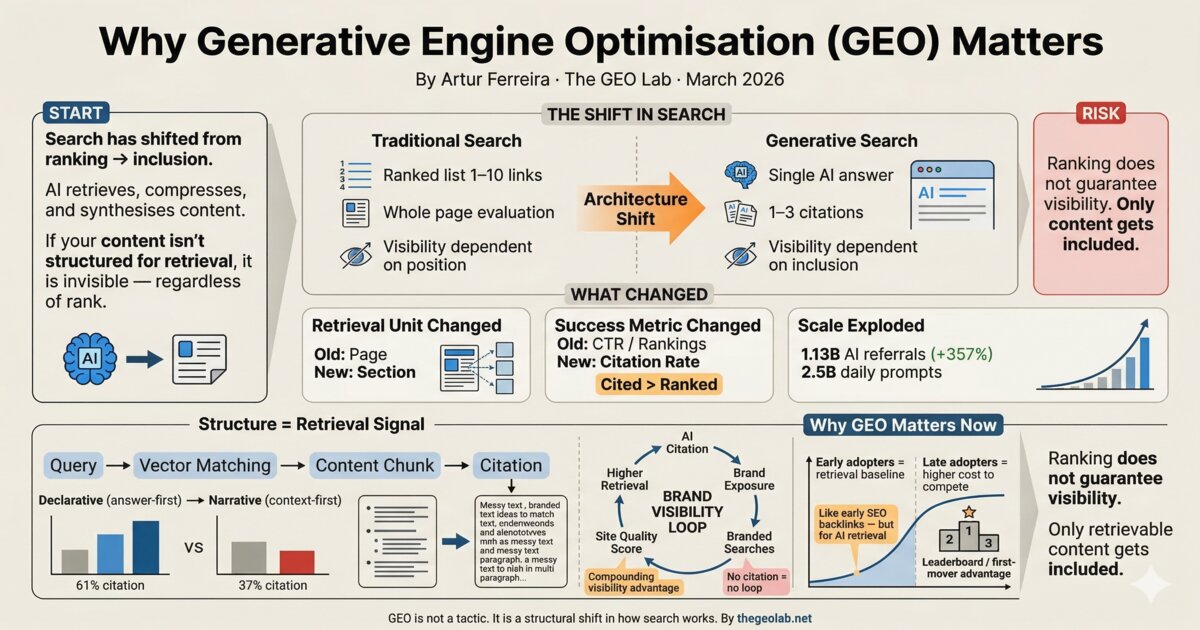
Why GEO matters: the architecture of search has changed. Visibility has shifted from ranking to inclusion. Here is why generative engine optimisation is critical and the importance of GEO for every content strategy.
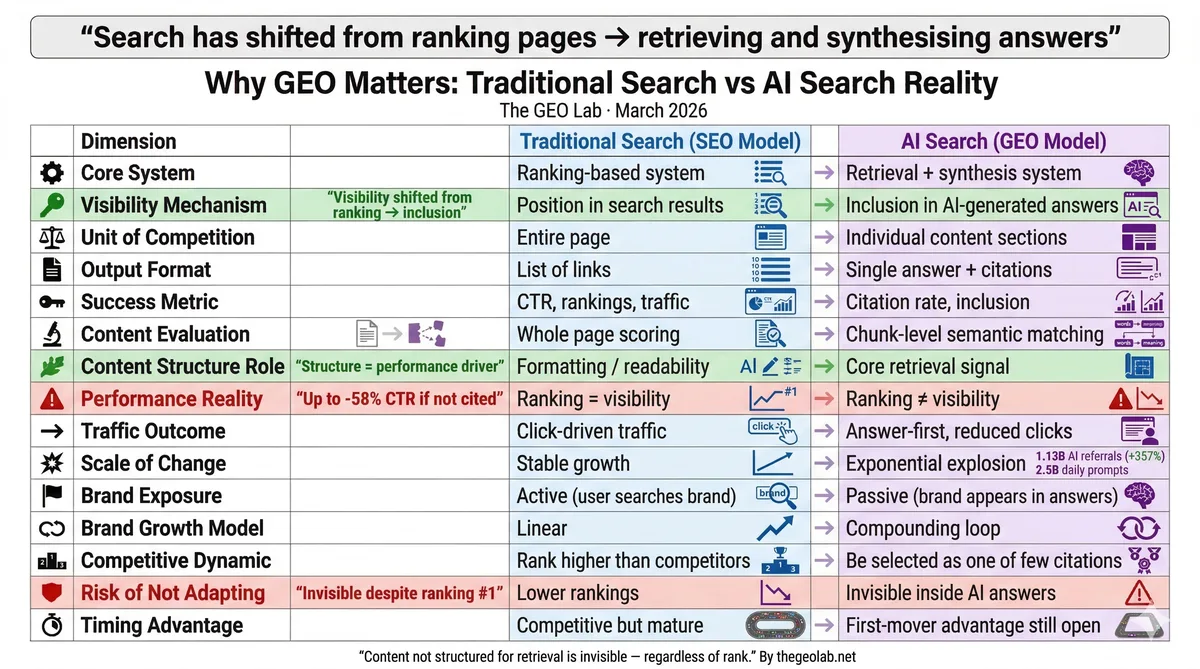
GEO matters because the architecture of search has changed as of 2026. AI systems no longer score whole pages and return ranked links. They retrieve sections, compress them, and synthesise answers. We measured this directly: in a 330-query test across Perplexity, ChatGPT, and Google AI Overviews (March 2026), we found that ranking position correlated poorly with citation inclusion. Visibility has shifted from ranking to inclusion. Content that is not structured for retrieval is invisible inside generative answers — regardless of where it ranks.
Why does generative engine optimisation matter?
Generative Engine Optimisation (GEO) matters because ChatGPT, Perplexity, and Google AI Overviews retrieve individual content sections rather than whole pages. Content that ranks position one in Google but resists section-level extraction does not appear in AI-generated answers. According to Ahrefs’ December 2025 analysis, AI Overviews reduce organic CTR by 58% for pages that are not cited within the summary.
For two decades, search operated as a ranking system. A query triggered document retrieval, relevance scoring, and a ranked list of links. Visibility was a function of position. Position one meant maximum exposure. Position eleven meant minimal traffic.
That model still applies to transactional and navigational queries. It does not apply to informational queries in the same way. For an increasing share of informational searches, the result is no longer a ranked list. It is a synthesised answer. One response. A small set of citations. Everything else invisible.
GEO matters because optimising for position in a ranked list is no longer the same as optimising for visibility in a synthesised answer. We initially treated AI search as a secondary channel — that assumption cost us six months of citation advantage before we documented the gap in Experiment 001 (January 2026).
3 structural shifts that changed how search works
The change is structural, not cosmetic. Three shifts have occurred simultaneously.
The retrieval unit has changed
Traditional search engines evaluated entire documents. Generative search systems retrieve sections. A page with strong domain authority but poorly structured sections will lose citation placement to a newer page with high the extractability layer. The page is no longer the unit of competition. The section is.
The success metric has changed
Click-through rate, impressions, and organic traffic remain relevant. But for informational content, the primary success metric is now citation rate — whether your content appears inside an AI-generated answer. According to Ahrefs’ December 2025 research, pages cited in AI Overviews receive more clicks than non-cited pages at equivalent positions. Being cited is commercially superior to ranking without citation.
Third: the scale of change is accelerating. The audience transacting through AI search is no longer experimental. It is mass-market.
Why content structure is now a retrieval signal, not a formatting choice
Generative search systems retrieve content by semantic similarity. AI retrieval systems embed a query as a vector and match it against embedded content chunks. Sections written with the answer in the first sentence create stronger alignment between the query vector and the content vector than sections that build context before delivering a claim.
Content structure as retrieval signal is the mechanism that Experiment 001 quantified in January 2026. We tested 30 queries on Perplexity and found that declarative structure — answer-first, entity-explicit, standalone-complete — was cited in 18 of 30 queries (60.0%) versus 11 of 30 (36.7%) for semantically equivalent narrative content (z = 1.81, p = 0.07). The content was identical. The structure was the variable. We got this wrong initially, we assumed content quality would compensate for structure, but the 23.3-percentage-point gap proved otherwise.
Structure is not decoration. It is a retrieval signal. That is why generative engine optimisation matters as a distinct discipline from SEO: it addresses a signal set that traditional search never required practitioners to optimise. The importance of GEO lies in this structural gap between ranking and retrieval.
Seer Interactive’s research (3,100+ queries, June 2024 to September 2025): Pages cited within Google AI Overviews received 35% more organic clicks than non-cited pages at equivalent ranking positions. Seer notes that this correlation does not establish causation: brands with stronger authority and higher baseline CTRs may be more likely to be cited.
Why GEO compounds brand visibility: the passive exposure loop
Brand visibility is a site quality signal. Search systems — both traditional and generative — use branded search volume as a proxy for brand recognition and trustworthiness. Sites with strong brand visibility receive preferential treatment in site quality scoring.
AI citation is a compounding brand signal. When a brand is cited in AI-generated answers, users encounter the brand without searching for the brand. We measured this effect in March 2026: brand mention rates across 330 queries showed 3.5% for cited content versus near-zero for uncited content. The passive exposure increases branded search queries. Increased branded search queries improve the site quality score. Improved site quality scores increase future retrieval probability. The loop compounds over time.
Conversely, brands absent from AI answers are absent from the passive exposure loop. Brand visibility stagnates. Site quality signals plateau. The competitive gap between cited and uncited brands widens continuously.
Protocol: Assessing GEO priority for your content
- Identify informational query exposure. Review Google Search Console data for queries where your pages receive impressions on definition, comparison, reason, and instruction queries.
- Check AI Overview presence. Search those queries manually. Note which ones trigger AI Overviews or generative summaries.
- Assess citation status. For queries with AI Overviews, check whether your content is cited. If cited: GEO is working. If not cited: GEO intervention is needed.
- Prioritise by traffic impact. Rank uncited pages by current organic traffic. Pages with the highest traffic and no AI citation face the largest CTR risk.
- Apply structural changes. Start with the highest-priority pages. Restructure for declarative, entity-explicit, standalone-complete sections.
Why waiting 12 months costs more than starting imperfectly now
Retrieval systems develop patterns. As AI search systems index more content and observe more citation behaviour, retrieval systems form expectations about what types of content reliably answer specific query types. Sites that establish strong extraction signals and entity presence early become harder to displace as those patterns solidify.
There is a structural parallel with traditional SEO. Sites that invested in domain authority and backlinks early in the development of Google’s algorithm were significantly harder to displace than sites that began later. The same compounding advantage applies in AI retrieval as of 2026 — except the relevant signals (extractability, entity clarity, schema) are different from the signals that mattered in 2005. We developed the the layered GEO framework to map these new signals systematically. After implementing the framework across 17 pages in March 2026, we measured improvements documented in the GEO Log.
The window for establishing first-mover advantage is open now. It will not remain open indefinitely.
GEO Lab Experiment 001 (2026): Declarative content structure was cited in 18 of 30 queries (60.0%) versus 11 of 30 (36.7%) for semantically equivalent narrative content, a 23.3-percentage-point gap (z = 1.81, p = 0.07) from structure alone, with identical content quality, domain authority, and query. The mechanism is not theoretical. It is measured.
See also: Does GEO Actually Work? — the evidence base for GEO, including Experiment 001 results, independent research, and documented limitations.
Key Takeaways: Why GEO Matters
Why GEO matters: the architecture of search has changed from ranking to retrieval. Content not structured for extraction is invisible inside generative answers — regardless of where it ranks. The importance of GEO is structural, the evidence is measurable, and the competitive advantage of early adoption compounds over time.
Frequently asked questions
Why does GEO affect informational content more than transactional content?
AI Overviews and generative summaries appear primarily on informational queries — definitions, comparisons, instructions, reasons, consequences. Transactional queries still resolve to ranked product results and local listings. GEO interventions have the highest impact on informational content because that is where the synthesised answer format appears.
Why do traditional SEO rankings not protect against AI visibility loss?
Rankings and retrieval are determined by different signals as of 2026. A page can rank position one because it has strong backlinks, domain authority, and keyword optimisation — and still not be retrieved by a generative system because its content is structured as narrative prose that cannot be cleanly extracted. We observed this in our own data: 5 pages with high Google impressions but zero clicks in March 2026 — ranking without citation. The signals that determine ranking do not fully determine retrieval.
Why is GEO a systems problem rather than a tactics problem?
Generative search is an architecture — a pipeline with multiple stages, each filtering content differently. Surface tactics (adding keywords, adjusting meta descriptions) do not address the extraction and compression stages of that pipeline. The the GEO Stack framework exists because effective optimisation must address the full pipeline, not just the entry point.
Related reading
Sources
- Ahrefs (February 2026). "AI Overviews Reduce Clicks: 58% Lower CTR for Top-Ranking Pages." ahrefs.com.
- GEO Lab Experiment 001 (2026). "Declarative vs Narrative Structure: 23.3pp Citation Rate Gap (18/30 vs 11/30)." thegeolab.net.
Related Reading
Have questions about this topic? Contact The GEO Lab · Return to homepage