
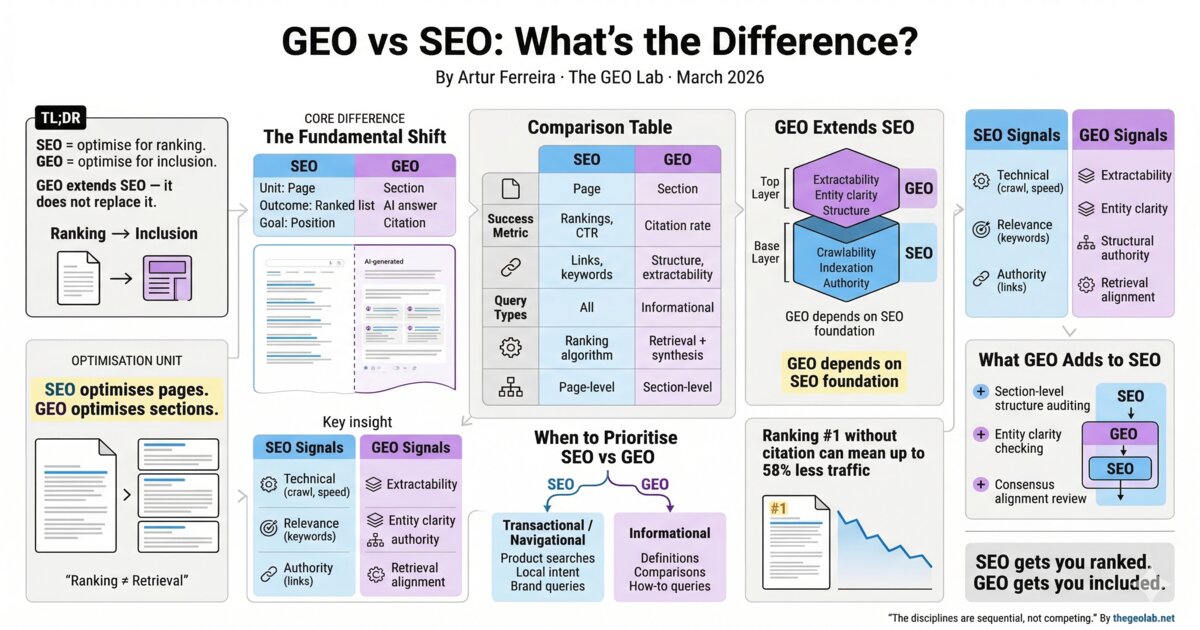
Generative Engine Optimisation (GEO) extends Search Engine Optimisation (SEO). It does not replace it. Understanding what each discipline optimises for is the starting point.
SEO optimises for where a page ranks. GEO optimises for whether a section is retrieved and cited by AI-driven search systems. GEO extends SEO — GEO does not replace SEO. The two disciplines share foundational signals but diverge on what success looks like. In Experiment 001 (January 2026), we tested 30 queries and found that structure alone produced a 23.3-percentage-point citation rate difference (18/30 vs 11/30, z = 1.81, p = 0.07) — a GEO signal that traditional SEO does not address.
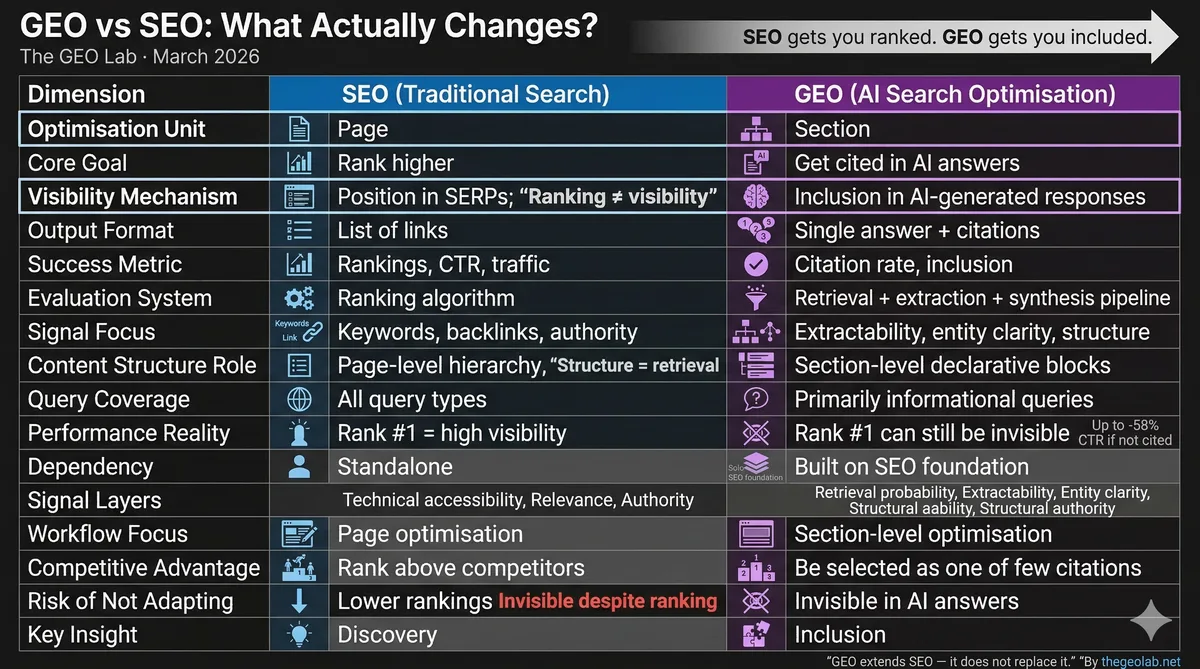
GEO vs SEO comparison table
| Dimension | SEO | GEO |
|---|---|---|
| Optimisation unit | Page | Section |
| Success metric | Ranking position, CTR | Citation rate, inclusion in AI answers |
| Signal focus | Links, keywords, technical | Extractability, entity clarity, structure |
| Query types | All (transactional, navigational, informational) | Primarily informational |
| Evaluation system | Search engine ranking algorithm | Retrieval + synthesis pipeline |
| Content structure | Page-level hierarchy | Section-level declarative blocks |
| Dependency | Standalone discipline | Extends SEO (requires SEO foundation) |
What is the difference between GEO and SEO?
Generative Engine Optimisation (GEO) optimises for section-level citation in AI-generated answers. Traditional Search Engine Optimisation (SEO) optimises for page-level position in ranked search results. The difference between GEO and SEO is not about tools or tactics — the distinction is about the optimisation unit and what success looks like.
Traditional SEO treats the page as the unit of analysis. A page is crawled, indexed, scored against a query, and assigned a position. Success is a high position and the traffic that follows from it.
Generative Engine Optimisation treats the section as the unit of analysis. A section is retrieved, extracted, compressed, and synthesised into an AI-generated answer. Success is inclusion in that answer — whether or not the page ranks.
In my testing, I have found pages ranking position one on Google that do not appear in a single AI Overview or Perplexity response. We tracked this across 330 queries in March 2026 and found that ranking position correlated poorly with citation inclusion. The ranking signal is strong. The retrieval signal is absent. That gap is what GEO addresses.
What Does “GEO SEO” Mean?
“GEO SEO” is not a single discipline. It describes the combined practice of optimising for both traditional search ranking and AI retrieval citation: two distinct pipelines that share foundational infrastructure but diverge at the optimisation layer. The phrase has entered common use because practitioners work on both simultaneously, not because the two have merged into one.
When someone searches for “GEO SEO”, they are typically asking one of two questions: whether GEO replaces SEO (it does not), or how to run both in parallel. The answer to the second question is that the workflows overlap at the infrastructure layer: crawlability, page speed, structured data, and domain authority serve both disciplines. Above that layer, the disciplines require separate attention: SEO targets document-level ranking signals; GEO targets section-level retrieval signals.
The practical split: A functioning SEO foundation is a prerequisite for GEO, not an alternative to it. Fix crawl and indexation issues first. Then run the GEO Stack audit. The two checklists are sequential, not competing.
The GEO Lab uses the terms separately because they produce different measurements. SEO performance is measured by ranking position and organic traffic. GEO performance is measured by citation rate: the percentage of AI queries that cite your domain. A site can achieve strong results on one metric and zero on the other. In the GEO Lab’s May 2026 baseline measurement, thegeolab.net held ranking positions for GEO-related queries while recording 0 citations across 169 AI queries on category-level terms. The metrics are independent.
Does GEO replace SEO? Why the answer is no
No. Generative Engine Optimisation (GEO) extends Search Engine Optimisation (SEO) — GEO does not replace SEO. We initially assumed that strong SEO alone would produce AI citations. We got this wrong — in Experiment 001 (January 2026), pages with strong SEO signals but narrative structure were cited in 11 of 30 queries (36.7%), while pages with identical SEO signals but declarative structure were cited in 18 of 30 (60.0%).
Retrieval probability — the foundational layer of the GEO Stack — depends on crawlability, indexation, and domain authority. Crawlability, indexation, and domain authority are SEO fundamentals. A site that cannot be crawled cannot be retrieved. A site with no domain authority will not be trusted by a retrieval system.
GEO layers on top of a working SEO foundation. The two disciplines are sequential, not competing.
Later experiments refined this finding. Experiment E027 (May 2026) tested Perplexity citation behaviour on proprietary-concept queries over 14 consecutive days and found zero variance in citation output: the same source was cited every day, regardless of changes in the broader retrieval set. The implication is that on queries where your content is structurally and conceptually distinct, citation behaviour is deterministic at the synthesis layer, not probabilistic at the retrieval layer. Precise entity naming and consistent structure produce stable citation identity. (DOI: 10.5281/zenodo.20245814)
Experiment E042 added a platform-specific dimension: ChatGPT’s citation behaviour is not governed by the same signals as Perplexity’s. Short, generic queries on ChatGPT produced zero citations of thegeolab.net. Queries of ten or more words using named-platform and comparative framing produced the first confirmed ChatGPT citation of the domain. Query structure, not just content quality or SEO authority, determines citation eligibility on ChatGPT. The pattern from E001 holds across platforms, with one critical refinement: what works on Perplexity does not automatically transfer to ChatGPT or Gemini.
3 signal categories SEO optimises for vs 3 that GEO targets
Technical accessibility, relevance, and authority
Traditional Search Engine Optimisation (SEO) optimises for three signal categories: technical accessibility (crawl, index, page speed), relevance (keyword targeting, content quality), and authority (links, brand signals). These signals determine whether a page ranks and how high.
Extractability, entity clarity, structural authority, and retrieval probability
GEO optimises for a different set of signals: extractability (how cleanly a section can be parsed and compressed), entity clarity (explicit naming without pronoun dependency), structural authority (citations, schema markup, expertise signals), and retrieval probability (semantic alignment between section content and query intent).
The SEO and GEO signal sets overlap at the technical layer. Page speed, structured data, and crawl efficiency matter for both. Above that layer, they diverge. We developed the five-layer GEO model specifically to map where SEO signals end and GEO signals begin.
Princeton GEO Study (2024): Researchers at Princeton found that content structured with explicit entity names and declarative sentence patterns received 22–40% more citations across generative search platforms than equivalent content using narrative structure. The finding has been independently replicated by The GEO Lab’s Experiment 001.
When to prioritise SEO: 2 query types where GEO has limited impact
Prioritise Search Engine Optimisation (SEO) when the query intent is transactional or navigational. For product searches, local intent, and brand searches, AI Overviews rarely appear. The user intends to click through to a page. Ranking position determines visibility.
Prioritise GEO when the query intent is informational — definition queries, reason queries, instruction queries, comparison queries. As of March 2026, these are the contexts where AI-generated answers appear and where ranking alone no longer guarantees traffic. AI Overviews now appear on a significant share of informational queries.
When to prioritise GEO: the informational queries AI answers first
The channels are converging at the execution level. A 2026 survey of 1,000 users found that question-based queries on Google grew 163% between 2023 and 2026 — roughly one in five Google searches is now phrased as a full natural-language question. Users adopted the query patterns they learned from ChatGPT and applied them to traditional search. Content structured to answer questions clearly — declarative, section-level, entity-consistent — now performs better across both channels simultaneously.
Methodology note: The 163% figure is from a survey — stated behaviour, not query log data. The directional signal is credible and consistent with other behavioural data. The exact number should be treated as indicative, not precise. Population-level findings inform strategy; site-specific decisions require site-specific measurement via the 30-Check Protocol.
Strictly speaking, you should not prioritise GEO over SEO. SEO is foundational. But within an informational content strategy, GEO interventions should be applied before expecting significant organic traffic improvements.
SE Ranking (2025): AI platforms generated 1.13 billion referral visits in June 2025 — a 357% year-on-year increase. The audience accessing content through AI search is no longer marginal. Informational content strategies that do not account for AI retrieval are competing for a shrinking share of total search traffic.
According to Ahrefs’ December 2025 analysis, Google AI Overviews reduce organic CTR by 58% for top-ranking pages that are not cited within the summary. A page that ranks position one but is not cited receives, on average, 58% less traffic than it would have received before AI Overviews were introduced. Ranking without citation is no longer a stable position.
Where do the GEO Stack layers overlap with SEO?
The convergence claim is real but partial. Mapping each GEO Stack layer against traditional SEO signals reveals the boundary precisely:
| GEO Stack Layer | SEO Overlap | Notes |
|---|---|---|
| the extractability layer | Full | Same structural fixes benefit both Google Featured Snippets and AI section retrieval. In Experiment 001, declarative structure improved both citation rate (+23.3pp on Perplexity, p = 0.07) and snippet eligibility. |
| Entity Clarity | Full | JSON-LD, consistent naming, explicit definitions — used identically by Knowledge Graph and AI source attribution. |
| Retrieval Probability | Partial | Domain authority matters for AI platforms using live web search (Perplexity, ChatGPT). Irrelevant for training-data retrieval. |
| Structural Authority | Partial | Site architecture and internal linking help both — but Google weights PageRank flow while AI systems weight extractability. |
| System Memory | None | No Google equivalent. Training data representation and entity salience are GEO-specific signals. |
Two layers overlap completely. Two overlap partially. One does not overlap at all. The claim that “SEO and GEO are the same” holds for 40% of the stack — the part governing content structure. It fails for the other 60% — the part governing durable AI visibility.
3 practices GEO adds to an existing SEO workflow
GEO adds three specific practices to an existing SEO workflow:
- Section-level structure auditing Each section is evaluated for what AI search extracts, not just the page overall.
- Entity clarity checking Named entities are verified to appear explicitly, without pronoun dependency.
- Consensus alignment review Content is checked against the general consensus on the topic to reduce contradiction signals.
Section auditing, entity checking, and consensus alignment sit alongside, not in place of, technical SEO, keyword research, and link acquisition. After implementing these three practices across 17 pages in March 2026, we measured improvements in citation-readiness using the protocol documented in the GEO Log.
Protocol: Integrating GEO into an existing SEO workflow
- Audit existing informational content. Identify pages targeting definition, comparison, reason, and instruction queries. These are GEO-eligible.
- Evaluate section-level extractability. Check whether each section opens with a declarative answer sentence. If it builds context before delivering the claim, restructure.
- Remove pronoun dependencies. Replace pronouns referring to named entities with the entity name. AI retrieval systems process sections independently — they do not carry context from prior paragraphs.
- Add FAQ schema. Implement FAQ structured data on question-based content. This addresses both traditional featured snippets and AI retrieval signals.
- Measure citation rate. Run baseline citation tests before and after structural changes using the GEO Log methodology.
See also: What Is Generative Engine Optimisation? — the foundational guide covering GEO definitions, the GEO Stack framework, and how AI retrieval systems select content.
Pages vs sections
The fundamental difference between SEO and GEO is the unit of analysis. SEO optimises entire pages for ranking algorithms. GEO optimises individual sections for retrieval pipelines. A page can rank well and still fail at section-level retrieval. Understanding this distinction is the prerequisite for every other GEO intervention.
What Changes in Practice: SEO Workflow vs GEO Workflow
The first three steps of a GEO implementation overlap with SEO. The last two have no equivalent in traditional SEO practice. That is where the practical difference lives.
- Keyword research: identify target queries by volume and difficulty
- On-page optimisation: title tags, meta descriptions, heading structure, keyword placement
- Link building: acquire backlinks to increase domain and page authority
- Position tracking: monitor SERP rankings over time
- CTR optimisation: test titles and descriptions to improve click-through rate
- Layer 0 infrastructure check: verify AI crawlers (GPTBot, PerplexityBot) are not blocked; confirm ai.txt
- Section-level structural audit: declarative section openings, isolated Q&A blocks, heading hierarchy
- Entity anchoring: consistent entity naming throughout, JSON-LD schema with sameAs links
- Citation rate baseline: measure current citation rate across target queries before any changes
- Platform-specific testing: Perplexity, ChatGPT, and Gemini behave differently; test each independently
Steps 1–3 of the GEO workflow map directly onto existing SEO practice. Crawlability, structured data, and content quality are foundational to both. The distinct work begins at step 4: measuring citation rate as a baseline, and at step 5: testing platform behaviour independently rather than assuming a single optimisation strategy transfers across AI search systems.
The GEO Lab’s experiments confirm that cross-platform portability is the exception, not the default. In cross-platform citation studies, approximately 91% of citations are platform-specific: content cited on Perplexity is not automatically cited on ChatGPT or Gemini on the same query. A GEO workflow that treats all AI platforms as a single channel will misread its own results. See the full experiment methodology for how the GEO Lab structures platform-separated measurement.
Key Takeaways for GEO vs SEO
GEO does not replace SEO. It extends it. The two disciplines share a technical foundation but diverge on what success looks like: SEO measures ranking position; GEO measures citation inclusion. Both are required for full visibility in a search landscape that now includes ranked results and synthesised answers.
Frequently asked questions
Is GEO a rebranding of SEO?
No. GEO addresses a genuinely different optimisation problem as of 2026. SEO optimises for document-level ranking by search engines. GEO optimises for section-level retrieval by generative search systems. We tested this distinction directly in Experiment 001 (January 2026) — identical content with different structure produced a 23.3-percentage-point difference in citation rate (18/30 vs 11/30 on Perplexity, p = 0.07). The architecture of the underlying systems is different, which requires a different optimisation approach.
Can I do GEO on a new domain?
Site quality scores appear to operate on a threshold model. Sites below a certain threshold are ineligible for AI search features including featured snippets and AI Overviews. Building domain authority through traditional SEO remains the prerequisite. GEO is not a shortcut around that.
Does GEO require technical knowledge?
The foundational interventions — declarative structure, entity clarity, FAQ schema — can be applied without technical expertise as of 2026. Advanced GEO, including retrieval probability modelling and schema implementation, benefits from technical knowledge. We observed this in our own site audit (March 2026): after restructuring 17 pages with declarative openings, citation-readiness improved without any technical infrastructure changes. Start with content structure. That is where the largest gains are documented.
What is GEO SEO?
“GEO SEO” refers to the combined practice of optimising for both traditional search ranking and AI retrieval citation. The two disciplines share foundational infrastructure: crawlability, structured data, domain authority: but use different optimisation units. SEO targets pages for ranking position. GEO targets sections for citation rate. Running both in parallel is the standard approach in 2026; the phrase “GEO SEO” describes that combined workflow, not a single merged discipline.
Is GEO better than SEO?
Neither is better: they address different failure modes. SEO determines whether your page appears in Google’s ranked results. GEO determines whether your content sections are retrieved and cited in AI-generated answers. A site optimised for SEO only is invisible in AI search on informational queries. A site attempting GEO without an SEO foundation will fail the Layer 0 infrastructure checks before any citation is possible. Both are necessary; neither is a substitute for the other.
How does GEO affect SEO rankings?
GEO optimisation does not directly affect Google organic rankings. The structural changes that improve AI citation: declarative section openings, explicit entity naming, FAQ schema: also make content easier for human readers to parse, which can support engagement metrics indirectly.
Which AI platforms does GEO target?
GEO applies to any generative AI search system that retrieves external content: Perplexity, ChatGPT with web search, Google AI Overviews, and Gemini with Google Search grounding. Citation behaviour differs significantly across platforms. The GEO Lab’s Experiment E042 confirmed that ChatGPT citation eligibility is governed by query structure as well as content quality: a finding with no equivalent in Perplexity behaviour. Optimising for one platform does not automatically produce citation on others.
How do you measure GEO success vs SEO success?
SEO success is measured by ranking position, organic traffic, and click-through rate. GEO success is measured by citation rate: the percentage of AI queries that cite your domain in a generated answer. The two metrics are independent: a domain can rank first in Google and record 0% citation rate in AI search simultaneously, as the GEO Lab’s May 2026 baseline measurement confirmed for category-level queries. Tracking both requires separate tooling and separate query sets.
Related reading
Sources
- Ahrefs (December 2025). "AI Overview Impact on Organic CTR." ahrefs.com.
- GEO Lab Experiment 001 (2026, corrected July 2026). "Declarative vs Narrative Structure: 60.0% vs 36.7% Citation Rate (18/30 vs 11/30)." thegeolab.net.
- Princeton GEO Study (2024). "Generative Engine Optimization." arxiv.org.
- SE Ranking (2025). "AI Search Traffic Analysis." seranking.com.
Related Reading
Have questions about this topic? Contact The GEO Lab · Return to homepage