
GEO Stack Layers
Overview · Retrieval Probability · Extractability · Entity Reinforcement · Structural Authority · System Memory
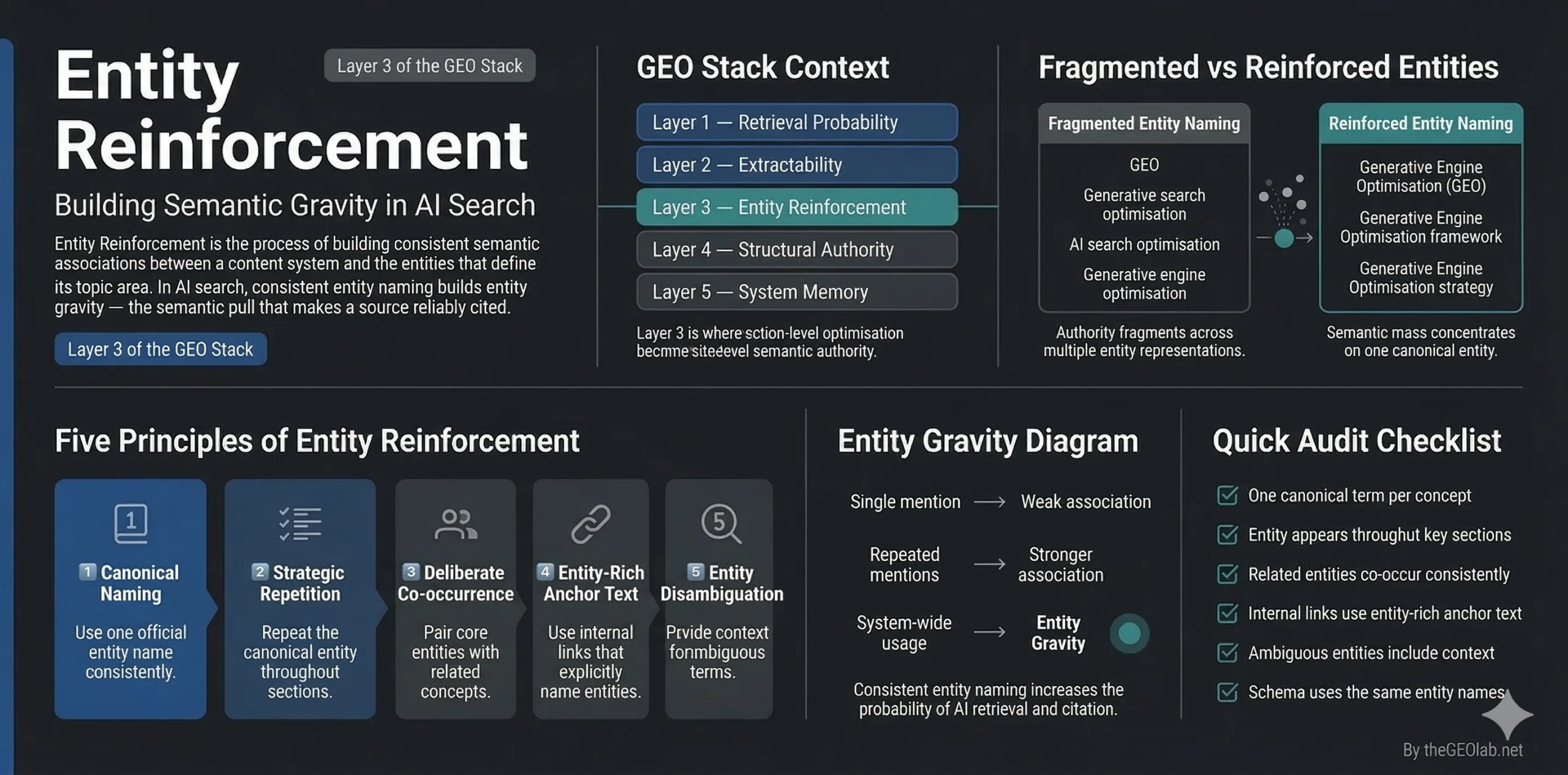
Entity Reinforcement is the process of building consistent, repeated semantic associations between a content system and the named entities — concepts, brands, people, frameworks, products — that define its topic area. It is Layer 3 of the GEO Stack, sitting above Extractability and below Structural Authority.
Generative AI systems do not just retrieve content — they build probabilistic models of what sources are authoritative for. Entity Reinforcement is what makes those models stable. Without it, citation is erratic: a site appears in answers for some queries and disappears for semantically identical ones. With it, a site builds entity gravity — the accumulated semantic pull that causes retrieval systems to associate it with specific topics reliably.
The five principles of Entity Reinforcement: canonical naming, strategic repetition, deliberate co-occurrence, entity-rich anchor text, and disambiguation.
Why consistent entity naming is what separates erratic citation from systematic authority — and how to build it
Why Entity Reinforcement Matters
There is a pattern I have seen repeatedly across sites with technically sound content: they get cited sometimes, but not reliably. The same query run on Monday retrieves their content; the same query on Friday does not. The content has not changed. The platform has not changed. The inconsistency comes from something more fundamental — the AI system does not have a stable semantic model of what the site is actually about.
This is an entity problem. Generative systems do not construct a static index of “this page is about X.” They build probabilistic associations — more like a network of semantic weights than a lookup table. Every time a concept appears with consistent naming alongside related entities, that weight increases. Every time it appears under a different name, or appears next to unrelated topics, the signal fragments. A site that refers to the same concept as “GEO”, “generative search optimisation”, “AI search optimisation”, and “generative engine optimisation” has distributed its authority across four separate entity representations. None of them accumulates the weight the canonical term would carry if used consistently.
Fixing Layers 1 and 2 gets content retrieved and extracted cleanly. Entity Reinforcement is what makes that extraction accumulate into something — a stable, recognisable semantic identity that retrieval systems can associate with specific topics and return to consistently. Without it, every piece of content starts from zero.
How Entity Reinforcement Works
Generative AI systems build their understanding of sources through a process of accumulated observation. As they process content across the web, they identify named entities — specific concepts, people, organisations, frameworks, products — and record the semantic context in which those entities appear. Over time, patterns form: certain sources become consistently associated with certain entities, and those associations increase the probability that the source will be retrieved when those entities appear in a query.
Think of it as semantic mass. A single mention of “Entity Reinforcement” on a single page adds a small amount of weight to the association between that source and that concept. Ten consistent mentions across ten well-structured sections add substantially more. Consistent use of the canonical term across twenty pages, with related entities appearing alongside it, builds what I call entity gravity — the pull that causes retrieval systems to select that source when the entity appears in a query, even before the query is fully processed.
The mechanism breaks when naming is inconsistent. If the same concept appears under three different terms across a site, the semantic mass accumulates across three separate entity nodes rather than concentrating on one. Each node individually is weaker than the single canonical node would be. The site has done the work — it has published the content — but the inconsistency has distributed the authority too thinly to create the gravity that drives systematic citation.
Entity Reinforcement operates at the site level, not the section level. Fixing entity naming in a single post does not fix the entity signal — that requires auditing and aligning naming conventions across the entire content system. This is what makes Layer 3 a different category of work from Layers 1 and 2.
Entity Signal Checker
Entity Reinforcement — Layer 3 of the GEO Stack — measures how consistently named entities appear across a content section. In The GEO Lab’s March 2026 audit of thegeolab.net, 18 of 28 sections had entity explicitness scores below 50, meaning over half the content relied on pronouns rather than explicit entity names.
You’ll see entity density, pronoun ratio, consistency scores, and highlighted entities vs pronouns.
High vs Low Entity Reinforcement: Side by Side
The difference between fragmented and reinforced entity naming is subtle at the section level and significant at the system level. This example shows the same concept handled two ways — and what each produces for an AI system building a semantic model of the source.
Post 1: “GEO is changing how brands appear in AI answers.”
Post 2: “Generative search optimisation requires structured content.”
Post 3: “AI visibility depends on how well your content is extracted.”
Post 4: “Optimising for generative engines means rethinking content structure.”
Post 1: “Generative Engine Optimisation (GEO) is changing how brands appear in AI-generated answers.”
Post 2: “Generative Engine Optimisation requires structured content that AI systems can cleanly extract.”
Post 3: “Generative Engine Optimisation visibility depends on Extractability — the degree to which AI systems can parse content sections cleanly.”
Post 4: “Generative Engine Optimisation requires restructuring content at the section level, not just the page level.”
The reinforced version uses the same canonical term in every post. It also does something subtler: it pairs “Generative Engine Optimisation” with “Extractability” in the same sentences, consistently. This deliberate co-occurrence builds a second association — between the canonical topic and its component concepts — that deepens the semantic model rather than widening it.
The Five Principles of Entity Reinforcement
These five principles address the specific ways entity signals get built, fragmented, or diluted across a content system. Applied consistently, they concentrate semantic authority rather than distributing it.
Canonical Entity Naming
Select one canonical term for each important concept and use it exclusively across all content on the site. Do not allow variant terms to coexist — not even as stylistic alternatives. “GEO” and “Generative Engine Optimisation” are not equivalent to a retrieval system: they are two different entity strings that build two separate semantic associations.
The canonical term should be the most complete, specific version of the concept name. Abbreviations, synonyms, and informal variants can appear after the canonical term has been established on first mention in a section, but they should not replace it as the primary entity name across different posts.
Strategic Repetition Within Sections
Entity names should appear throughout a section — not just on first mention, and not just in the heading. The semantic weight of a section’s embedding is built from all the entity signals within it, not just the opening sentence. A section that mentions “Generative Engine Optimisation” once in the heading and then refers to it as “it” or “this approach” for the rest of the section builds a weaker entity association than a section that uses the canonical name four or five times.
This is the same principle as Explicit Entity Anchoring in Extractability — but applied with a different goal. Extractability uses entity repetition to make sections parseable in isolation. Entity Reinforcement uses it to build the semantic weight of the entity association across the embedding of the entire section.
Deliberate Co-occurrence
Entity gravity is built not just by the frequency of a single entity’s appearance, but by the consistency with which related entities appear together. A site that always discusses “Generative Engine Optimisation” alongside “Retrieval Probability”, “Extractability”, and “Entity Reinforcement” builds a semantic cluster — a web of associations that deepens the retrieval system’s model of what this source is authoritative for.
Deliberate co-occurrence means identifying the three to five entities most closely associated with your core topic and ensuring they appear together consistently across the content system. Not forced — the co-occurrence should emerge from genuinely related content — but planned, so the associations are intentional rather than accidental.
Entity-Rich Anchor Text
Internal links carry entity signals — but only when the anchor text names the entity explicitly. A link that reads “learn more” or “click here” contributes nothing to the entity association between the linking page and the destination. A link that reads “Generative Engine Optimisation framework” or “Extractability at Layer 2” contributes both to the structural signal (Layer 4) and to the entity signal of both the linking and the destination page.
Every internal link in a content system is an opportunity to reinforce entity associations. Treating those links as navigation rather than as semantic signals is a missed opportunity for Entity Reinforcement that compounds across a site with hundreds of posts.
Entity Disambiguation
Some entities are ambiguous — the same term means different things in different contexts. “Stack” could mean a technology stack, a poker term, or the GEO Stack framework. Disambiguation is the practice of providing enough co-occurring context that retrieval systems associate your use of the term with the correct meaning.
Disambiguation is achieved by pairing ambiguous entity names with their context consistently: “the GEO Stack five-layer framework” rather than just “the Stack”, “Retrieval Probability in generative search” rather than just “retrieval probability”. The additional specificity prevents the entity signal from being distributed across unrelated domains where the same term appears with different meanings.
Entity Reinforcement Audit Checklist
Entity Reinforcement — Layer 3 of the GEO Stack — measures how consistently named entities (brand names, author names, methodology names) appear across a site. Apply the Entity Reinforcement checklist across the content system — not just to individual pages. Entity Reinforcement is a site-level property. A single well-named post does not fix fragmented entity signals across the rest of the content.
-
One canonical term per concept, used consistently across all posts No variant names, synonyms, or abbreviations functioning as primary entity names. A glossary of canonical terms across the site is a useful starting point for enforcing this.
-
Canonical entity name appears at minimum once per paragraph in key sections Not just in the heading or on first mention. The entity should appear throughout the section, replacing pronouns and vague references.
-
Related entities co-occur consistently in the same sections Core entity and its two to three closest related entities appear together across the most important posts — not scattered across isolated pages.
-
Internal link anchor text is entity-rich throughout the site No generic link text (“here”, “this post”, “learn more”) on links to important entity pages. Anchor text names the entity and its context explicitly.
-
Ambiguous entity names carry disambiguating context on every mention Terms that could belong to multiple semantic domains are accompanied by context that ties them to the correct domain throughout the content, not just on introduction.
-
Schema markup names entities consistently with in-content naming The entity names in structured data match the canonical names used in the prose. Inconsistency between markup and content produces a fragmented signal at the metadata level.
-
Historical content has been updated to reflect canonical naming Older posts published before canonical naming was established are a persistent source of entity fragmentation. Systematic retroactive updating is part of Entity Reinforcement — not just publishing new content with correct naming.
Entity Reinforcement and Its Adjacent Layers
Entity Reinforcement sits between Extractability (Layer 2) and Structural Authority (Layer 4), and it depends on both:
- The relationship with Layer 2: Extractability requires explicit entity naming within sections — every pronoun replaced with the canonical entity name, every “this approach” replaced with the actual concept name. This is Entity Reinforcement applied at the section level. The same naming discipline that makes a section extractable also reinforces the entity signal it contributes. Both layers benefit from the same structural habit, but they measure different things: Extractability measures whether a section survives isolation, Entity Reinforcement measures whether the entity association across the whole system is stable.
- The relationship with Layer 4: Structural Authority uses internal linking architecture to reinforce topical relationships between pages. But internal links carry entity signals through their anchor text — which means Entity Reinforcement and Structural Authority are built through the same physical acts. Every well-named internal link both strengthens the entity association (Layer 3) and the structural coherence signal (Layer 4). The two layers compound each other when both are implemented correctly.
The diagnostic signal for a Layer 3 problem: citation that is inconsistent rather than absent. If content appears in AI responses for some queries but not for semantically similar ones — and Layers 1 and 2 are sound — the issue is almost always entity fragmentation. The retrieval system has an unstable semantic model of what the site is about, and citation reflects that instability.
Measuring Entity Reinforcement
Entity Reinforcement is measurable through four practical methods, each targeting a different dimension of entity signal quality. I found the citation consistency test most revealing — it surfaces Layer 3 failures that content audits alone miss:
- Canonical naming consistency audit: Search each of your five most important entity terms across your entire content system. Count how many variant names appear for each canonical term. A consistent score is zero variants — every mention uses the same canonical form. Each variant name is a fragmentation point.
- Entity co-occurrence mapping: For each core entity, list the five entities that most frequently appear alongside it in your content. Compare this list to the entities you intend to be associated with. Gaps between intended co-occurrence and actual co-occurrence indicate where Entity Reinforcement is underdeveloped.
- Citation consistency testing: Run the same query ten times across a two-day period on Perplexity. Consistent citation (appearing in seven or more of ten runs) indicates strong entity association. Erratic citation (two to five of ten runs) indicates a Layer 3 problem even when Layer 1 retrieval is partially functioning. Absent citation (zero to one of ten runs) indicates a Layer 1 failure that must be addressed before Entity Reinforcement can be evaluated.
- Anchor text entity coverage: For each of your hub pages, collect all inbound internal anchor text from across the site. Calculate the percentage of links using entity-rich anchor text versus generic anchor text. Aim for at least 80% entity-rich anchors on the highest-priority pages.
Results from entity experiments are published in The GEO Log. Experiment 002, publishing 24 March 2026, directly tests entity density as an independent variable — measuring whether increasing named entity frequency within sections produces an independent citation lift beyond the structural effects measured in Experiment 001.
Summary
Entity Reinforcement is the Layer 3 variable that determines whether a content system builds stable, consistent AI citation authority or generates erratic, unpredictable citation patterns. It operates through canonical naming, strategic repetition, deliberate co-occurrence, entity-rich anchor text, and disambiguation — applied consistently across the whole content system, not just within individual sections.
The central insight is that generative AI systems do not evaluate pages in isolation. They build probabilistic models of sources over time, based on the accumulated entity signals those sources produce. Entity Reinforcement is the discipline that makes those signals coherent rather than fragmented — concentrating semantic mass rather than distributing it.
Entity Reinforcement sits at Layer 3 of the GEO Stack, developed by Artur Ferreira at The GEO Lab. It depends on Layers 1 and 2 being functional — entity naming cannot produce citation gravity if the sections containing those entities are never retrieved or never cleanly extracted. The full implementation framework is in the GEO Field Manual.
Frequently Asked Questions
What is Entity Reinforcement in GEO?
Entity Reinforcement is the process of building consistent, repeated semantic associations between a content system and the named entities that define its topic area. It is Layer 3 of the GEO Stack. Generative AI systems build probabilistic models of what sources are authoritative for — Entity Reinforcement is what makes those models stable. Without it, citation is erratic. With it, a site develops entity gravity: the accumulated semantic pull that causes retrieval systems to associate the source with specific topics reliably across repeated queries.
What is entity gravity?
Entity gravity is the accumulated semantic weight that causes retrieval systems to associate a content source with a specific entity or topic. It builds through consistent entity naming, strategic repetition, and deliberate co-occurrence of related entities across a site’s content system. The more consistently an entity appears with canonical naming alongside related entities, the greater the gravity — and the higher the baseline probability that the source will be retrieved when that entity appears in a query.
Why does using different names for the same concept hurt citation?
Using different names for the same concept fragments the entity signal. Generative AI systems build semantic associations based on entity strings — “GEO”, “generative search optimisation”, and “Generative Engine Optimisation” are three separate entity representations to a retrieval system, even if they mean the same thing to a human reader. Each post that uses a variant name contributes semantic mass to a different entity node rather than concentrating it on the canonical term. The result is that no single entity representation builds enough gravity to produce consistent citation.
How is Entity Reinforcement different from keyword optimisation?
Keyword optimisation targets specific search query strings to influence ranking position in traditional search results. Entity Reinforcement targets the semantic associations that generative AI systems build between sources and topics — a different mechanism that operates at the level of named entities rather than query strings. Entity Reinforcement is concerned with consistent naming across a content system, deliberate co-occurrence of related entities, and the accumulation of semantic mass over time. It is a site-level discipline, not a page-level keyword placement strategy.
What is the fastest way to improve Entity Reinforcement?
The fastest improvement comes from canonical naming consolidation — identifying all variant names for the three to five most important entities and updating existing content to use the canonical term consistently. Start with the ten highest-traffic posts, since these have the strongest accumulated signals to redirect. The second fastest improvement is replacing generic internal link anchor text with entity-rich descriptions on links to hub pages. Both interventions are editing tasks rather than content creation tasks, and both can produce measurable citation consistency improvements within four to eight weeks of re-crawling.
How does Entity Reinforcement relate to the other GEO Stack layers?
Entity Reinforcement (Layer 3) depends on Layers 1 and 2 being functional — entity naming cannot build citation gravity if sections containing those entities are never retrieved or never cleanly extracted. It feeds into Layer 4 (Structural Authority) through entity-rich anchor text on internal links, and into Layer 5 (System Memory) through the accumulated consistency of naming conventions over time. The five GEO Stack layers interact sequentially: fixing Layer 3 without first addressing Layer 1 and Layer 2 failures produces no improvement in citation rate.