
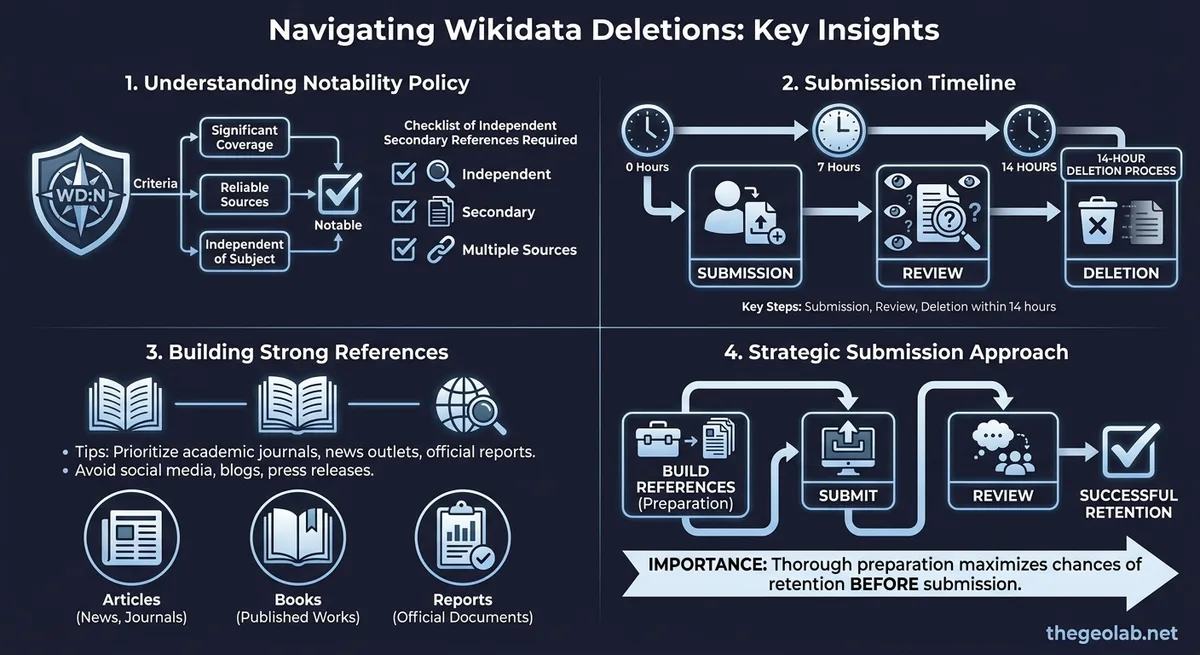
We created Wikidata item Q139710735 for Artur Ferreira on 9 May 2026 with an ORCID identifier, occupation and organisation link. The Wikidata deletion came roughly 14 hours later under Wikidata’s notability policy (WD:N). An ORCID on its own does not clear the notability gate: you need at least one serious, independent, publicly available reference that describes the subject. The 14-hour turnaround removed the illusion that a self-created item accumulates value before anyone notices. Wikidata is a late entity-reinforcement lever, not an early one. Build independent references first, then the item becomes admissible.
What we submitted and why
We submitted a Wikidata item for Artur Ferreira on 9 May 2026. It was deleted roughly 14 hours later. The deletion was not a mistake, a glitch or an act of hostility. It was the notability policy working exactly as designed, and the speed of it is the most useful thing that happened, because it exposed a gate that most entity-building advice for GEO quietly ignores.
This is a build-log post rather than an experiment writeup. The point is to document what we did, why it failed, and what the failure tells anyone planning to use Wikidata as an entity-reinforcement lever for AI search.
The reasoning was straightforward. Wikidata is a structured node in the knowledge graph that several AI systems draw on for entity understanding. A clean item for the person behind The GEO Lab, linked to an ORCID identifier and to the organisation, looked like a low-cost way to reinforce an entity that the research depends on being recognised. We created item Q139710735 with the standard properties: a description, an occupation, an ORCID identifier (0009-0004-4072-9741) and a link to the organisation.
The theory was sound. The execution ran straight into the part of Wikidata that does not care about theory.
Going deeper? The GEO Pocket Guide covers entity reinforcement, knowledge-graph signals, and which entity-building steps actually move AI recognition.
The notability gate: WD:N
Wikidata has its own notability policy, WD:N, and it is stricter than people who have only dealt with Wikipedia tend to expect. An item is allowed if it meets one of three conditions: it refers to an instance of a clearly identifiable entity that can be described using at least one serious and publicly available reference, it links to existing valid items such as a Wikipedia article in some language, or it fulfils a structural need, meaning other valid items genuinely need it to make sense.
An ORCID identifier on its own does not clear this. ORCID confirms that a person exists and has a research identifier. It is not a serious secondary reference that describes the person, and it does not create a structural need. With no Wikipedia article in any language and no independent secondary sources describing the subject, the item satisfied none of the three conditions. The deletion notice, in substance, said exactly that: insufficient evidence of notability under WD:N, no structural need demonstrated. It was removed inside a day.
Why the 14-hour speed matters
A slow deletion would have let us believe the item was contributing something during the weeks it sat live. The speed of the Wikidata deletion removed that illusion. It told us that self-created Wikidata items for entities without independent coverage do not get a grace period, and they do not quietly accumulate value before anyone notices. The gate is enforced fast and early.
That is the practitioner lesson. If you are planning to build out a Wikidata presence as an entity-reinforcement tactic, the notability gate is the first thing you hit, not a refinement you tune later. The order of operations matters: you earn the independent references first, then the Wikidata item becomes admissible. Doing it the other way round wastes the effort and, on a person item with a real name attached, leaves a deletion record.
How this fits the entity-reinforcement work
The episode is logged in the GEO Lab failure registry because that is where attempts like this belong: documented, dated and turned into a rule. It also connects to the E025 entity reinforcement intervention, where the broader question — central to the Entity Reinforcement layer — is which signals actually move an entity into AI recognition. Wikidata is one candidate signal, but the notability gate means it is only available to entities that have already cleared an independent-coverage threshold elsewhere.
That reframes Wikidata from an early lever to a late one. It is not a way to manufacture entity authority from nothing. It is a way to consolidate authority you have already established through references that exist independently of you. The Entity Reinforcement layer of the GEO Stack accounts for this ordering: signals that require pre-existing authority cannot be the first move in an entity-building sequence.
What we would do differently
Build the independent references before the item, not after. For a person, that means secondary sources that describe the subject rather than identifiers that merely confirm existence. For an organisation, it means coverage and citations that establish the entity is discussed by parties other than itself. Only once at least one serious, publicly available reference exists does a Wikidata item have a defensible claim to notability. Submit before that, and a Wikidata deletion is not a risk, it is the expected outcome.
- Wikidata enforces notability fast. Our Wikidata deletion took just 14 hours. Self-created items without independent references do not get a grace period.
- ORCID alone does not clear WD:N. An ORCID confirms existence; it is not a serious secondary reference describing the subject. The notability policy requires independent coverage.
- Wikidata is a late lever, not an early one. It consolidates entity authority you have already established elsewhere. It cannot manufacture authority from nothing.
- Order of operations matters. Build independent references first, then submit the Wikidata item. Reversing this wastes effort and leaves a deletion record.
Building entity authority for AI search? The GEO Stack framework maps where entity reinforcement sits in the five-layer model and what moves an entity into AI recognition.
Questions? Contact The GEO Lab.
Frequently asked questions
Why was the Wikidata item deleted so quickly?
It failed Wikidata’s notability policy, WD:N. The item had an ORCID identifier but no Wikipedia article in any language and no independent secondary references describing the subject, so it met none of the three notability conditions. Wikidata enforces this gate fast, and the item was removed about 14 hours after creation.
Does an ORCID make a person notable on Wikidata?
No. An ORCID confirms a person has a research identifier, but it is not a serious secondary reference that describes them, and it does not create a structural need for the item. On its own it does not satisfy WD:N, which is why an item resting on an ORCID alone is liable to deletion.
Is Wikidata useful for GEO entity reinforcement?
It can be, but only after an entity has cleared an independent-coverage threshold elsewhere. Wikidata is a consolidation lever, not a way to create authority from nothing. The notability gate means you need serious, publicly available references to exist before the item is admissible, so it sits late in an entity-building sequence, not early.
What is WD:N?
WD:N is Wikidata’s notability policy. An item is allowed if it refers to a clearly identifiable entity describable by at least one serious, publicly available reference, links to existing valid items such as a Wikipedia article, or fulfils a structural need for other items. An item meeting none of these is eligible for deletion.
Should I create a Wikidata item for my brand before I have press coverage?
No. Without at least one serious, independent, publicly available reference that describes your entity, the item will fail the WD:N notability check and be deleted. The GEO Lab’s own item was removed in 14 hours. Build independent references first — press coverage, academic citations, third-party profiles — then submit once you can point to sources that exist independently of you.