
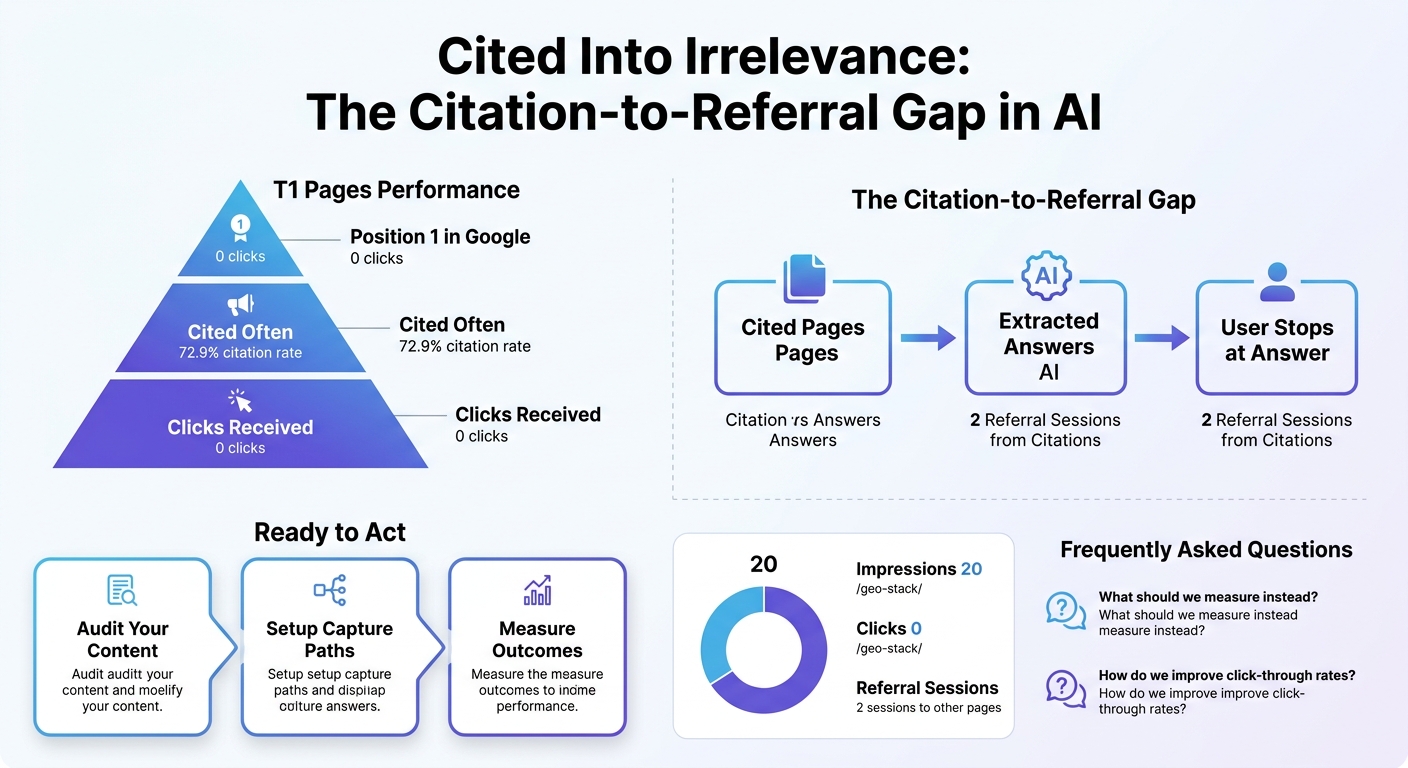
Our own GSC and GA4 data, 90 days: the pages AI engines cite most often are the pages that receive almost no referral traffic from them.
Two of our most-cited T1 pages hold position one in Google and earn zero clicks. Perplexity cites them at a 72.9% citation rate and sent two referral sessions in 90 days — neither to the cited page. The citation-to-referral gap is structural: engines extract the answer from the theoretical page and route the rare click to practical assets. The fix is not more citations. It is pairing each citation asset with an early conversion path, then reading branded search and direct traffic — not impressions on the cited URL — as the proxy for citation value.
Ranked first, cited often, clicked never
Two of our tier-one (T1) framework pages hold position one in Google for their defining query and earn zero clicks. In the Google Search Console 90-day window (February–May 2026), /geo-stack/ sat at average position 1.25 for “how does the geo stack work?” across 20 impressions with 0 clicks. our retrieval probability page sat at position 1.85 for “what is retrieval probability in ai search?” across 27 impressions with 0 clicks.
/geo-stack/ (0 clicks)
T1 pages (E027)
from those citations
cited T1 pages
Position one with zero clicks is not a title problem. It is the definitional query being answered inside an AI Overview before the user ever reaches a result to click. A third T1 page, passage extractability, behaved differently — its query cluster carried genuine click-through headroom, which is why we rewrote its title on 13 May rather than treating it as the same case.
The clean signal is the two definitional pages: the system surfaces our answer and the click stops at the answer.
The citation-to-referral gap
Perplexity cites our T1 pages at a 72.9% citation rate and sends them no one. That citation measurement comes from experiment E027, our 14-day zero-variance replication of Perplexity citation behaviour, published on Zenodo (DOI 10.5281/zenodo.20245814). In the matching window, those citations produced two GA4 referral sessions in 90 days — and both landed on the GEO Field Manual and the Pocket Guide, not the T1 pages Perplexity actually cited.
Ready to act on the gap? The GEO Workbook is a 30-day AI visibility action plan that walks through citation audit, capture-path setup, and the measurement framework that separates presence from referral.
The fresh GA4 pull deepens that gap. Over the current window (6 March–4 June 2026), the three T1 pages drew 66 sessions from human sources — direct, Facebook, LinkedIn, and organic search — and exactly zero sessions from any AI platform. Site-wide, AI referrers sent just six sessions in total (excluding claude.ai): Perplexity 3, ChatGPT 1, and Microsoft Copilot 2. Every one of those six landed on a practical asset — the Field Manual, the Pocket Guide, the GEO for WordPress guide, the GEO Experiments log, the ebooks library — and not one landed on a cited T1 page.
So the funnel break is structural, not a volume problem. The engines cite the theoretical page that defines a term, and on the rare occasion they pass a click, they route it to the downloadable thing a reader can use. The pages that earn the most citations capture the least referral.
What this measurement can and cannot prove
This is a single-window snapshot, not a before-and-after. The GA4 property has no data before 6 March 2026, so there is no earlier 90-day period to compare against. The only earlier reference point is E027’s two-session count from its own window. Read the current figures as one clean observation — 66 human sessions, zero AI sessions to the cited pages — rather than a measured trend over time. We excluded 20 claude.ai sessions from the citation count, because assistant link-following is not the same signal as organic citation routing.
The citation itself is stable — the clicks were never coming
Citation presence on our T1 pages is holding across consecutive monthly measurements, which is what makes the missing traffic a structural finding rather than a bad month. In our third monthly wave (measured 28 May 2026), the combined citation rate across platforms was 12.0%, statistically flat against the prior wave’s 12.9% and well inside our 22-point measurement noise floor. The T1 tier held at 24.0% while the non-owned T2 tier stayed at 0.0%.
ChatGPT cited the extractability page for the first time in wave three — sole source, six inline citation references — after zero citations across two prior waves. Meanwhile a separate entity reinforcement intervention returned a clean null: zero-point movement in non-owned citation. Citation presence is durable and, on at least one platform, strengthening. The referral simply does not follow it.
That ordering matters. If citation were eroding, you could dismiss the traffic gap as decline. It is not eroding. The page is cited, the citation is stable, and the click still does not arrive.
This is not just us
Industry-scale data points the same way our first-party data does. Cloudflare’s 2025 Year in Review found that roughly 80% of AI crawling is training-only and returns no referral traffic at all — the clearest external statement of the thesis that most AI extraction of content sends nothing back. Our 72.9%-citation-rate-to-two-sessions gap is the same phenomenon viewed from a single domain.
The scale is also shifting fast. TollBit’s State of the Bots report (Q4 2025) put AI bots at roughly 1 in 31 web visits, up from about 1 in 200 at the start of 2025. The synthesis from Kinsta’s analysis of more than 10 billion requests is the practical conclusion: raw visit counts no longer reflect reality, and the signals that do are the correlated ones — branded search, direct traffic, engagement quality, and revenue.
What to measure instead
Stop reading citation rate and referral traffic as if one predicts the other. They are different layers: citation rate measures presence in the answer, and referral measures capture of the click. On our T1 pages the first is high and the second is near zero, so a dashboard that watches impressions on the cited URL will report success while the page sends nobody anywhere.
The practical fix follows from where the six AI-sourced clicks actually went. They went to downloads. So a cited theoretical page should carry its own capture mechanism — an early, explicit path from the layered GEO framework page to the Field Manual, from our retrieval probability page to the matching guide — so that a rare AI-sourced visit converts instead of bouncing. Treat the T1 page as both a citation asset and a conversion asset, because the engines have decided it is only the former.
And report the right number. Branded search and direct traffic are where the value of a citation you cannot click actually lands. Reading those, rather than impressions on the cited page, is the difference between knowing your content is working and being cited into irrelevance.
A citation rate above 70% and a referral rate of near zero are not contradictory — they are the same system working as designed. The engine extracts your answer, satisfies the reader, and keeps the click. Measuring citation rate in isolation will always look like success.
The signal worth tracking: branded search volume and direct traffic in the window after each citation wave. If those are growing, your citations are converting somewhere upstream. If they are flat, your citation asset has no capture path and the citation has no downstream value.
Add a conversion anchor to every T1 page that carries a high citation rate: one early, relevant link to the practical asset that serves the same reader. That is the only change that turns a citation into a visit.
The methodology behind this post is pre-registered and independently reproducible: Zenodo DOI 10.5281/zenodo.20245814.
Frequently asked questions
What does “cited into irrelevance” mean?
It describes a page that AI search engines cite frequently but send almost no traffic to. The engine extracts the page’s answer, presents it in the generative response, and the user’s need is met without a click. The page earns visibility inside the answer while becoming irrelevant as a destination — high citation rate, near-zero referral.
Why do AI engines cite a page but not link traffic to it?
Because citation and referral serve different purposes. The engine cites the page that best defines a concept to ground its answer, but a satisfied reader rarely clicks through. In our GA4 data, when AI platforms did pass a click, they routed it to practical downloads rather than the theoretical page they cited. The cited page grounds the answer; a different page captures the rare visit.
How much AI crawling actually returns traffic?
Very little. Cloudflare’s 2025 Year in Review found roughly 80% of AI crawling is training-only and sends no referral traffic. AI bots have also grown to about 1 in 31 web visits, per TollBit’s Q4 2025 report, up from around 1 in 200 a year earlier. The volume of automated access is rising sharply while the share that converts to a human visit stays small.
What should you measure if citation rate doesn’t predict clicks?
Measure correlated signals rather than referral alone. Track citation rate as a presence metric, then watch branded search volume, direct traffic, and engagement quality as the places where unclickable citations create value. Reading impressions on the cited URL will overstate success. Separating presence in the answer from capture of the click is the core methodological shift.