
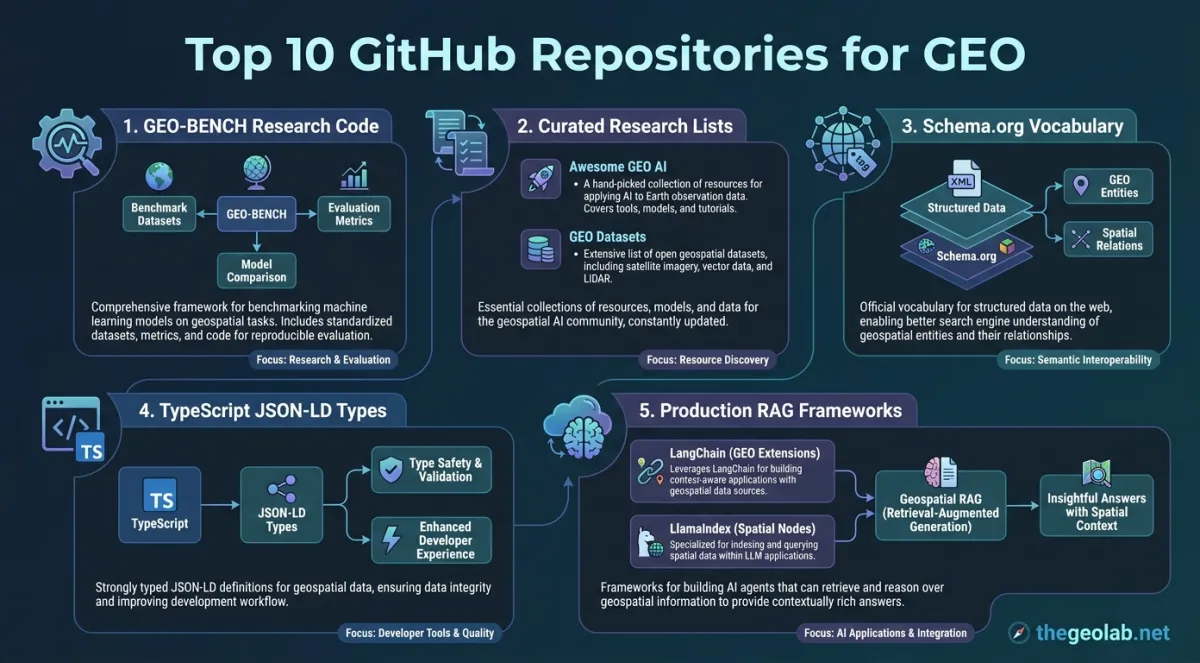
Ten GEO repositories that anchor the technical substrate of Generative Engine Optimisation: research, frameworks, schema tooling, and curated lists
GEO is often discussed as if it lived entirely on LinkedIn. It doesn’t. The field has an actual code substrate, the repositories where the research was published. The GEO Stack framework organises these findings into five actionable layers, the RAG frameworks AI search is built on, the schema tooling that makes content extractable, and the curated lists that track what’s going on.
Aggarwal et al. (2024) measured 22–40% visibility improvement from content interventions on GEO-BENCH (10,000 queries, 9 domains). Ten repos cover the substrate those findings sit on: the GEO-BENCH research code, two curated research lists, the Schema.org vocabulary, TypeScript JSON-LD types, two production RAG frameworks, a curated RAG list, a GEO audit CLI that checks 47 research-backed methods, and a structured-knowledge schema for LLM-compiled content.
GEO Has a Code Substrate and Most People Don’t Read It
Most of what gets discussed as GEO advice originates from one of three places: a peer-reviewed paper, a production system, or somebody’s Wednesday-afternoon LinkedIn post. The first two have code on GitHub. The third one doesn’t. Knowing which source a claim comes from is how you tell well-grounded advice from recycled speculation.
I’ve spent more time than I’d like to admit tracing GEO claims back to their source. The exercise is unreasonably clarifying. “AI engines reward structured content” turns out to mean different things depending on whether you’re reading the KDD 2024 paper, the Haystack pipeline docs, or a thought-leadership post from last Tuesday. The paper’s claim is testable. The pipeline docs describe what actually happens. The post is, at best, a compressed summary that drops the conditions under which the claim holds.
The ten repositories below are the primary-source layer for GEO. They group into five categories of GEO repositories: original research, curated lists, the Schema.org vocabulary and its tooling, the RAG frameworks that power AI search, and practical GEO audit tools. Knowing what each category contains is enough. Reading every line of code in every GEO repository is not necessary, and not particularly useful.
Going deeper? The GEO Pocket Guide maps the five GEO Stack layers these repositories anchor, from retrieval probability through system memory.
Five Categories, Ten Repos
Before the individual repo cards, a map of the territory. Each category serves a different purpose in a GEO practitioner’s workflow.
The categories aren’t equal-weighted. Research and schema tooling repositories are load-bearing, they’re what the field is built on. The GEO Stack organises these findings into five layers. RAG frameworks are the technical reality of AI search. Curated lists are navigation aids. Practical tools are where the substrate meets day-to-day work.
The Ten GEO Repositories
GEO repositories ordered by practitioner value, what changes your thinking soonest comes first. Each card lists the repo slug, what it is, and what a GEO practitioner actually uses it for.
GEO-optim/GEO
Researchgithub.com/GEO-optim/GEO
The reference implementation for Aggarwal et al. (2024), “GEO: Generative Engine Optimization”, published at KDD 2024. Contains the nine GEO optimisation methods tested in the paper, the evaluation framework, and pointers to the GEO-BENCH dataset on Hugging Face.
Reading the repo is how you move from “the paper said statistics addition works” to understanding exactly what “statistics addition” meant in the measurement, which specific modifications, against which query set, under which evaluation conditions. Every GEO claim worth testing starts with clarifying its operational definition, and GEO-optim/GEO is where the definitions live.
DavidHuji/Awesome-GEO
Curatedgithub.com/DavidHuji/Awesome-GEO
A curated list of research papers on Generative Engine Optimisation. Covers the foundational Aggarwal et al. paper plus extensions, multimodal GEO, adversarial attacks on generative search, conflict-aware instruction fusion, conversational SEO benchmarks.
The one-stop reference for peer-reviewed and preprint GEO research. When a claim sounds like it might be academic, check Awesome-GEO first, the paper is probably linked there, and you’ll skip the hour of searching.
amplifying-ai/awesome-generative-engine-optimization
Curatedgithub.com/amplifying-ai/awesome-generative-engine-optimization
A curated practitioner resource list:, tools, guides, platforms, newsletters, agencies, case studies. Broader than the research-focused DavidHuji list, with more day-to-day utility for content teams.
The map of the industry side of GEO. When evaluating a new tool or platform, check whether it’s listed here first, the curators filter out most low-quality entries, and the surrounding context tells you where the tool sits in the ecosystem.
schemaorg/schemaorg
Schemagithub.com/schemaorg/schemaorg
The canonical repository for the Schema.org vocabulary itself, schemas, examples, definitions, and the supporting software that publishes schema.org. Contains every type and property in the vocabulary as RDF/Turtle source files.
When a schema question comes up, is this type still supported, what properties does it actually have, is this subtype valid, the answer is in this repo, not in a third-party guide. Reading the source files is how you avoid propagating outdated or incorrect schema definitions in your own content.
google/schema-dts
Schemagithub.com/google/schema-dts
TypeScript type definitions for the Schema.org vocabulary in JSON-LD format. Discriminated type unions allow IDE autocompletion and strict validation at build time rather than at runtime.
Invalid schema is worse than no schema for AI extractability. schema-dts enforces correctness in the codebase, you cannot ship a malformed FAQPage, a missing required property, or a subtype that doesn’t belong. Build-time validation prevents the category of errors that makes schema a liability rather than an asset.
deepset-ai/haystack
RAGgithub.com/deepset-ai/haystack
An open-source orchestration framework for production RAG and agent workflows. Modular pipelines with explicit control over retrieval, ranking, memory, and generation. Supports dense and sparse retrievers, multiple vector databases, and model-agnostic generation.
Reading the Haystack component definitions is the fastest way to understand how retrieval-augmented generation actually works inside the systems you’re optimising for. The framework exposes the same primitives, retriever, reranker, reader, generator, that commercial AI search engines use internally. Understanding this architecture is prerequisite to retrieval probability work, just with the abstractions visible.
run-llama/llama_index
RAGgithub.com/run-llama/llama_index
A framework for connecting custom data sources to language models through indexing and retrieval. More specialised than Haystack toward the data-ingestion and index-construction side of RAG, sentence window retrieval, hierarchical parsing, multimodal ingestion.
LlamaIndex’s node abstractions map directly to how chunks are indexed and retrieved in AI search systems. Understanding what counts as a retrievable unit, how chunking decisions affect retrieval quality, and how reranking interacts with indexing is the substrate that makes GEO content-structure advice interpretable.
Danielskry/Awesome-RAG
Curatedgithub.com/Danielskry/Awesome-RAG
A curated list of retrieval-augmented generation frameworks, patterns, and tutorials. Covers naive RAG, advanced RAG, modular RAG, agentic RAG, self-RAG, GraphRAG, the full taxonomy of retrieval patterns with implementation links.
Not every AI search system uses naive RAG. When a practitioner claim makes sense for one retrieval pattern but not others, Awesome-RAG is where you verify which pattern applies. The list keeps pace with a rapidly-moving field better than any single vendor documentation.
Auriti-Labs/geo-optimizer-skill
Toolgithub.com/Auriti-Labs/geo-optimizer-skill
A CLI tool that audits websites against 47 research-backed GEO methods drawn from the KDD 2024 paper and subsequent AutoGEO research. Produces 0–100 scores, regression detection against saved history, and output formats for GitHub Actions, GitLab CI, Jenkins, and human-readable reports.
Research-grounded GEO auditing rather than vibe-based scoring. The methods checked map back to the peer-reviewed literature, which means a failing check has a citation behind it. Useful for CI integration and longitudinal monitoring, with the usual caveat that any score is a simplification of a more complex reality.
arturseo-geo/llm-knowledge-base
Toolgithub.com/arturseo-geo/llm-knowledge-base
An AGENTS.md schema standard for LLM-compiled personal knowledge bases, with a versioned template, worked example, and a spaced-repetition learning layer. Built at The GEO Lab and published under MIT. Formalises the markdown-wiki-built-by-LLM pattern into a reproducible workflow.
Not a GEO tool directly, but the question it answers is adjacent. “How do you structure content so an LLM can reliably compile it into a coherent output?” is the same underlying question as “how do you structure content so an AI system can reliably extract it for a citation?” The schema choices that make one work are mostly the same choices that make the other work.
The Ten GEO Repositories at a Glance
Reference table. Each row is a repo worth bookmarking, grouped by what problem it solves.
| # | Repository | Category | Primary use |
|---|---|---|---|
| 01 | GEO-optim/GEO |
Research | Reference implementation for the Aggarwal et al. KDD 2024 paper |
| 02 | DavidHuji/Awesome-GEO |
Curated | Research paper index for the field |
| 03 | amplifying-ai/awesome-generative-engine-optimization |
Curated | Industry resource map for GEO |
| 04 | schemaorg/schemaorg |
Schema | Canonical Schema.org vocabulary source |
| 05 | google/schema-dts |
Schema | TypeScript JSON-LD type safety |
| 06 | deepset-ai/haystack |
RAG | Production RAG orchestration framework |
| 07 | run-llama/llama_index |
RAG | Indexing and retrieval primitives for RAG |
| 08 | Danielskry/Awesome-RAG |
Curated | Taxonomy of RAG patterns with implementations |
| 09 | Auriti-Labs/geo-optimizer-skill |
Tool | CLI GEO auditing with 47 research-backed methods |
| 10 | arturseo-geo/llm-knowledge-base |
Tool | Schema for LLM-compiled structured content |
Using GEO Repositories Without Drowning in Code
The trap with a list of ten repositories is treating it as a reading list. Nothing on this list needs to be read cover-to-cover. What matters is knowing where to look when a question arises.
For a research-flavoured claim: start with DavidHuji/Awesome-GEO. If the paper exists, it’s linked there. If it isn’t linked there, the claim is probably not peer-reviewed, which doesn’t make it wrong, but does change what you should conclude from it.
For a schema or structured-data question: start with schemaorg/schemaorg. The source files answer questions that third-party guides often get wrong, whether a type still exists, what properties it supports, what the correct subtype is. Supplement with google/schema-dts if you work in TypeScript and want build-time validation.
For a retrieval-side question about how AI search actually works: read the Haystack component definitions. They’re unusually clear documentation of retrieval primitives, and the abstractions map closely to what commercial systems use. LlamaIndex is the specialist’s follow-up, especially for questions about chunking and indexing.
For a practical audit or tooling question: Auriti-Labs/geo-optimizer-skill runs research-grounded checks. Use it as an input to your judgement, not as the verdict.
A compact mapping from common questions to the right starting repo:
| Question | Start with | Why |
|---|---|---|
| Does this GEO claim have research backing? | DavidHuji/Awesome-GEO |
Paper index — if the claim is peer-reviewed, it’s linked |
| What did the KDD 2024 GEO paper actually measure? | GEO-optim/GEO |
The measurement code itself, not second-hand summaries |
| Is this schema type valid and current? | schemaorg/schemaorg |
Canonical vocabulary source |
| How does an AI system actually retrieve content? | deepset-ai/haystack |
Retrieval primitives exposed with clear abstractions |
| Which RAG pattern does this system use? | Danielskry/Awesome-RAG |
Full taxonomy with implementation links |
| What should I audit my site against? | Auriti-Labs/geo-optimizer-skill |
47 research-backed checks with CI integration |
On the limits of substrate reading. Reading the substrate tells you what claims are well-grounded. It does not tell you what claims are worth acting on for your specific situation. A peer-reviewed finding that holds across a 10,000-query benchmark may not matter for your site’s 200-page content library; a practitioner observation from a single blog post may be exactly the signal you need. The substrate is a filter, not a verdict. Use it to narrow what you consider, not to replace your own measurement.
Frequently Asked Questions
Is there a reference GitHub repository for Generative Engine Optimisation research?
Yes, GEO-optim/GEO is the reference implementation for the Aggarwal et al. (2024) GEO-BENCH paper published at KDD 2024. It contains the nine GEO methods tested in the study, the evaluation framework, and pointers to the benchmark dataset hosted on Hugging Face. For tracking the peer-reviewed and preprint literature beyond that single paper, DavidHuji/Awesome-GEO curates research on generative engine optimisation, including adversarial and multimodal extensions.
Which RAG frameworks are most relevant to AI search optimisation?
Haystack from deepset-ai and LlamaIndex from run-llama are the two open-source frameworks most directly relevant to AI search optimisation. Both expose the retrieval patterns that modern AI search engines use under the hood, dense retrieval, chunking, reranking, generation with citations. Studying the frameworks lets a practitioner reason about the retrieval side of AI search from the same primitives the systems are built on.
How do structured data tools on GitHub help with AI visibility?
Structured data tooling, schemaorg/schemaorg for the vocabulary itself, google/schema-dts for TypeScript JSON-LD type definitions, lets content creators emit valid JSON-LD that AI systems can use to parse content structure reliably. Misaligned or invalid schema is worse than no schema for extractability, so tooling that enforces correctness at build time is an underrated GEO investment.
Are there open-source GEO audit tools on GitHub?
Yes. Auriti-Labs/geo-optimizer-skill is a CLI tool that audits websites against 47 research-backed methods drawn from the KDD 2024 GEO paper and subsequent AutoGEO work. It produces scores, regression detection, and integrates with CI pipelines. The category is evolving fast, evaluate any GEO audit tool against your own measurement requirements rather than treating any as authoritative.
Where should a new GEO practitioner start with these repositories?
Start with the two curated GEO repositories, DavidHuji/Awesome-GEO for research papers and amplifying-ai/awesome-generative-engine-optimization for practitioner resources. Both give you a map of the territory without requiring you to install anything. Move to GEO-optim/GEO when you want to understand how the Aggarwal et al. (2024) measurements were actually conducted. Only then explore the RAG frameworks and audit tools, since those become more useful once you understand the research context they operate in.
Key GEO Lab Takeaway
Ten repositories form the code substrate of GEO: Aggarwal et al. (2024) for the foundational research, Awesome-GEO for the paper index, Schema.org and schema-dts for structured data tooling, Haystack and LlamaIndex for RAG architecture understanding. Start with the two curated GEO repositories to orient, then visit a specific repository when a question about implementation or measurement methodology arises.